
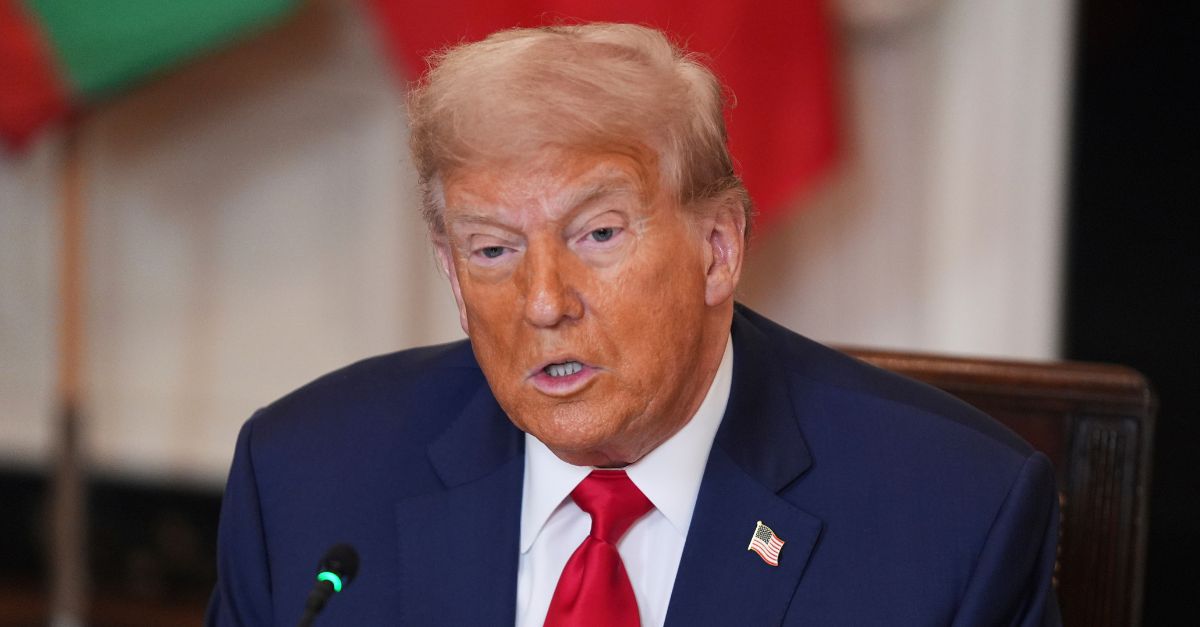
President Donald Trump speaks during a lunch with African leaders in the State Dining Room of the White House, Wednesday, July 9, 2025, in Washington (AP Photo/Evan Vucci).
The judge tasked with overseeing President Donald Trump's since-settled lawsuit against the IRS and ensuing "anti-weaponization fund" should "rectify the fraud perpetrated" and "deter future misconduct," several state attorneys general said in a Tuesday court filing.
In a 19-page amicus brief, top prosecutors representing California and 22 other states say the underlying case is "no ordinary lawsuit."
"As the Court has already observed, the circumstances of this case, including the potential lack of adversity between the parties, are highly unusual," the filing reads. "[T]he Court was correct to raise jurisdictional questions, and the 'settlement' that purports to resolve the case is further evidence that the litigation has been colored by fraud from the beginning."
In January, Trump's original lawsuit against the IRS was filed in the Southern District of Florida. By the middle of May, however, the case was closed — on the plaintiff's own request — with the 45th and 47th president opting instead for a publicly subsidized fund that would reward pro-Trump stalwarts and others similarly situated.
In her order closing the case, U.S. District Judge Kathleen Williams, a Barack Obama appointee, expressed a number of doubts about the process. Meanwhile, at least four other lawsuits and/or claims were filed aiming to halt what critics call a "slush fund."
Now, the California-led effort becomes at least the fifth to challenge the would-be settlement — which has also alarmed critics due to a provision that purports to bar the IRS from auditing the past or present tax returns of Trump, his sons, or the Trump Organization.
The attorneys general argue the entire trajectory of the case — from beginning to end with a promise of $1.776 billion — is clear evidence the settlement was not aboveboard.
"That 'settlement' is not a reasonable resolution of the claims asserted here," the filing goes on. "Instead, it is a mechanism to enrich President Trump's political allies and attempt to immunize the Trump family from legitimate law enforcement, all at the expense of American taxpayers."
The amicus brief points to the behavior of the parties even before the settlement was reached to challenge what eventually transpired.
"The Court recognized that the parties' likely lack of adversity raised a threshold jurisdictional question," the filing continues, referring to initial concerns raised by Williams about the fact that Trump was suing an agency he controlled via political appointments.
In service of those concerns, the court ordered "the parties to brief the question of whether a case or controversy existed in this matter" and directed those motions to be filed by May 20, the amici note.
Those motions, in the end, never came. The attorneys general frame the lack of such motions as evidence the settlement was untoward.
"Rather than answer the Court's question, the parties evaded it," the filing goes on. "On May 18, two days before the briefs were due, Plaintiffs voluntarily dismissed their claims with prejudice."
The amicus brief muses about how the DOJ could have defended the IRS against the lawsuit, instead of quickly settling. From the filing:
[DOJ] refused to assert several robust substantive defenses to the President's claims, including defenses the IRS previously asserted in litigation stemming from disclosure of other taxpayers' information by the same federal contractor who allegedly leaked the President's information. Nor did the Department seek to dismiss the case as time barred under [the relevant law], despite it being a straightforward argument. The Department similarly failed to make any arguments concerning the limits on statutory damages, the plain defects with the Plaintiffs' Privacy Act claims, or the lack of any waiver of sovereign immunity[.]
The amici also take issue with exactly how the parties settled.
In deciding to end the lawsuit, the DOJ agreed to create the anti-weaponization fund out of the Department of the Treasury's Judgment Fund, which is a permanent outlay created by Congress.
The filing argues the settlement terms "lay bare an attempted end-run around constitutional limits on executive authority."
"This Court should not countenance such a scheme," the brief continues. "Here, that abuse would open a backdoor through which the President could shovel public funds to his friends and family."
To hear the amici tell it, the controversy is about basic principles of law, justice, and popular consent for governance.
"Were the parties to succeed in their scheme, public trust in the judicial process would suffer," the brief says. "Corruption, self-dealing, deception, and fraud, in the service of skirting constitutional limits and enriching the President, does grave damage to public trust in the rule of law and in the judicial process."
The amici summarize by insisting the settlement is an effort to "commandeer the machinery of the judicial system to skirt constitutional limits on executive power, with the goal of enriching President Trump, his family, and his allies" and that "[t]he Court should not countenance such malfeasance."

Comments