

Background: A man wearing a vest displaying "HSI" records a Maine resident in January 2026 (Hilton v. Noem complaint). Inset: Department of Homeland Security Secretary Kristi Noem participates in the Angel Families remembrance ceremony in the East Room at the White House in Washington on February 23, 2026 (Photo by Yuri Gripas/Abaca/Sipa USA/Sipa via AP Images).
Homeland Security Secretary Kristi Noem and the Trump administration are violating U.S. citizens' First Amendment rights by using facial recognition software and other technology to identify, track, and intimidate them, a new lawsuit alleges.
The 46-page complaint filed in the U.S. District Court in Maine accuses Department of Homeland Security (DHS) officers of unleashing these tactics to deter the citizens from recording and documenting the agents' behavior.
"As the federal government expands its aggressive deportation campaign throughout the country, ordinary Americans in Maine are holding their government to account by bearing witness and protesting the government's abusive tactics," the lawsuit says. However, "Defendants and other federal agents acting at their direction are responding by unlawfully retaliating against Mainers exercising their constitutional right to dissent."
The class-action lawsuit is spearheaded by two legal "observers" in Maine who say they have invoked their First Amendment right to "voice support for their neighbors, oppose the administration's policies, and document the actions of federal agents to promote accountability." They recount the "chilling" maneuvers undertaken by federal officers — with what they say is backing by officials at the very heights of the federal government.
On Jan. 21, 2026, Portland resident Elinor Hilton was watching and recording federal law enforcement activity in a public parking lot. As she did so, officers took her "biometric data" and license plate information, and one of them told her, "If you keep coming to things like this, you are going to be on a domestic terrorist watchlist," per the complaint, with the agent allegedly adding, "Then we're going to come to your house later tonight."
Colleen Fagan is another resident of the bayside city. Fagan says that two days after Hilton's incident, Fagan herself was also recording federal activity in a public space when agents collected her information and then told her, "We have a nice little database. And now you're considered a domestic terrorist, so have fun with that."
In another incident, which also took place on Jan. 21, 2026, a woman was filming federal agents making an arrest in Westbrook, a suburb of Portland. After she learned that agents were "monitoring an elementary school bus stop," she decided to follow an agent's vehicle — just to wind up at her own home.
"The agents likely obtained [her] name and address by recording her face or license plate during one or both of her constitutionally-protected observations of agent activity that morning," the complaint states. "[Her] friend recorded the subsequent encounter between [the woman] and the agents in front of her residence. In the recording, an agent approaches [her] car holding a smartphone and says, 'This is a warning. We know you live right here.'"
The lawsuit contends that these women are "far from" the only ones "targeted for intimidation," and it traces an apparent line between the rhetoric used by the agents and those under whom they serve.
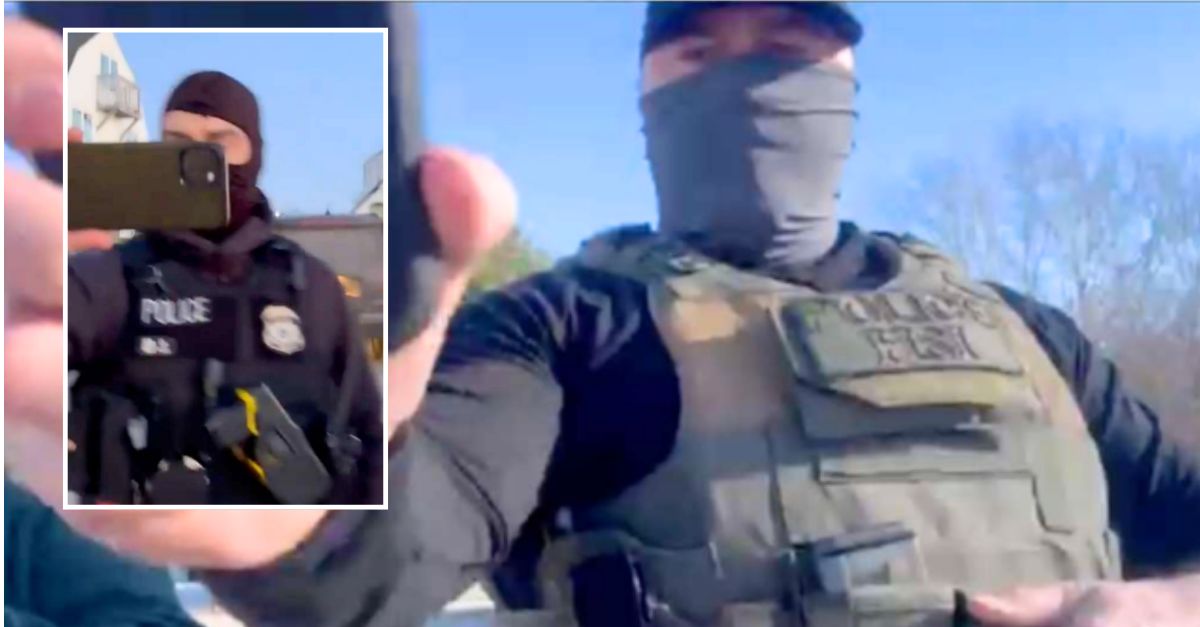
Background and inset: Federal agents hold cameras up to Maine residents recording their activities (Hilton v. Noem complaint).
"In July 2025, at a DHS press conference, Defendant Noem publicly claimed that 'videotaping' federal agents 'where they're at, when they're out on operations' was 'violence' and 'threatening their safety,' the complaint states. "Defendant Noem intentionally mischaracterized what is in fact First Amendment-protected activity as conduct that amounts to a federal crime."
The administration's actions, according to the complaint, force the plaintiffs to "either abandon their constitutional rights or accept being cataloged and branded as 'domestic terrorists.' That is a choice the Constitution does not require Plaintiffs, or anyone, to make."
According to the lawsuit, in May 2025, Immigration and Customs Enforcement (ICE) and Customs and Border Protection (CBP) began using a facial recognition app called Mobile Fortify to "identify an individual using a smartphone camera." By January 2026, the agency had allegedly used the software more than 100,000 times.
Another app was deployed in November 2025, this time to swiftly read vehicles' license plates, the observers say. Mobile Companion has reportedly been used by the administration to scan license plates using a smartphone, track travel patterns, and access other data including phone numbers, addresses, associates, and social media activity.
"In an effort to chill their protected activity, federal law enforcement agencies, including the Department of Homeland Security and its immigration enforcement agencies, are leveraging the government's significant surveillance capabilities to collect and track personal information about observers and other protestors," per the complaint. "In some cases, federal agents also have used these surveillance tools and the information they collect to threaten and harass Mainers, again seeking to deter them from exercising their First Amendment rights."
The plaintiffs further add that the federal government's recent practices are a "significant deviation" from prior DHS policies, including those issued during President Donald Trump's first term in office. The lawsuit says that a May 2019 DHS memorandum "prohibited precisely the kind of record collection and maintenance at issue here."
To the plaintiffs, the "deviation" underscores that "[t]he federal government is pursuing a conscious course of action to silence and sideline Mainers and other Americans who choose to observe, record, and share information about the conduct of federal agents who have been deployed to their streets."
They contend that even citizens' travel is being hindered by federal officials, as "[o]ne observer from Minnesota reported that DHS revoked her Global Entry status without explanation just days after a federal agent used facial recognition to identify her" and "during another incident, a federal agent reportedly detained an observer in a vehicle and stated, 'The registered owner of this vehicle is going to have fun trying to travel.'"
The plaintiffs seek a declaration that the Trump administration's behavior violated the First Amendment and a preliminary and permanent injunction barring federal officials and those who serve under them "from engaging in the unconstitutional collection, maintenance, and dissemination of records based on First Amendment-protected activity and from threatening, harassing, and otherwise retaliating against Plaintiffs and other Class Members for exercising their First Amendment rights."
They also want a court order "requiring expungement of any records collected or maintained about Plaintiffs and other Class Members based on their exercise of First Amendment rights."



Comments