
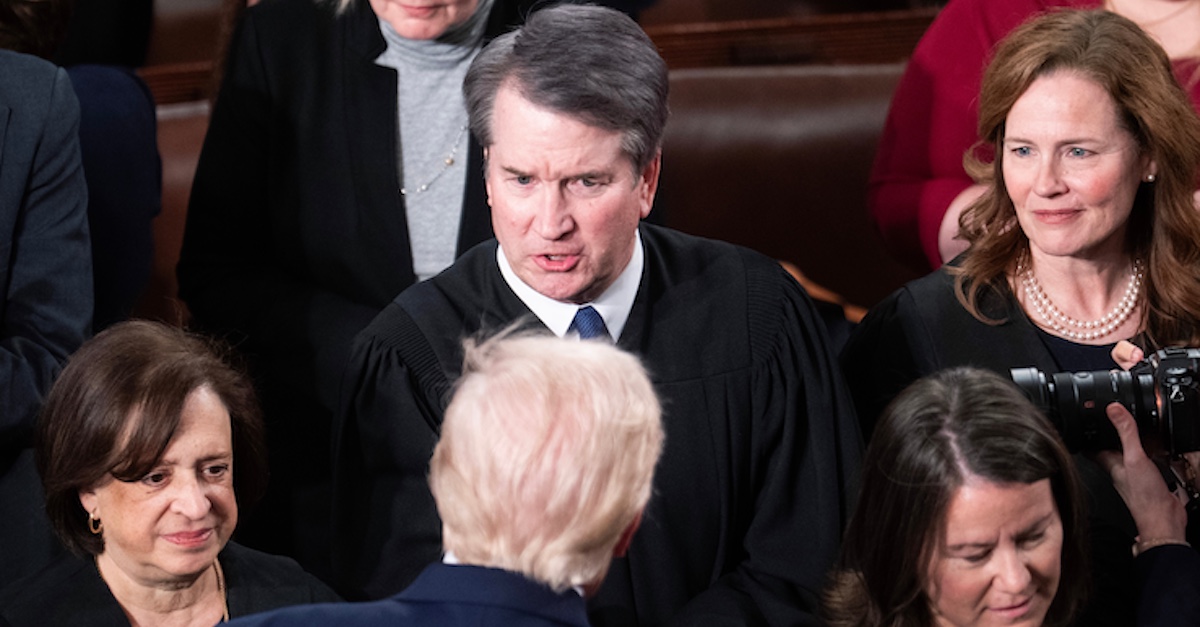
President Donald Trump talks with, from left, Supreme Court associate justices Elena Kagan, Brett Kavanaugh, and Amy Coney Barrett, before the State of the Union address in the House Chamber of the U.S. Capitol on Tuesday, February 24, 2026 (Tom Williams/CQ Roll Call via AP Images).
Still not over the U.S. Supreme Court's smackdown of his global emergency tariffs, for which he publicly berated some of his own appointees during the State of the Union address, President Donald Trump seemed convinced Monday that the justices are too "dumb" to end birthright citizenship. With oral arguments in just two days, the attack may reflect a lack of confidence on Trump's part that he will walk away a winner from this latest round of legal sparring.
In August 2025, during the lead-up to tariff arguments, Trump posted online — and the DOJ darkly warned in briefs — that if the Supreme Court did not side with the administration, then the justices would be the ones shouldering the blame for another Great Depression that would make America a "dead country." The fall-guy scenario ultimately did nothing to sway the majority of the justices away from concluding that Trump unilaterally and illegally tariffed the world by invoking a statute that did not use the word tariffs and had never been used for that purpose.
The president called the decision by Chief Justice John Roberts and two of Trump's own appointees, Justice Amy Coney Barrett and Justice Neil Gorsuch, an "embarrassment to their families" for having joined with the liberal justices against him. On the eve of the State of the Union, the president made a point to post "supreme court" in "lower case letters for a while based on a complete lack of respect!"
Trump then turned his attention to birthright citizenship and the 14th Amendment, predicting that the Supreme Court "will find a way to come to the wrong conclusion" — just as it did with his tariffs — and make a pro-China decision.
"Our incompetent supreme court did a great job for the wrong people, and for that they should be ashamed of themselves (but not the Great Three!)," he said on Feb. 23, referring to Justices Brett Kavanaugh, Clarence Thomas, and Samuel Alito. "The next thing you know they will rule in favor of China and others, who are making an absolute fortune on Birthright Citizenship[.]"
Then, the next night at the State of the Union address itself, Barrett, Roberts, Kavanaugh, and Justice Elena Kagan looked on as Trump complained of the "unfortunate ruling from the United States Supreme Court." Gorsuch did not attend.
Similarly on Monday, in a Truth Social post before 7 a.m., Trump stated that birthright citizenship "is not about rich people from China, and the rest of the World, who want their children, and hundreds of thousands more, FOR PAY, to ridiculously become citizens of the United States of America" but about the BABIES OF SLAVES!"
Under the citizenship clause of the 14th Amendment, "[a]ll persons born or naturalized in the United States and subject to the jurisdiction thereof, are citizens of the United States and of the State wherein they reside," except the children of foreign diplomats. The Trump administration's counterpoint is birthright citizenship creates an "incentive" for illegal immigration.
Upon Trump's inauguration last year, he issued an executive order claiming to protect the "meaning and value of American citizenship."
"It is the policy of the United States that no department or agency of the United States government shall issue documents recognizing United States citizenship, or accept documents issued by State, local, or other governments or authorities purporting to recognize United States citizenship, to persons: (1) when that person's mother was unlawfully present in the United States and the person's father was not a United States citizen or lawful permanent resident at the time of said person's birth, or (2) when that person's mother's presence in the United States was lawful but temporary, and the person's father was not a United States citizen or lawful permanent resident at the time of said person's birth," the order said.
The government's most recent reply brief before the Supreme Court said that the "'main object' of the Citizenship Clause was to grant citizenship to freed slaves and their children, whose allegiance to the United States had generally been established through generations of parental domicile."
"By contrast, aliens who are just passing through the United States, and those who cross our borders illegally, lack ties of allegiance and do not obtain the 'priceless and profound gift' of citizenship for their children," the brief went on.
On the heels of Wall Street Journal reporting about his relationship with the court, Trump claimed Monday that America is the only country on earth "that dignifies" birthright citizenship with "discussion," but also that the world is "laughing at how STUPID our U.S. Court System has become (TARIFFS!)."
"'Dumb Judges and Justices will not a great Country make!'" he added.
The tariffs and birthright citizenship cases are but two examples of Trump and his administration rocking the boat with arguments on the horizon. As the Supreme Court was set to hear arguments on Trump's bid to fire Lisa Cook from the Federal Reserve in January, the administration handed proponents of U.S. central bank independence a case-in-point, as chairman Jerome Powell revealed the DOJ's criminal probe.
Kavanaugh, a so-called member of the "Great Three!" praised by Trump, led the charge in pumping the brakes and pointing out bad incentives for the executive, regardless of party.
"It incentivizes a president to come up with what, as the Federal Reserve former governors say, trivial, inconsequential, or old allegations that are very difficult to disprove, it incentivizes kind of the search and destroy, find something and just put that on a piece of paper, no judicial review, no process you're done," he said. "Again what are we doing when we have a system like that?"
Follow Law&Crime:


Comments