
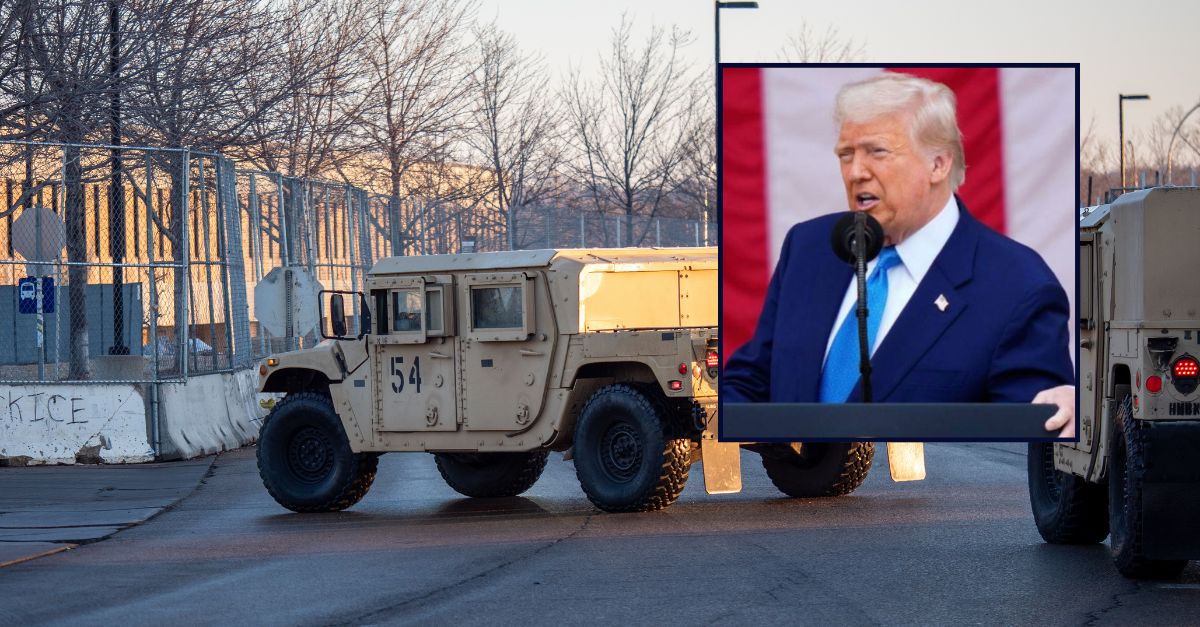
Inset: President Donald Trump delivers the Memorial Day Address at the 157th National Memorial Day Observance at Arlington National Cemetery, Monday, May 26, 2025, in Arlington, Va. (AP Photo/Julia Demaree Nikhinson). Background: Minnesota National Guard vehicles arrive at the Bishop Henry Whipple Federal Building in Minneapolis, Minnesota, on February 14, 2026 (Jason Whitman/NurPhoto via AP).
The Trump administration is unlawfully "prohibiting faith leaders from providing essential pastoral care" to detained immigrants in Minnesota, a lawsuit filed in federal court this week alleges.
The plaintiffs in the 26-page complaint are concerned with a by-now infamous federal building in the Land of 10,000 Lakes — and one that is the focus of several other immigration-related lawsuits.
"The Bishop Henry Whipple Federal Building—named for Minnesota's first Episcopal bishop, a 19th-century advocate for the dignity and rights of non-citizens—now stands in stark contrast to its namesake's legacy," the lawsuit begins. "The federal government is using the building to hold Minnesotans detained by Immigration and Customs Enforcement (ICE) while barring faith leaders from offering prayer, pastoral guidance, sacramental ministry, and spiritual comfort to detainees in moments of profound fear, isolation, and despair."
The lawsuit does not mince words and alleges violations of the First Amendment's free exercise clause as well as the Religious Freedom Restoration Act (RFRA), a 1993 law which offers greater protections for religious practice than even the U.S. Constitution provides.
"By prohibiting faith leaders from providing essential pastoral care to individuals in ICE detention, the federal government unconstitutionally obstructs their sacred obligation to exercise their faith through ministry to community members in the greatest need of spiritual comfort," the filing continues.
The plaintiffs in the case are the Minneapolis Area Synod of the Evangelical Lutheran Church in America, the Minnesota Conference of the United Church of Christ, and Father Christopher Collins, a Jesuit priest. Faith leaders have held an ongoing "interfaith demonstration of solidarity and support for immigrants" every second Tuesday of the month outside Whipple since 2018, the lawsuit claims.
Since the vigils, the plaintiff churches have called on their members "to offer pastoral care to detainees," and "reach out to those in detention," the lawsuit notes. The provision of such care is "integral" or "central" to their religious practice and calling, the plaintiffs say.
Late last year, however, such efforts became considerably more difficult, according to the lawsuit, due to the actions of ICE and its parent agency, the Department of Homeland Security (DHS).
In December 2025, thousands of ICE agents began to sweep the Twin Cities of Minneapolis and St. Paul for immigrants in a massive roundup entitled "Operation Metro Surge." Later, the Trump administration boasted that this controversial campaign was "the largest immigration enforcement operation ever carried out."
"For context, the number of federal agents in Minnesota equaled nearly one agent for every 1,000 of the Twin Cities' 3.2 million residents," the lawsuit reads. "The number of federal agents was more than five times the number of officers in the Minneapolis Police Department and roughly equivalent to the combined total of the ten largest law enforcement agencies in the area."
A series of homicides committed by federal agents resulted in massive national uproar and the operation has since been pared down considerably — with U.S. Border Czar Tom Homan announcing the formal end of the operation on Valentine's Day. But, the lawsuit says, "at least 500" federal agents still remain in Minnesota.
During those deployments, federal agents detained hundreds of individuals per day, according to the complaint. The great majority of those detainees were housed at Whipple, the plaintiffs say.
And, all the while, faith leaders were consistently denied access to provide pastoral care at the federal building, the plaintiffs say.
"Father Collins attempted to enter Whipple to pray for a detained mother of a local student, but when he arrived, he was blocked from even entering the parking lot to Whipple," the filing explains as an example. "He was prevented entirely from accessing the building and from ministering to those believed to be inside the building."
Last week, a reverend attempted to visit Whipple to "impose ashes" for detainees on Ash Wednesday and was instead "directed to the ICE waiting room" where she was denied access on the basis of "security" and "safety" concerns. Then, when the reverend asked for clarification, the federal employee "unfoundedly claimed that the detainees could become agitated," according to the lawsuit.
The complaint also alleges numerous — non-Whipple-related — instances where faith leaders or religious gatherings were attacked, set upon, or otherwise interrupted by federal agents since Operation Metro Surge began.
"Defendants have engaged in a documented pattern and practice of substantially burdening the free exercise of religion," the lawsuit alleges. "Defendants' actions have interfered with religious expression and the ability of clergy and faith communities to carry out their ministries."
The complaint goes on like this, at length:
The First Amendment of the Constitution broadly prohibits the government from restraining the free exercise of religious practices…
The United States has a long history of accommodating such religious freedom and practice inside of prisons and jails, and there is no reason to deny them at Whipple, particularly where the vast majority of detainees have no criminal records…
There is a special religious need for Plaintiffs to enter Whipple because the isolation is longer, the conditions in which they are held are worse, and the trauma that many detainees have suffered due to separation from their families is greater. This is particularly true given the lack of criminal history for most detainees at Whipple…
The plaintiffs are asking a court to issue an injunction that permits "in-person pastoral visits by faith leaders to all detainees" at Whipple and requires the government to "establish a clear, predictable process for scheduling visits by faith leaders." Such visits, the plaintiffs insist, should be allowed at "a regular frequency" with allowances for "urgent pastoral care or time-sensitive religious rites."
In an accompanying motion, the plaintiffs have also requested an expedited hearing to argue their motion in the interest of quick relief.


Comments