
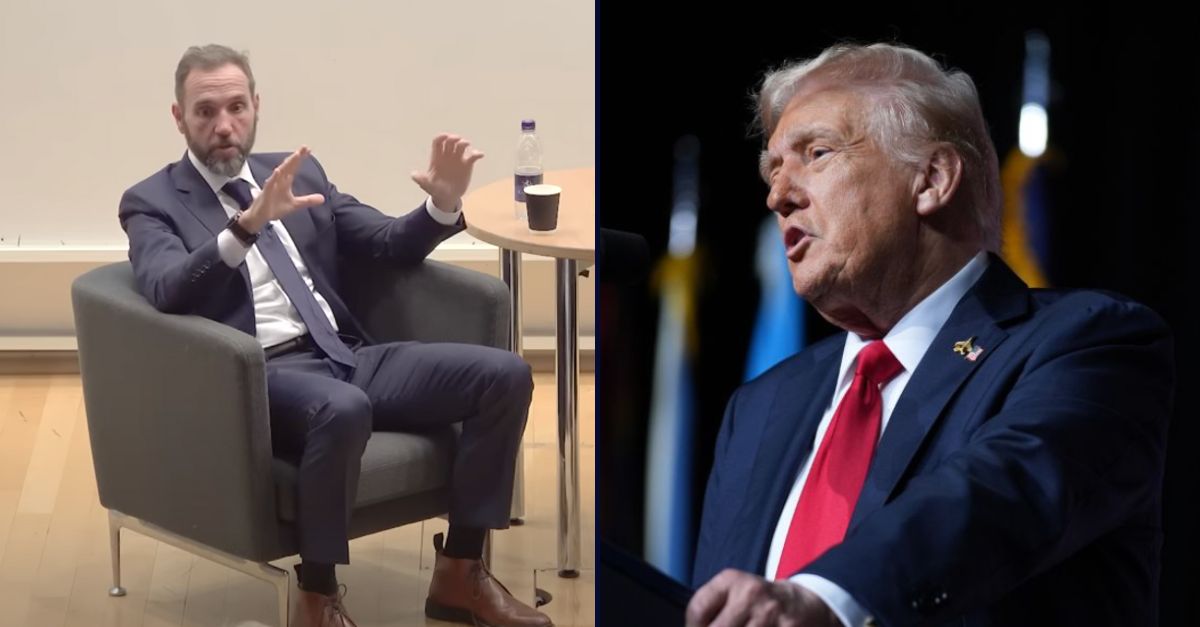
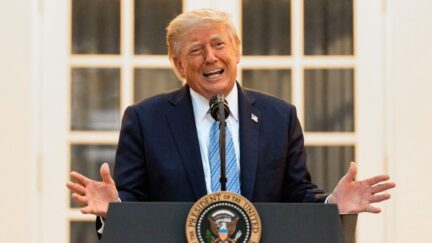
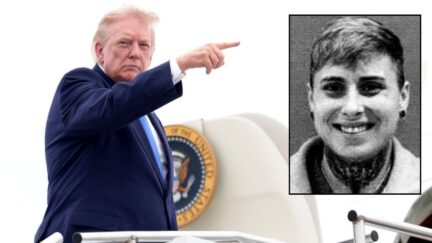
Left: Former special counsel Jack Smith speaks on Oct. 8, 2025, at the UCL Centre for Global Constitutional Democracy (UCL Laws/YouTube). Right: President Donald Trump speaks to a gathering of top U.S. military commanders at Marine Corps Base Quantico, Tuesday, Sept. 30, 2025, in Quantico, Va. (AP Photo/Evan Vucci).
Donald Trump's defamation lawsuit in Florida against the British Broadcasting Corporation over 12 seconds featured in a Jan. 6 documentary has placed evidence of his "state of mind" at the center of a hotly contested discovery dispute.
Trump and the defendants jointly filed court documents on Wednesday, calling for U.S. District Judge Roy Altman, a Trump appointee, to set a discovery hearing.
On the one hand, Trump maintains that the defendants' 47 subpoenas of third parties — seeking the "same records" former special counsel Jack Smith pursued against him — constitute an "improper fishing expedition" on the part of the BBC, by attempting to pry into the communications of his "family members, members of his executive cabinet, and several federal agencies." A 1,200-page exhibit showed the subpoena recipients included Donald Trump Jr., Ivanka Trump, and Jared Kushner.
The subpoenas broadly sought "[a]ll Documents and Communications Concerning the attack on the U.S. Capitol following the 'Stop the Steal' rally on January 6, 2021" and all the documents the parties provided to or received from the Jan. 6 Committee, Smith, congressional committees, among other entities.
The BBC has argued, on the other hand, that the broadcaster is entitled to documents that would tend to show that it's substantially true that Trump "fomented the violence" on Jan. 6.
At issue is an edit in the Panorama documentary "Trump: A Second Chance" that stitched together different parts of Trump's Jan. 6 speech from the Ellipse that, by the BBC's own admission, "unintentionally created the impression that we were showing a single continuous section of the speech, rather than excerpts from different points in the speech, and that this gave the mistaken impression that President Trump had made a direct call for violent action."
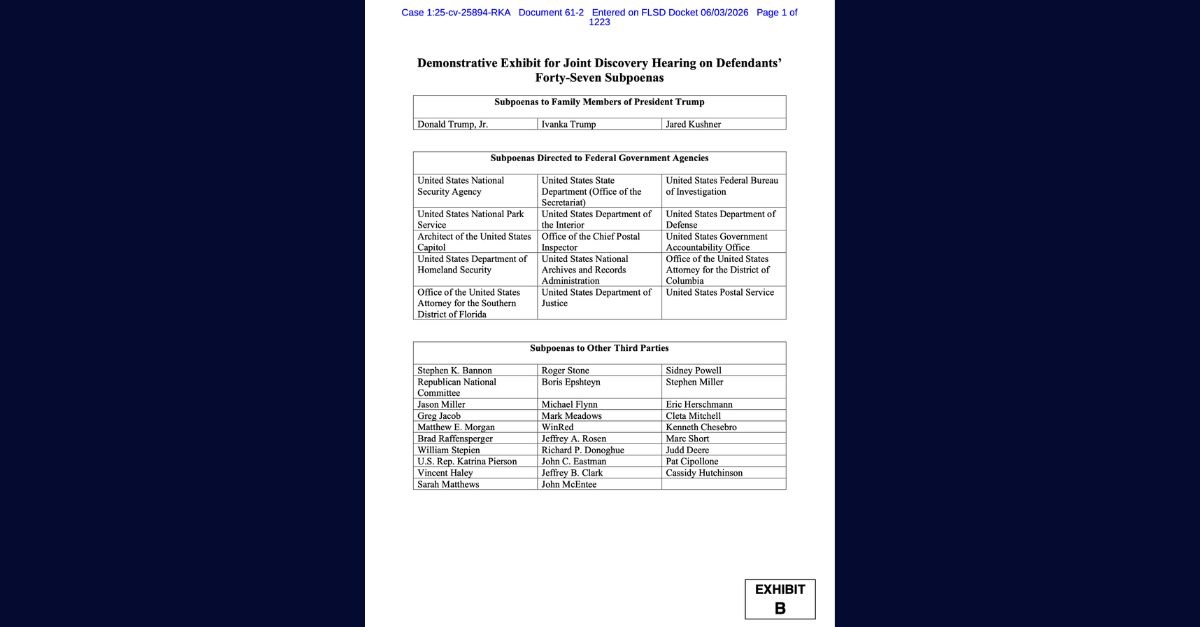
Exhibit B shows a list of 47 Trump family members, federal agencies, or associates facing subpoenas (DOJ).
Despite a public apology from the BBC, Trump filed a $10 billion complaint in December alleging the documentary "falsely depicted" him telling a crowd of supporters that would become a mob, "We're going to walk down to the Capitol and I'll be there with you. And we fight. We fight like hell and if you don't fight like hell, you're not going to have a country anymore."
"President Trump never uttered this sequence of words," the complaint said.
The BBC is taking the position that it doesn't matter that Trump didn't say those words and it doesn't matter that he was never criminally charged with incitement, because it's still "reasonable" to believe discoverable records will show he "cannot prove it would be false to imply that he fomented the violence of January 6," which goes to the heart of the case.
"In short, to prevail in this case, Plaintiff must prove that he did not foment or incite the January 6 Capitol riot. Plaintiff has placed that question directly at issue in bringing this libel lawsuit – he cannot now prevent Defendants from seeking records that would shed light on his true knowledge, intent, and state of mind in delivering his speech at the Ellipse," the defendants argued (emphasis in original).
To combat Trump's "fishing expedition" claim, the BBC turned to Smith's report on the Jan. 6 probe.
"Plaintiff errs in calling these subpoenas a fishing expedition. Special Counsel Jack Smith wrote in his final report on his investigation into Plaintiff's efforts to interfere with the 2020 election that this investigation 'determined that there were reasonable arguments to be made that Mr. Trump's Ellipse Speech incited the violence at the Capitol on January 6 and could satisfy the Supreme Court's standard for 'incitement,' and that 'the evidence established that the violence was foreseeable to Mr. Trump, that he caused it, that it was beneficial to his plan to interfere with the certification, and that when it occurred, he made a conscious choice not to stop it and instead to leverage it for more delay,'" the filing said.
Smith explained that he didn't find "direct evidence—such as an explicit admission or communication with co-conspirators—of Mr. Trump's subjective intent to cause the full scope of the violence that occurred on January 6."
The BBC added that Trump's "refusal to date to produce even a single document" requested so far "only makes these third-party subpoenas even more necessary."
Follow Law&Crime:



Comments