
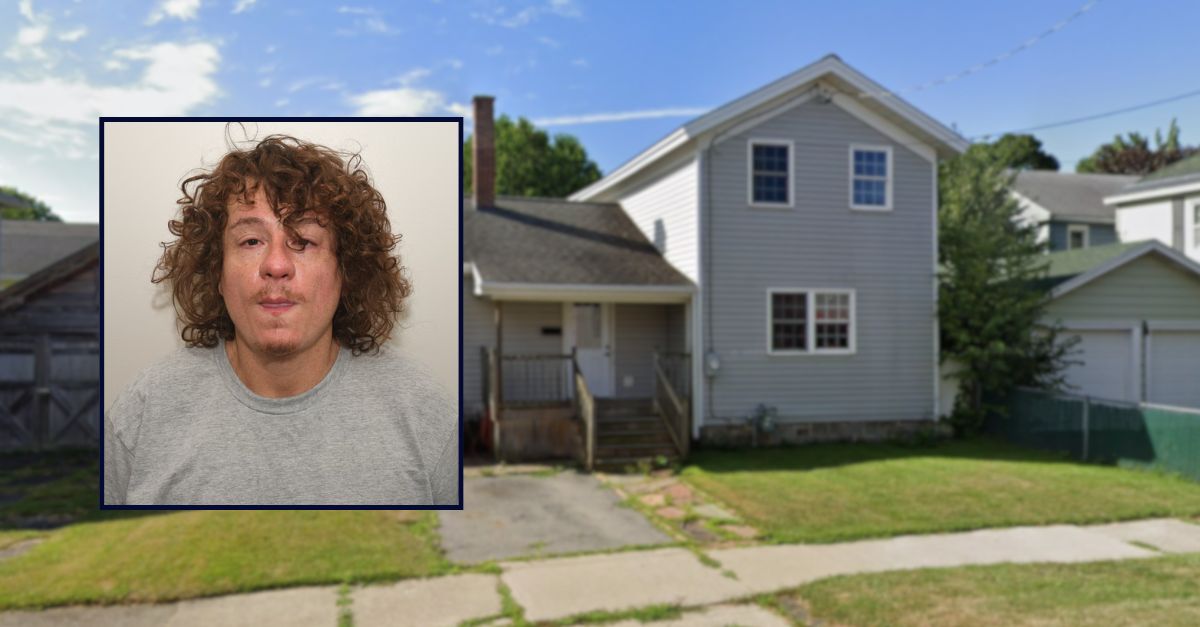
Inset: Ricky Colon (Oswego County District Attorney's Office). Background: The residence where Colon brutally murdered Rachel Allen in Oswego, N.Y. (Google Maps).
An upstate New York man will spend several decades behind bars for brutally beating his friend to death with a cast-iron stove grate.
In February, Ricky Colon, 37, was found guilty by an Oswego County jury on charges of murder in the second degree, assault, criminal possession of a weapon, and tampering with physical evidence in the death of 38-year-old Rachel Allen.
On Monday, he was sentenced to 25 years to life in prison by Oswego County Supreme Court Justice Armen Nazarian.
The judge also ordered an additional 25-year sentence for the assault count and single-digit sentences for the lesser crimes, but assessed all of the sentences to run concurrently, or at the same time, according to a courtroom report by Oswego County News Now, the collective online outlet for The Palladium-News and The Valley Times.
The underlying incident occurred on July 13, 2024, at Colon's own residence on West Schuyler Street in the City of Oswego, a small college town located roughly 40 miles north of Syracuse.
The judge described the murder as one of the most "brutal and disturbing" crimes he had ever seen, recounting an insurance report that said the crime scene required over $20,000 in cleaning services.
"The sheer violence required to inflict those injuries demonstrates an astonishing level of cruelty," the judge said, "and defies comprehension."
During the trial, prosecutors said the bludgeoning was so brutal that the metal grate broke into several pieces. The medical examiner determined Allen died from blunt force trauma caused by 58 external injuries and 13 internal injuries. First responders who knew the victim said the damage was so severe they could not recognize her.
Immediately after the killing, Colon recorded a series of cellphone videos inside the house, according to Syracuse.com. In those videos, the defendant is seen covered in blood, crying, and speaking incoherently. In one such video, Colon said he found his friend dead and proclaimed his innocence — expressing a desire to call the police before later saying he believed his life was over.
A prosecutor described the videos as "extremely bizarre" in comments to Syracuse.com.
During sentencing, the defense formally argued the salience of a different kind of life-altering event, one that occurred long before Allen's murder — citing Colon's military service during the U.S.-led invasion of Iraq and the post-traumatic stress disorder he suffered as a result.
During the trial, however, the court did not allow the defendant's counsel to mention his PTSD diagnosis, despite repeat efforts.
"Judge, he entered the service one person and came back a different person," attorney Michael Spano said. "We see that in the letter his brother wrote. He describes him as a happy person, always smiling, but when he came back he was a profoundly different person."
The state, however, dismissed such excuses offered by the foreign war veteran, saying he was given the right to an attorney, a fair trial, and considerable leeway over a series of in-court outbursts.
"Now I'm asking this court to give him what he deserves," prosecutor Louis Mannara said. "He showed no mercy…At this point in time the people request you show him the same. He's not deserving of any."
After Allen was beaten to death, Colon moved the victim's body and burned her clothes before calling 911. While speaking with dispatchers, the since-condemned man said his friend had died of a drug overdose. The crime scene belied that claim.
"In a final act of profound callousness, he showered over the deceased body, washed the blood off of himself and onto her," Nazarian said. "He's demonstrated a complete and absolute lack of remorse."
The court also took issue with the post-slaying videos, particularly one in which the defendant said he found Allen in his apartment after waking up from a nap. At this point of the lecture, Colon piped up to interject an obscenity-laden diatribe and to claim that he did not receive a fair trial because he was not allowed to testify on his own behalf. Then, deputies removed the defendant and took him to a holding cell for the duration of the hearing.
Nazarian continued on, despite an objection from the defense.
The judge continued to upbraid Colon, this time for an argument he made to the probation department in his own presentencing report that he needed to supply his victim with alcohol to "save her life" from withdrawal symptoms — though he killed her later the same day.
Colon, the court said, used alcohol and PTSD to try to shield himself from responsibility for his actions and never made any effort to try to alleviate his substance and mental health problems.
"The defendant who absolutely refuses to acknowledge his role in his own horrific actions is a defendant who can't be rehabilitated," Nazarian intoned. "His complete lack of remorse combined with his proven capacity for extreme, explosive violence makes him a profound and continuing danger to society and the community. Therefore the maximum sentence allowable by law are not only appropriate in this case, they are absolutely necessary."



Comments