
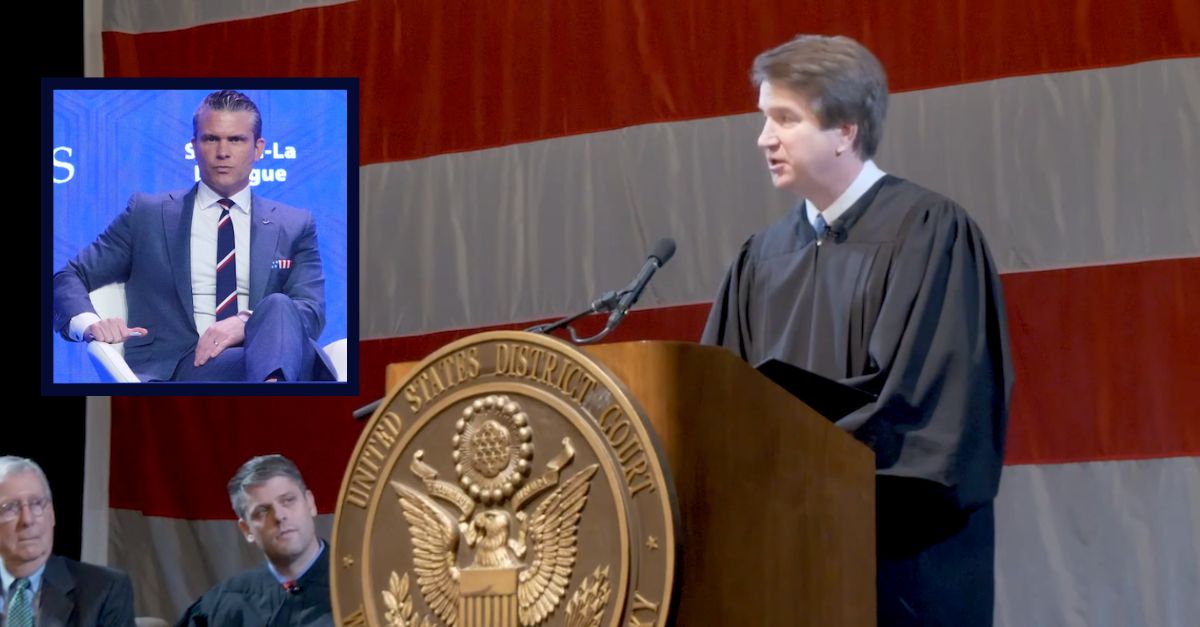
Main: Justice Brett Kavanaugh swears in his former law clerk Justin Walker as a federal judge, as then-Sen. Majority Leader Mitch McConnell looks on in March 2020 (YouTube/Walker Investiture). Left inset: U.S. Defense Secretary Pete Hegseth listens to a question during the Shangri-La Dialogue, Asia's annual defense and security forum, in Singapore, Saturday, May 30, 2026 (AP Photo/Achmad Ibrahim).
Pete Hegseth's attempt to ban transgender service members actively serving in the military flopped on Monday at the U.S. Court of Appeals for the District of Columbia Circuit, but a noted protégé of Justice Brett Kavanaugh helped keep the possibility of a forward-looking bar alive — and the defense secretary is already saying "see you at SCOTUS."
U.S. Circuit Judge Robert Wilkins, Senior U.S. Circuit Judge Judith Rogers, and U.S. Circuit Judge Justin Walker reached a fractured 2-1 decision that registered as a loss for the Trump administration on the so-called "Hegseth Policy," but only as it relates to currently serving transgender members of the military — for now.
In February 2025, following President Donald Trump's executive order, a Pentagon memo declared that "medical, surgical, and mental health constraints on individuals who have a current diagnosis or history of, or exhibit symptoms consistent with, gender dysphoria are incompatible with the high mental and physical standards necessary for military service." The memo also said that troops "being processed for separation in accordance with this policy will be afforded all statutorily required rights and benefits."
Wilkins, a Barack Obama appointee, explained how it was that he and Rogers agreed to protect transgender plaintiffs "already in the military" — over Walker's objection — while he also agreed with Walker to "vacate" the lower court's preliminary injunction "as it relate[d] to Plaintiff-Appellees seeking accession into the military" — namely, recruits.
"[T]he record shows that the purpose of the Hegseth Policy is to target applicants and servicemembers who express what the Administration believes is a 'false gender identity,' and the Policy goes far beyond disqualifying persons currently or recently suffering from gender dysphoria. Some of those disqualifications are completely unexplained and have no reasonable justification," Wilkins said.
Adding that the Trump administration "has not attempted to defend or provide any factual basis for [its] disparaging characterizations of American citizens" who "happen to be transgender and have suffered from gender dysphoria," Wilkins and Rogers each blasted the "Hegseth Policy" as one "based upon animus."
Walker, a Donald Trump appointee and a clerk to Kavanaugh when the latter was a D.C. Circuit judge, penned a lengthy dissent that said the appellate court had no business intruding in military affairs. He did not persuade his two colleagues to join that view, but he did convince Wilkins not to block the policy as applied to prospective service members.
"Judge Stephen Williams, 'one of the most distinguished jurists ever to serve on the D.C. Circuit Court of Appeals,' wrote seven years ago that in the military 'there is no constitutional right for, say, biological males who identify as female to live, sleep, shower, and train with biological females. Whether allowing such flexibility in military service is a good idea or not is of no concern to the courts; that is a question for the people acting through their elected representatives,'" the dissent began. "Now, as then, transgender plaintiffs object to a policy that excludes them from the military. Now, as then, the district court has enjoined the policy's operation. And now, as then, the Government has appealed."
From there, Walker chided the majority judges for fashioning themselves as "generals," while also saying he understood the "impulse."
"[The Supreme Court said that the military can deprive its members of rights that the Constitution may well guarantee to civilians. Like today's majority, I cherish those rights, and so I understand the impulse behind the majority's unprecedented intervention into military affairs. But because the plaintiffs are service members not civilians, and because we are judges not generals, I respectfully dissent," he wrote.
In a half-concurrence, half-dissent, Rogers took aim at Walker for his "great deference" to the executive branch in the face of a "likely" showing that the ban is unconstitutional.
"Even under the highly deferential form of rational basis review espoused by the government, a policy is unconstitutional if it is 'inexplicable by anything other than animus,'" Rogers said, citing the case of Trump v. Hawaii. "Plaintiffs-appellees are likely to make that showing. Judge Wilkins identifies three features of the Hegseth Policy that are unexplained and irrational. At least two are illustrative of that problem, and our dissenting colleague does not suggest that a policy explainable only by animus is constitutional[.]"
See you at SCOTUS. https://t.co/BhLprXz5Im
— Pete Hegseth (@PeteHegseth) June 1, 2026
Hegseth acknowledged the setback by stating "See you at SCOTUS," where Walker's former boss now sits.
Follow Law&Crime:



Comments