

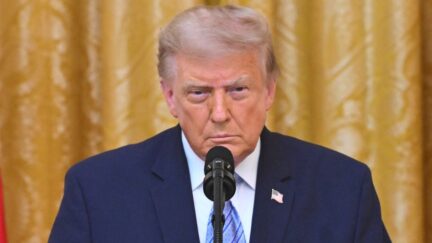
President Donald Trump listens during an event to announce the Freedom Haulers initiative at the White House, Thursday, July 30, 2026, in Washington (AP Photo/Alex Brandon).
The Trump administration cannot indefinitely detain most immigrants who have been living in the country, a federal court of appeals ruled on Thursday in the latest blow to the controversial and admittedly novel power claimed by Immigration and Customs Enforcement (ICE).
In July 2025, ICE issued the policy — breaking with decades of precedent — in a memo penned by acting ICE Director Todd M. Lyons instructing agents to deny bond to anyone who entered the country without "inspection" and triggering a wave of litigation as thousands of detainees have filed petitions for a writ of habeas corpus.
Under the policy, such immigrants are to be detained "for the duration of their removal proceedings" unless granted parole, a rarer form of release. In real terms, however, the Trump administration has made clear such detentions are intended to be indefinite.
On Thursday, a divided panel on the U.S. Court of Appeals for the 9th Circuit rejected the government's interpretation of the Immigration and Nationality Act (INA), deepening an existing circuit split and all but ensuring ultimate resolution before the U.S. Supreme Court.
The disputed policy is sourced from a section of the INA that says certain immigrants "shall be detained for a proceeding." For nearly three decades, this section of the INA only applied to immigrants who are stopped at the border.
The Trump administration drastically altered longstanding federal practice. The memo says the federal government has "revisited its legal position on detention and release authorities" and determined such immigrants "may not be released from ICE custody."
Over the intervening months, in over 15,000 disputes before district courts, judges have considered the interplay and applicability of two statutes outlining the government's detention authority, often using language drawn from a 2018 U.S. Supreme Court ruling.
The government claims ICE has the authority to subject almost any immigrants to mandatory detention under 8 U.S.C. §1225(b), which applies to "aliens seeking entry into the United States."
Advocates for immigrants, as well as most of the hundreds of judges who have ruled on the matter, have instead turned to 8 U.S.C. §1226(a), which applies to "aliens already present in the United States."
The vast majority of district courts to consider the issue — and most appellate courts — have sided against the Trump administration, rejecting the position put forward by ICE about its detention authority, according to a rolling analysis of court rulings by Politico.
Now, settling the dispute at the 9th Circuit, at least, an appeals court has, for the fifth time, ruled against ICE's position.
The majority opinion largely frames the question, and its own eventual answer, in terms of what the INA actually says — with the added insight of historical detention practices.
"We conclude that the text, context, and structure of the INA, considered as a whole, did not direct such a significant, yet overlooked, change in the law," the opinion reads. "Although no reading of the complicated and interrelated textual provisions at issue here is without some shortcomings, the historical understanding of the statute is the better one."
At root, the appellate court says the power claimed by the government simply does not exist, and again refers to history, but this time in the negative sense in terms of the admitted "novelty" of the would-be mandatory detention power.
"That no Administration 'has ever found' a duty mandatorily to detain unadmitted aliens present in the interior of the country 'is strong evidence that it does not exist,'" the opinion goes on.
In terms of the basic statutory battle, the 9th Circuit concluded that §1225(b) only applies to immigrants apprehended at the border. Therefore, immigrants already present in the country are subject to §1226(a), which allows for release on bond.
The majority also expressed a certain level of skepticism at the power claimed by the government — finding that the statute is by no means clear enough to support the government's position.
"Congress would have spoken more clearly if it had intended the dramatic expansion of mandatory detention authority that the government's new interpretation portends," the opinion continues.
The panel ended its opinion with a return to the statute:
[S]tatutory interpretation does not always yield a crystal-clear answer…In this case, the better and more natural interpretation of the text, considered in context, is that Congress in 1996 did what practice and precedent long understood it to have done: subject unadmitted aliens entering the United States at the border to §1225(b)(2)(A), and unadmitted aliens present in the interior of the country to §1226.
There is a pronounced circuit split at the appellate level on the policy.
The 5th Circuit recently muddied its own guidance; the 8th Circuit has ruled in the government's favor, and the 7th Circuit has not issued a majority opinion. Meanwhile, the 2nd Circuit, 6th Circuit, 10th Circuit, and 11th Circuit have also ruled against ICE.





Comments