
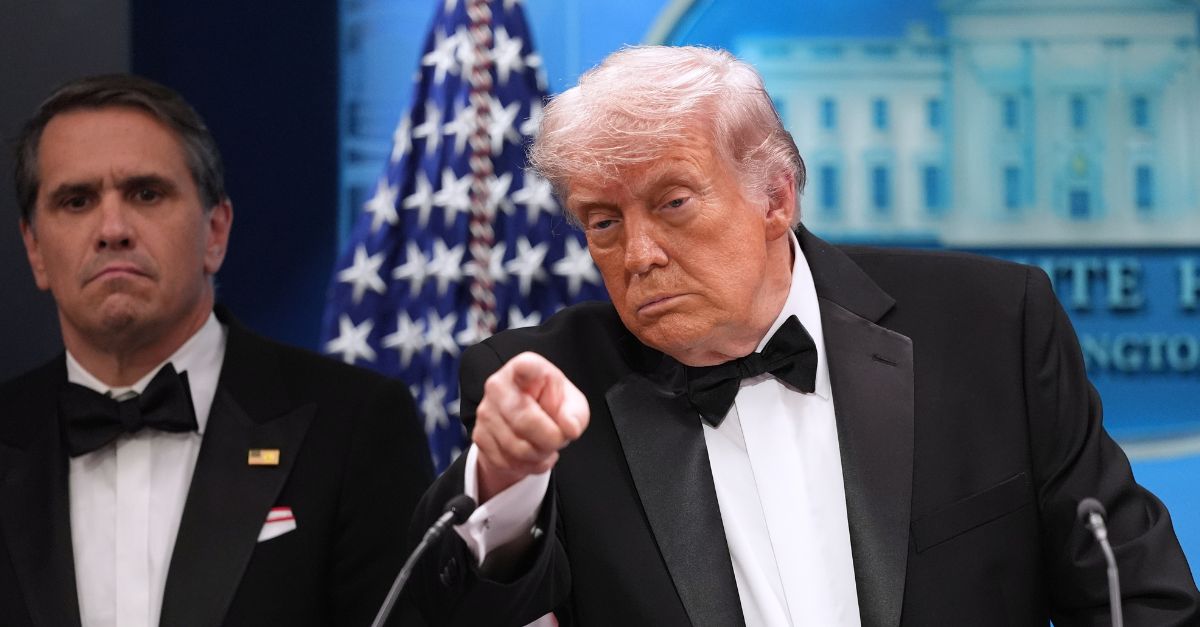
President Donald Trump speaks in the James Brady Press Briefing Room at the White House after an unspecified threat at the annual White House Correspondents' Association Dinner in Washington, Saturday, April 25, 2026, as Acting Attorney General Todd Blanche looks on (AP Photo/Alex Brandon).
Far from convinced that President Donald Trump's $1.776 billion "anti-weaponization fund" is dead and never coming back to life, a federal judge in Virginia refused to put a stop to a lawsuit and signaled the parties should start thinking about discovery.
The lawsuit brought by former Jan. 6 prosecutor Andrew Floyd, one of several cases the DOJ is fighting, last month convinced U.S. District Judge Leonie Brinkema that the fund, ostensibly used to compensate individuals targeted by the government, should be barred from making any payments.
On Wednesday, the Bill Clinton-appointed jurist ordered the DOJ to respond to the lawsuit and to prepare itself for a lengthy civil discovery process.
Notably, Brinkema was unmoved by any of Acting Attorney General Todd Blanche's assurances in his testimony before Congress, writing that he "was not under oath" on June 12 when he said, "we are not moving forward with the fund, period." Nor was the judge impressed by the representations the government made in court, which cited those same Blanche remarks.
Instead of filing documents that could have ended the matter, the DOJ decided to fight being forced to take that action.
"[D]efendants were offered the opportunity to end this litigation by filing written declarations under the penalty of perjury affirming what they have represented to the public, the House Appropriations Subcommittee on Commerce, Justice, Science and Related Agencies, our judicial colleagues in the United States District Court for the District of Columbia, and this Court—namely, that they will not take any action to create or operate the Anti-Weaponization Fund and that the Fund will not proceed in any manner or under any other name," the judge said. "Instead of filing those declarations, defendants have filed a Notice declining to provide such assurances under the penalty of perjury, claiming that '[s]uch declarations are unnecessary and the compelled testimony of senior officials from the Executive Branch implicates serious separation of powers concerns.'"
"[T]hey were simply offered the option to provide a short, written declaration under the penalty of perjury. Such a declaration would have sufficient evidentiary weight to render this litigation moot," Brinkema said, calling it "particularly concerning" that outside of court Trump and Blanche still regard the fund as "important."
"As the Court explained during the June 12 hearing, a civil suit does not necessarily become moot when the defendants agree to stop the conduct at issue in the litigation. Under the voluntary cessation exception to the mootness doctrine, 'a party should not be able to evade judicial review, or to defeat a judgment, by temporarily altering questionable behavior,'" the judge explained.
Using the Trump administration's "unwillingness to provide declarations under the penalty of perjury" against it, the judge ordered the DOJ to respond to the lawsuit by July 17. Brinkema reminded the parties that she also issued an order on Monday, "starting the standard civil discovery process."
A pretrial conference was set for July 8 to "consider the claims, defenses, possibilities of a prompt settlement or resolution of the case, trial before a magistrate judge […] and to develop a discovery plan," with the aim of completing discovery by Nov. 13.
Around the same time Brinkema issued an injunction in May, dozens of former federal judges filed a motion to "reopen" Trump's Florida federal lawsuit against the IRS. The president voluntarily tossed that case by citing the "settlement" fund, before the presiding judge could explore whether there really was an actual case or controversy at hand between Trump and the government he heads.
Follow Law&Crime:


Comments