
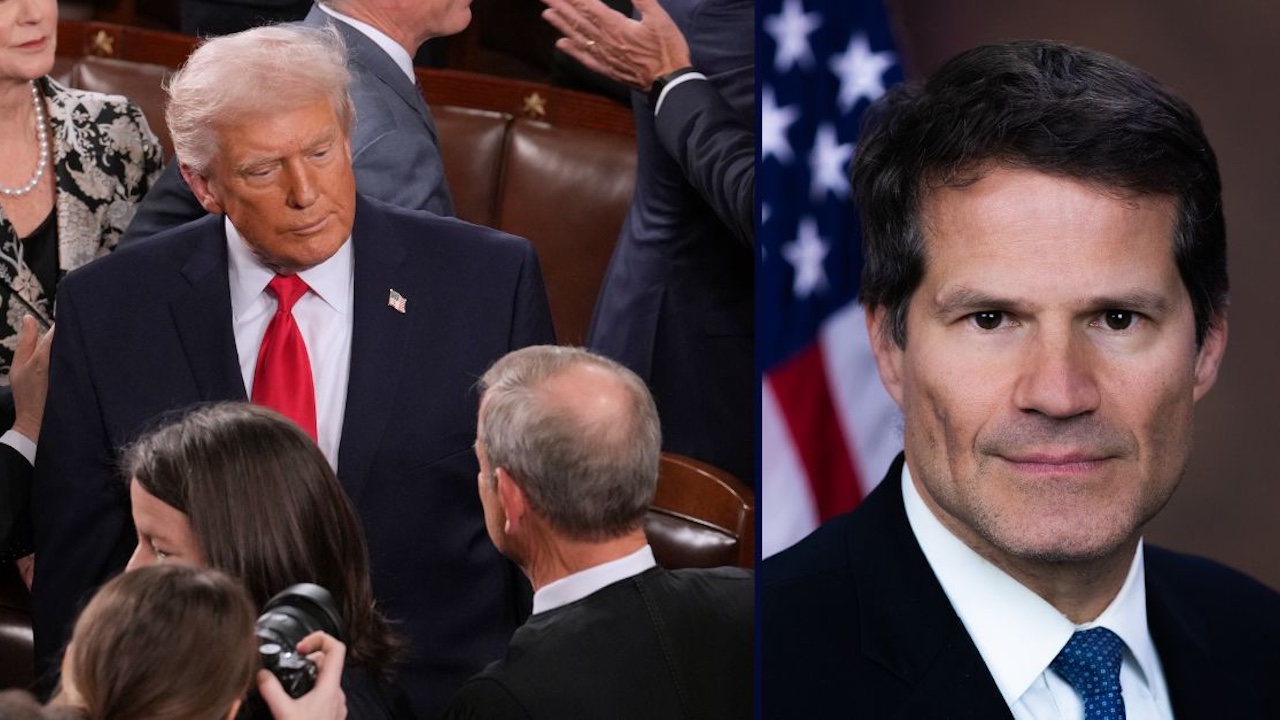
Left: President Donald Trump is greeted by Supreme Court Chief Justice John Roberts as he arrives on the House floor to give his State of the Union address to a joint session of Congress, at the Capitol in Washington, Tuesday, Feb. 24, 2026. (AP Photo/J. Scott Applewhite). Right: U.S. Solicitor General D. John Sauer (DOJ).
Once again telling the U.S. Supreme Court that the real threat to America's elections came from a lower court, the DOJ asked for a timely stay of an order it called "a flagrant abuse" of an "extraordinary" remedy.
U.S. Solicitor General D. John Sauer, President Donald Trump's former personal attorney, submitted an application for Chief Justice John Roberts' review on Thursday, backing the Federal Communications Commission (FCC) and claiming "judicial intervention at this late date could upend campaign-finance rules in the 'critical weeks leading up to the midterms.'"
Roberts followed through in short order, issuing an administrative stay on Thursday and setting a response deadline for 5 p.m. on Saturday.
The case from the 4th U.S. Circuit Court of Appeals is captioned National Republican Congressional Committee v. Sherrod Brown. Brown, a Democrat in Ohio seeking a Senate seat, and several other Democrats filed a lawsuit after the FCC in March issued a "public notice" on its "lowest unit charge (LUC) requirements" for political party ads over a period of "45 days preceding the date of a primary election and 60 days preceding the date of a general election."
The notice said that LUC "requirements are applicable to (1) authorized committees, including authorized committees that engage in joint fundraising with legally qualified candidates for federal office, and (2) advertisements that qualify as coordinated expenditures of political parties and legally qualified candidates for federal office."
The Democrats who filed suit found success at the 4th Circuit by disputing "whether political parties and joint fundraising committees with non-candidate members" were also entitled to lower advertising rates. They maintained that "only political candidates" could get those rates and that the notice be declared unlawful.
But the Supreme Court rebuffed the candidates on Sept. 4, granting the emergency stay the DOJ sought.
The per curiam order said that the Communications Act required "an aggrieved party" to "wait for the Commission to resolve its application for review by order before filing a petition for judicial review," and because that didn't happen, the 4th Circuit didn't have jurisdiction.
But that wasn't the end of the story. Days later, Brown filed a petition for a writ of mandamus, an "extraordinary" remedy to force the FCC to act.
The 4th Circuit, in a 2-1 decision on Wednesday, did just that, giving the FCC a deadline of Oct. 9 at noon to "resolve […] the Federal Candidates' Application for FCC Review."
"First of all, at this critical juncture, the Federal Candidates have no other adequate remedy through which they could obtain relief," according to Senior U.S. Circuit Judge Robert King, a Bill Clinton appointee, and U.S. Circuit Judge James Wynn Jr., a Barack Obama appointee.
The DOJ relied heavily on the lone dissent, penned by U.S. Circuit Judge J. Harvie Wilkinson, in its latest stay application.
A Ronald Reagan appointee, Wilkinson saw the majority's order as a "new board game."
"Litigants far and wide will be eager to purchase the majority's new board game: Make The Supreme Court Say It Twice. Once is enough for me, so I vote to deny the petition for a writ of mandamus," the dissent said. "The grant of a writ of mandamus is a direct affront to the Supreme Court's stay order in this case. That order embraced what the Supreme Court has long emphasized: the need to preserve settled understandings prior to an election, here, in the 'critical weeks leading up the midterms.'"
Picking up where Wilkinson left off, Sauer urged the justices not to let this "egregious intrusion into the nation's electoral process" stand and to issue an "immediate administrative stay of the order" before it becomes moot at the Friday noon deadline.
"The panel reiterated its view that the public notice is 'plainly contrary to law'—strongly suggesting that, if the FCC affirms or declines to review the Bureau's notice, the panel will then immediately vacate that order," Sauer said. "Judge Wilkinson dissented, observing that the panel's decision 'is a direct affront to [this] Court's stay order' and 'is 'chaotic with a capital C.'"
"Wholly apart from the merits, a writ of mandamus is inappropriate under the circumstances of this case, given that the challengers delayed for months in seeking such relief and that judicial intervention at this late date could upend campaign-finance rules in the 'critical weeks leading up to the midterms,'" the application added.
Follow Law&Crime:




Comments