
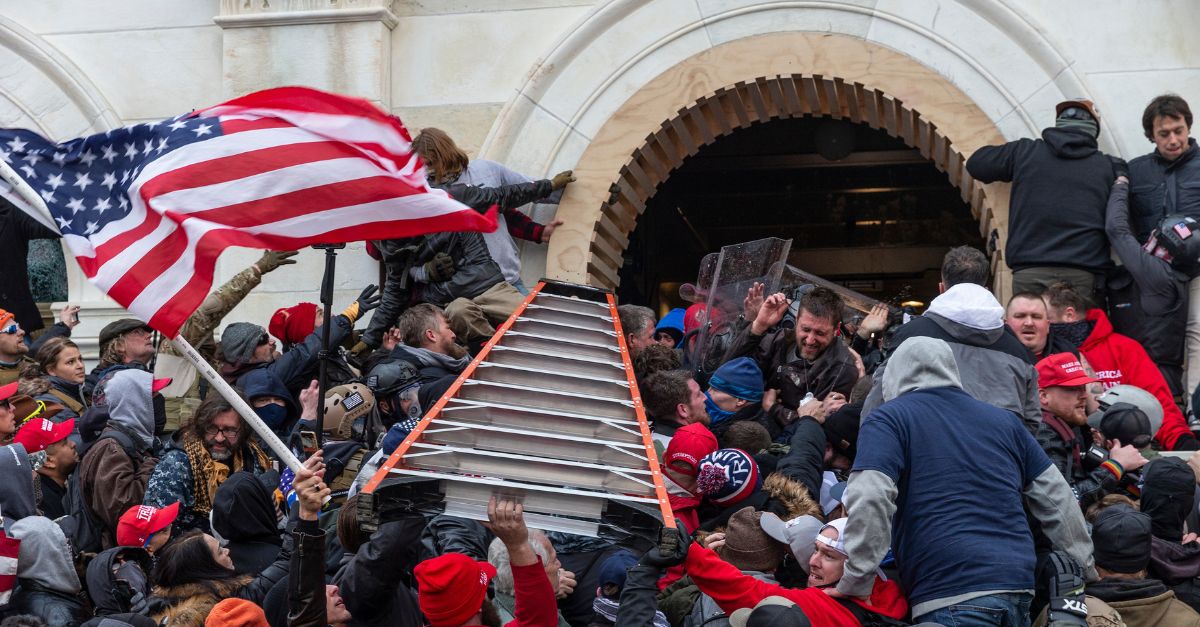
Rioters trying to enter the Capitol building through the front doors in Washington, D.C., on January 6, 2021, clash with police (Photo by Lev Radin/Sipa USA)(Sipa via AP Images)
A convicted Jan. 6 rioter's claim that she was prosecuted differently than other accused protesters holds no weight and must be dismissed, federal prosecutors say.
In its 20-page motion to dismiss the complaint from Cindy Young, the U.S. Attorney's Office for New Hampshire argues her attempts to contrast Jan. 6 defendants with those alleged to have protested in support of Black Lives Matter (BLM) in 2020 "fail" and that she is not entitled to relief.
Before being pardoned by President Donald Trump on the first day of his second term, Young was convicted of four federal misdemeanors "for her part in the January 6, 2021 attack on the United States Capitol." As Law&Crime previously reported, she said she was given four months in jail, followed by two months of home detention and two years of probation.
Young is well known to federal prosecutors. She filed a motion in December 2024 seeking permission to attend Trump's swearing-in ceremony and later demanded that a memorial plaque meant to commemorate the law enforcement officers who protected the Capitol on that fateful day honor the insurrectionists, too.
She filed the selective prosecution complaint in November 2025 and amended it on April 22, arguing that when she turned herself in on the misdemeanor charges, FBI agents took a DNA swab from her cheek without a warrant or consent. Such actions, she argued, exceeded the agents' authority and underscored how Jan. 6 defendants "faced much more aggressive federal prosecution" than BLM defendants, violating federal law.
One by one, the Department of Justice worked to dismantle her claims.
First, FBI agents are "authorized" DNA collectors, and Young "had no right to refuse to provide a DNA sample, and thus no consent form or opportunity to decline were required."
And as for the allegation that her "guarantee of Equal Protection" under the Fourteenth Amendment was violated, Young "is drawing comparisons between people who are not similarly situated," the prosecutors wrote.
"[T]his claim itself recognizes that the two groups were not similarly situated because they were prosecuted by different sovereigns," they continue. "There is a simple reason why the January 6 defendants faced 'more aggressive federal prosecution' than BLM protesters: the January 6 attack at the Capitol took place on federal property, in the federal District of Columbia. Federal authorities have exclusive jurisdiction over the District of Columbia, and it is governed by federal law."
The BLM protests of 2020 were "[c]onversely" not limited to places under federal jurisdiction, and even if Young could prove unequal effects of the arrests, "she has alleged no facts to support the claim that such an impact was motivated by a discriminatory purpose," prosecutors say.
As she "cannot meet the demanding standard to plead a selective prosecution claim," her amended complaint should be denied, the attorney's office concludes.
Comments