
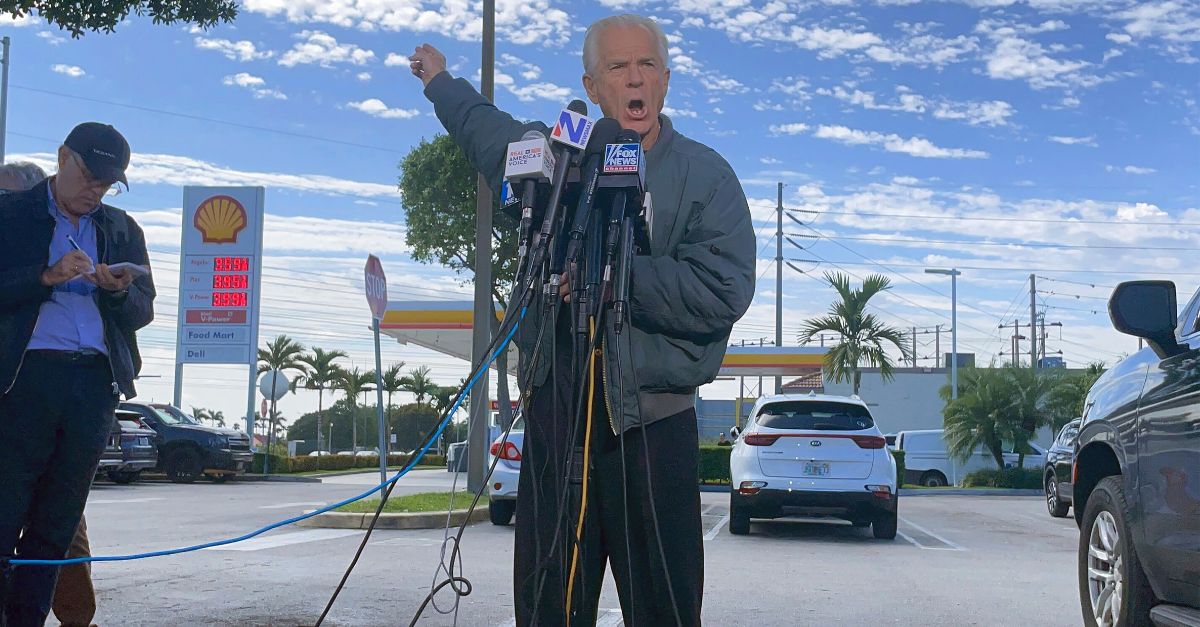
Then-former Trump White House official Peter Navarro speaks to reporters before he heads to prison, Tuesday, March 19, 2024, in Miami, to begin serving his sentence for refusing to cooperate with a congressional investigation into the Jan. 6, 2021, attack on the U.S. Capitol (AP Photos/Adriana Gomez Licon).
A panel of federal appellate court judges unanimously affirmed Peter Navarro's contempt conviction for defying a Jan. 6 Committee subpoena, in turn confirming that the appeal of President Donald Trump's senior counselor on trade and manufacturing went as poorly as it seemed in 2025.
In December, Navarro's attorney astounded a three-judge panel with arguments that his client properly invoked executive privilege in a blanket way. The proceedings were entirely a back-and-forth between U.S. Circuit Judges Patricia Millett, Cornelia Pillard, and J. Michelle Childs, and attorney Stanley Brand, because the Trump administration DOJ abandoned the defense of the conviction.
Millett — who repeatedly stressed that executive privilege is for the president to invoke and not available to Navarro in blanket or "presumptive" form — ended up writing the opinion of the U.S. Court of Appeals for the District of Columbia Circuit on Tuesday, holding that his "individual mistake" meant everything.
Referring to the appellant throughout as "Dr. Navarro," the judge said he asserted executive privilege "without consulting anyone" and without even seeing the subpoena at issue.
"The only difference, then, between an advice-of-counsel defense and Dr. Navarro's individual mistake is that Dr. Navarro immediately and categorically asserted executive privilege without consulting anyone, whether counsel or the President to whom the privilege belongs," the opinion said. "And he did so before even seeing the subpoena and its cover letter that made clear the subpoena sought some information that Dr. Navarro concedes is not privileged because he had discussed it publicly 'in [his] recently published book, in interviews with reporters, and * * * on a podcast[.]' That all cuts against Dr. Navarro's purported good-faith defense, not in favor of it."
During arguments, Millett got Navarro's lawyer to make a key concession.
"I don't understand how you could have a presumptive privilege and agree that it's subpoena-specific, as you said in district court," the judge said. "I don't know what the difference between presumptive privilege and a blanket privilege is. Can you tell me what the difference is?"
"I suppose there isn't one," Brand admitted.
Navarro served four months in jail after failing at each level of the federal court system to prevent that outcome following his conviction in January 2024 on two misdemeanor counts of criminally stonewalling the congressional Jan. 6 investigation.
In the district court, prosecutors in the Biden administration DOJ roasted Navarro's last-gasp executive privilege assertions as "unfounded" and little more than "fan fiction."
"As the Court emphasized, the Defendant presented nothing — no words from the former President, no 'smoke signal' from any conversation nor anything conveyed by another — that would constitute an actual assertion of the privilege," the government said. "The Court was left with only the Defendant's fan fiction version of what the Defendant wished or hoped the former President might have wanted but left unsaid."
At sentencing, U.S. District Judge Amit Mehta agreed that if Trump had "issued a similar letter" to Navarro, like the ones issued to ex-chief of staff Mark Meadows and deputy chief of staff for communications Dan Scavino, ordering them not to testify about Jan. 6, "the record here would look very different."
After Navarro's exit from incarceration in Miami, he cast himself as a martyr for Trump, saying he "refused" to "betray" Trump to "save my own skin."
On appeal, Navarro acknowledged that he "in fact did not comply with the subpoena by providing documents or appearing for a scheduled deposition" before the Jan. 6 Committee, but he insisted the resulting prosecution was an "unjust result."
The D.C. Circuit said no such thing on Tuesday.
"To be sure, executive privilege's protection extends beyond the President himself to his immediate advisers," the panel said. "But that is not because those advisers have any claim of privilege in their own right."
In a statement to Politico, Navarro's current attorney Abhishek Kambli himself said the result was "not surprising."
"Peter Navarro knew that it would be one step in a battle to correct decades of incorrect DC Circuit precedent," said the lawyer, who left the DOJ after defending Trump's law firm executive orders at the D.C. Circuit in May. "He intends to move swiftly with his appeal because his case affects every senior presidential advisor, regardless of political party, who believes in good faith they cannot comply with a Congressional subpoena based on executive privilege."
Follow Law&Crime:

Comments