
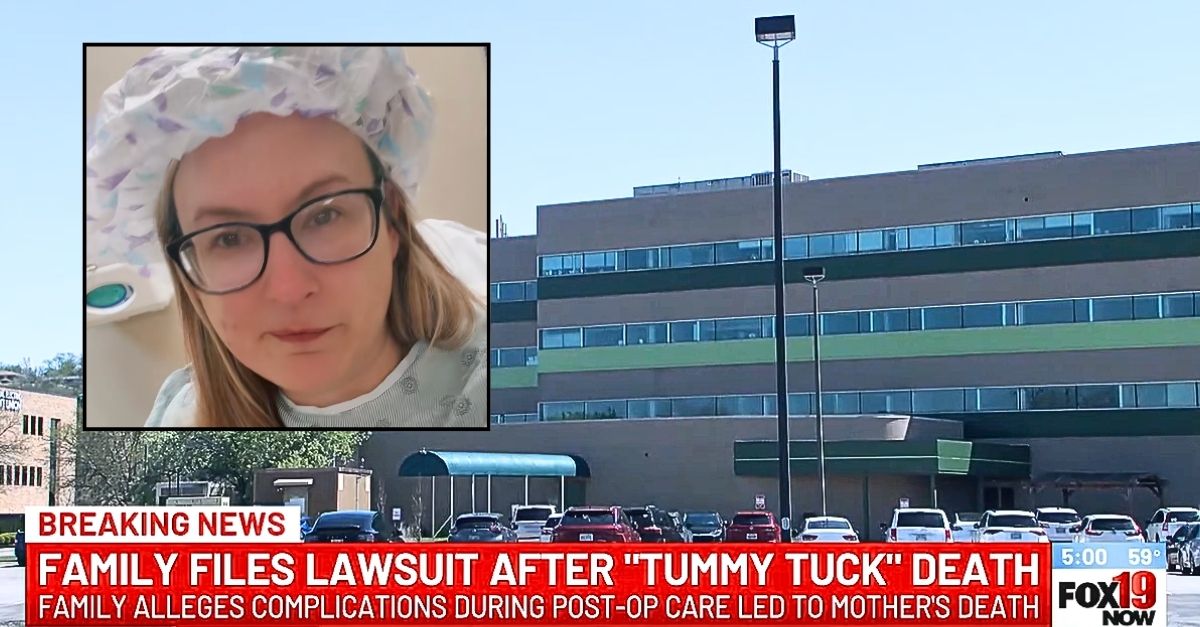
Inset: Rachel Tussey (TikTok). Background: The Ohio building where Rachel Tussey's surgery center is located, which her family says caused her to go into cardiac arrest after giving her too much pain medicine (WXIX/YouTube).
An Ohio mom of three documenting a wellness journey on TikTok that included getting a "tummy tuck" was killed by surgery staff members who pumped "excessive" amounts of fentanyl and Dilaudid into her too rapidly, a lawsuit says.
"I'm really looking forward to this next chapter," Rachel Tussey said in one of her final TikTok videos posted on Feb. 25 before going into surgery. "I'm in good hands," she told her more than 80,000 followers. "Let's do this."
Tussey's husband is suing the surgery center where the mom got her tummy tuck procedure, JourneyLite of Cincinnati, and its anesthesia partner, Associated Anesthesiologists of Springfield, for negligence and wrongful death. His attorneys allege that Tussey was the "victim of horrific medical malpractice" caused by the center's "complete and total failure to provide safe recovery and post-anesthesia care," according to their legal complaint.
"Following surgery, JourneyLite's unqualified post-anesthesia care unit nurse administered Rachel a lethal opioid overdose, which sent Rachel into cardiac and respiratory arrest and deprived her brain of oxygen," the complaint says. "The end result of this prolonged oxygen deprivation was catastrophic, irreparable brain damage that left Rachel in a coma from which she never recovered."
Tussey allegedly underwent an abdominoplasty — commonly known as a "tummy tuck" — liposuction, and an umbilical hernia repair on Feb. 25 at JourneyLite's Evandale surgery center. She was documenting her wellness journey on TikTok as a "mommy makeover."
In one of her final posts before undergoing anesthesia, Tussey expressed that she felt a range of emotions, "mostly excitement and gratitude," according to the complaint, while noting that she was looking forward to the next chapter of her wellness journey.
Her husband's lawyers say that following an "uncomplicated surgery," Tussey was administered "excessive doses of powerful opioid medications," including fentanyl and Dilaudid, during post-anesthesia recovery and was left without appropriate monitoring, staffing, and emergency response capabilities.
About 50 minutes after the surgery, Tussey's husband noticed that her "lips were blue and that she had stopped speaking," per the complaint. "Despite repeatedly calling Rachel's name and speaking loudly near her ear, Mr. Tussey received no response," the complaint recounts. "Rachel had become hypoxic and unresponsive, and that EMS had been called."
Tussey's doctor, who had left the surgery center, was notified of what was happening and asked staff whether Tussey had been administered anything prior to her "acute change" in condition, according to the complaint. A nurse allegedly advised that Tussey had been given "150 micrograms of fentanyl" post-operatively and "0.5 milligrams of Dilaudid" right after the doctor left the facility.
Tussey had received 100 micrograms of fentanyl and 0.5 milligrams of Dilaudid during the nine-hour duration of her surgery, according to the complaint.
"Rachel died because two JourneyLite post-anesthesia care unit nurses … administered 150 micrograms of fentanyl and 0.5 milligrams of Dilaudid within 30 minutes after surgery and failed to appropriately respond when Rachel coded," the complaint alleges. "The amount of fentanyl administered post-operatively exceeded the total amount of fentanyl Rachel received during the entirety of her nine‑hour surgery. In addition to the fentanyl, Rachel was also administered a total of 1 milligram of Dilaudid within a 37-minute time period."
The complaint says the "lethal combination" and amount of fentanyl and Dilaudid administered by the JourneyLite nursing staff caused Rachel to experience "significant opioid toxicity." After she coded, nurses allegedly failed to properly respond and "improperly used a bag mask" for ventilation, suffocating her.
The center's anesthesiologists were unable to provide lifesaving care and help after leaving for the day prior to the completion of Tussey's tummy tuck, according to the complaint. "They had abandoned their patient before the post-anesthesia case had concluded," the document says.
"When patients entrust their lives to a surgical facility, they trust the facility to protect their safety at every state of care and immediate emergency response if something goes wrong," attorney Bernard E. Layne, who is representing Tussey's husband, said in a statement. "The allegations in this case, which have been supported by the surgeon who performed Mrs. Tussey's procedures, alleges a profound breakdown of those basic responsibilities — and that those failures were compounded after the fact by altered and destroyed records," Layne charged.
In addition to medical negligence, the complaint alleges that negligent hiring, retention, and supervision led to Tussey's death. It also accuses the surgery center of spoliation of evidence, alleging that critical medical records and personnel files were altered or destroyed after JourneyLite was on notice that litigation was likely.
Tussey's husband is seeking compensatory and punitive damages, attorneys' fees, and other relief permitted under Ohio law.




Comments