
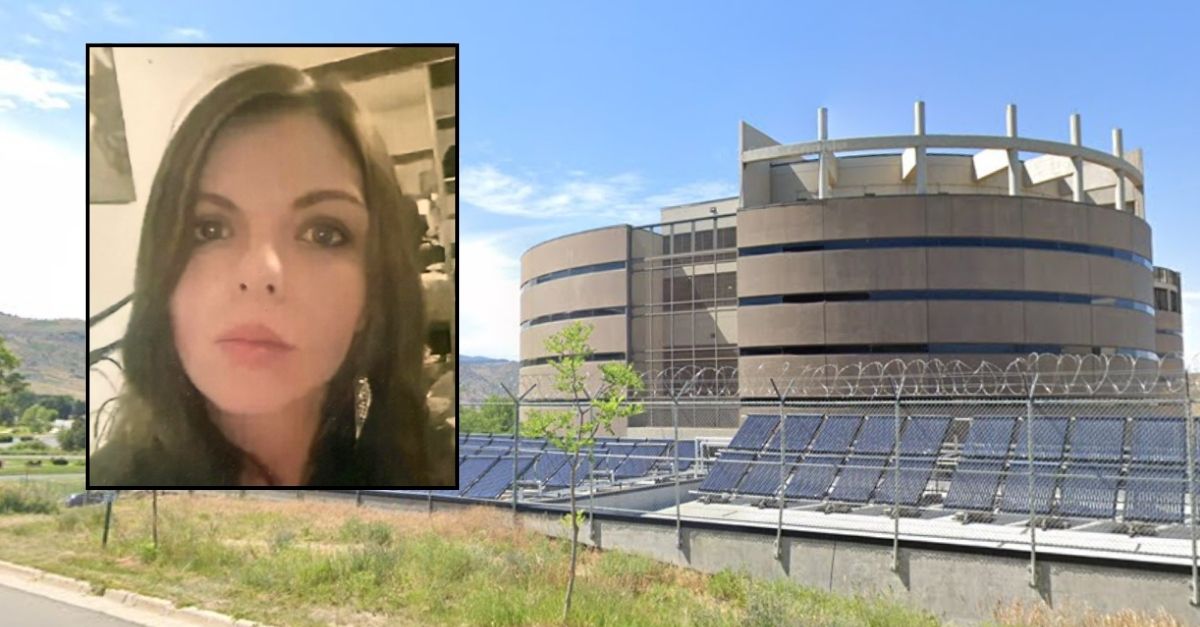
Inset: Courtney Tinker (Springsteen Law Firm). Background: The Jefferson County Detention Facility in Colorado where Courtney Tinker was jailed (Google Maps).
Colorado jail workers let a woman with lupus die "alone in her cell" after choosing to take her to a "lower level" medical clinic instead of a hospital and then locking her up on failure-to-appear warrants, her mother says in a newly filed lawsuit.
"Jefferson County deputies and VitalCore staff failed to provide adequate medical evaluation, appropriate monitoring, emergency escalation, or timely intervention," the legal complaint filed by Courtney Tinker's mother says. "With timely recognition, escalation, monitoring and treatment — Ms. Tinker's death could have been prevented," the complaint alleges.
Attorney Anita Springsteen, with the Colorado-based Springsteen Law Firm, tells Law&Crime that Tinker's death at the Jefferson County Detention Facility in 2024 was a direct result of the county and its contracted medical provider, VitalCore, looking at inmate medical care "in terms of dollars and cents, rather than what is required to keep people alive and healthy."
Instead of taking Tinker to an "appropriate Level One hospital" for medical clearance — like St. Anthony's Hospital in Lakewood "right by the jail" — deputies chose to bring her to a "lower level clinic that was more like an urgent care" that could not provide adequate services for the serious symptoms Tinker displayed, Springsteen charges in the complaint.
According to the Jefferson County Sheriff's Office, deputies were dispatched to perform a welfare check on Tinker after she was found "slumped over the wheel" of her vehicle. When deputies arrived, Tinker allegedly told them that she "could not breathe" and also noted "chest pains and feeling weak," per First Judicial District Attorney Alexis King.
"Law enforcement noticed her hyperventilating," King wrote in a September 2024 decision letter announcing that there was no evidence of criminal conduct related to Tinker's death.
The legal complaint filed by Tinker's mother says she was "fatigued" and experiencing serious symptoms related to her history of lupus. "These symptoms described and observed demonstrated an objectively serious medical need," the complaint says.
Deputies took the Colorado woman to HealthONE Southwest ER, which describes itself as a "full-service, 24-hour freestanding emergency room" that is an "extension of HCA HealthONE Swedish," which is a hospital. The legal complaint says the facility "failed to provide adequate diagnosis, stabilization, treatment, treatment instructions sufficient for custodial staff to protect her, or a level of care appropriate to her symptoms and serious medical needs."
According to the complaint, HealthONE "negligently, and upon information and belief with pressure from law enforcement, 'cleared' Ms. Tinker so she could be transported to JCDF for booking" after deputies ran her information and discovered she had multiple failure-to-appear warrants for theft, possession of a controlled substance, damage to property, and motor vehicle theft.
"HealthONE did not properly consider a cardiovascular event or a cardiovascular consequence of Ms. Tinker's Lupus when making the decision to release her — knowing the level of care at JCDF would be insufficient for a cardiac event or a complex set of symptoms from lupus," the complaint says.
Tinker informed deputies that she had a past medical history of lupus, which is an autoimmune disease characterized by systemic inflammation that damages skin, joints, heart, lungs, and kidneys. "Fatigue is often the first sign of a flare of Lupus, which Ms. Tinker was complaining of," the complaint says.
Tinker's chest pain and shortness of breath that she reported "likely meant" that she was "experiencing a flare that was attacking her heart, lung tissue, or vascular system (Raynaud's Syndrome)," according to the court document.
"Upon information and belief, the medical examination at HealthONE did not include adequate blood work measuring immunity markers for lupus and/or a lupus flare or urine samples," the complaint alleges. "Ms. Tinker was experiencing symptoms that should have been taken seriously by both HealthONE and JCDF — but instead were ignored."
Tinker was jailed on March 25, 2024. Two days later, she allegedly told a jail deputy that she was not feeling well. "On March 28, 2024, at the beginning of her shift, the same jail deputy observed vomit in Ms. Tinker's cell, and that Ms. Tinker's appearance was worse than the day before," the complaint recounts. "The jail deputy did nothing to report this."
Multiple deputies allegedly encountered Tinker during their shifts and "observed or were informed of her worsening condition," per the complaint. They had the authority to "summon medical help, initiate emergency response, notify supervisors, request transport and increase observation" but failed to do so.
"On the morning of March 29, 2024, at approximately 5:30 a.m., Ms. Tinker did not wake up or respond when the original deputy called her over the intercom regarding breakfast," the complaint says. "The deputy walked to Ms. Tinker's cell door to try and wake her up, but she was unresponsive."
Tinker was allegedly found lying on her mat, with her eyes open, fixed and staring at the ceiling, and her mouth agape. She was not breathing, according to the complaint.
A deputy allegedly called out Tinker's name and tried to wake her up with a sternum rub that had no effect. "Only then did the deputy call for a medical emergency on her radio and start CPR," the complaint says.
Tinker was allegedly picked up, moved off her bunk, and carried to the dayroom area, where she was laid on the floor on her back. The deputies administered CPR to her while waiting for EMS to arrive.
"All lifesaving measures were unsuccessful," the complaint says.
Tinker was pronounced dead on the morning of March 29, 2024, at St. Anthony's Hospital. An autopsy determined the manner of death as being natural and cause of death being due to hypertensive cardiovascular disease.
"[The forensic pathologist] stated that chronic obstructive pulmonary disease, systemic lupus erythematosus, chronic alcoholism, and COVID-19 viral infection were significant contributing factors," according to DA King.
"She stated that Ms. Tinker's long-term history of prescription drug abuse (opioids) and presumed high tolerance was considered in the interpretation of the toxicology results," King said in her decision letter. "She stated that there was no evidence of significant acute/recent trauma at the autopsy. It was noted that the toxicology portion of the autopsy report listed traces of fentanyl[.]"
According to King, Tinker did not share any recent use of fentanyl and told deputies that she last used the drug six months before she was jailed. "Given the facts … Ms. Tinker's death was not caused by any criminal actions taken by law enforcement," King concluded.
Tinker's mother and her attorney, however, insist that "systemic deficiencies in jail medical and custody practices, including but not limited to inadequate training regarding serious medical symptoms, inadequate communication between deputies and medical staff, inadequate escalation procedures, and inadequate monitoring of detainees with known acute medical complaints" are ultimately to blame.
Since December 2023, at least three families have alleged that their loved ones did not receive proper care while locked up at the Jefferson County Detention Facility. One of the families, whose loved one Ashley Raisbeck died behind bars, is being represented by Springsteen, who refers to the Jefferson County jail as a "House of Horrors."
The attorney tells Law&Crime, "After personally spending nearly three years investigating the lack of medical care in Jeffco like that experienced by Courtney Tinker and Ashley Raisbeck — who died unnecessarily, alone, and in extreme pain within months of each other — it is my personal mission to expose the lack of humanity and deliberate indifference that I believe goes on there on a daily basis."
The county did not respond to Law&Crime's requests for comment on Wednesday. A sheriff's spokesperson told Law&Crime that the department does not comment on pending litigation.






Comments