
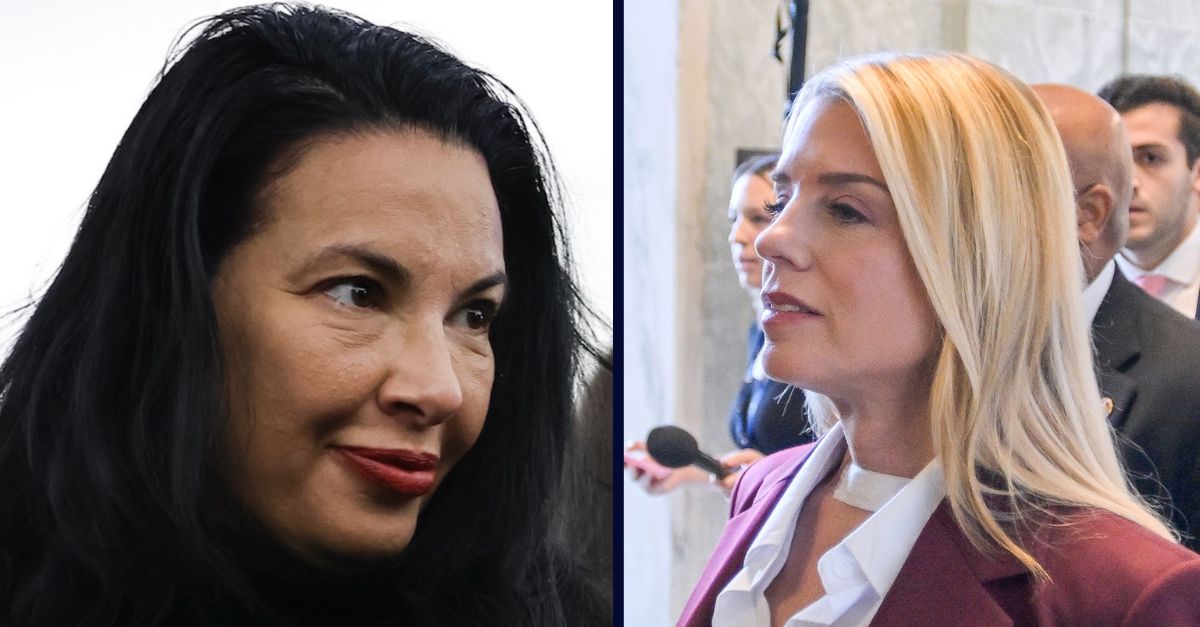
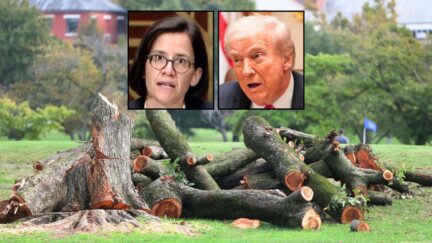
Left: Sigal Chattah, left, attorney representing Guard the Constitution Project founder Shawn Meehan, and Monti Levy, right, attorney representing Nevada Republican Party delegate Eileen Rice, appear in court in Las Vegas Monday, March 4, 2024. (Wade Vandervort/Las Vegas Sun via AP). Right: Former Attorney General Pam Bondi, center, arrives for her deposition at the Rayburn House Office Building on Capitol Hill, Friday, May 29, 2026, in Washington (AP Photo/Rod Lamkey, Jr.).
Yet another one of ex-U.S. Attorney General Pam Bondi's lingering "acting" U.S. attorneys was barred from supervising her challengers' prosecutions on Monday, as an appellate court found the Trump administration's "tactics" and "maneuvers" to keep Sigal Chattah in place remain unlawful.
The 9th U.S. Circuit Court of Appeals decision, unanimously observing that Chattah is "not lawfully serving" as acting U.S. Attorney in Nevada under the Federal Vacancies Reform Act, joined the ranks of numerous courts across the country in rejecting the Trump administration's sidestepping of the U.S. Senate's advice and consent role.
Rather than going through that constitutional process to fill these top federal prosecutorial positions on a permanent basis, the DOJ has time and again tried to transform loyalist interim U.S. attorneys facing expiration of their 120-day stints into acting U.S. attorneys with several more months on the job — in some cases by firing their court-appointed replacements in a time of vacancy.
U.S. Circuit Judge Eric Miller, a Donald Trump appointee, was clear that the DOJ "cannot" make Chattah the acting U.S. attorney just by firing the first assistant U.S. attorney — or second-in-command — who was in place.
"The maneuvers used to extend Chattah's time atop the U.S. Attorney's Office are not unique to the District of Nevada. The Attorney General has employed similar—though not always identical—tactics to extend the service of other temporary appointees who have not been confirmed by the Senate. The district court's reasoning was consistent with that of the other courts to consider those tactics, every one of which has concluded that they violate the limits imposed by the FVRA," the opinion said.
The panel cited decisions that cut against the temporary U.S. attorney appointments of Alina Habba in New Jersey, Bilal Essayli in California, Lindsey Halligan in the Eastern District of Virginia, John Sarcone in the Northern District of New York, and Ryan Ellison in New Mexico.
Miller was joined in the decision by Senior U.S. District Judge Sidney Thomas, a Bill Clinton appointee, and U.S. District Judge Stanley Blumenfeld, Jr., a Trump appointee sitting on the three-judge appellate panel by designation.
The panel upheld Senior U.S. District Judge David Campbell's ruling from October, which sided with criminal defendants Giann Icob Salazar Del Real, Devonte Devon Jackson, and Jorge Enriquez, Jr. in holding — without dismissing indictments — that their prosecutor had to be disqualified.
Campbell, a George W. Bush appointee in Arizona, said the FVRA was enacted by Congress "precisely" to prevent a scenario where a president and attorney general might attempt to backfill anyone into a top prosecutor role.
"The Court will disqualify Ms. Chattah from participating in or supervising Defendants' prosecutions," Campbell said.
The 9th Circuit, referring to Chattah as the "putative Acting United States Attorney," affirmed the disqualification order and gave "no weight" to the DOJ's reliance on an Office of Legal Counsel opinion from 2001.
Although the OLC concluded "first assistants may be elevated at any point after the vacancy arises," the court said, the opinion was "inconsistent with earlier executive interpretations of the [FVRA] statute, and it relies on reasoning that has since been rejected."
Chattah earlier defended her appointment as "not unconstitutional" and "not done in a nefarious manner," according to local CBS affiliate KLAS.
"You know, a lot of these people, I know that they're scared because I know where a lot of the bodies are buried because I come from the defense world," she said.
Follow Law&Crime:


Comments