
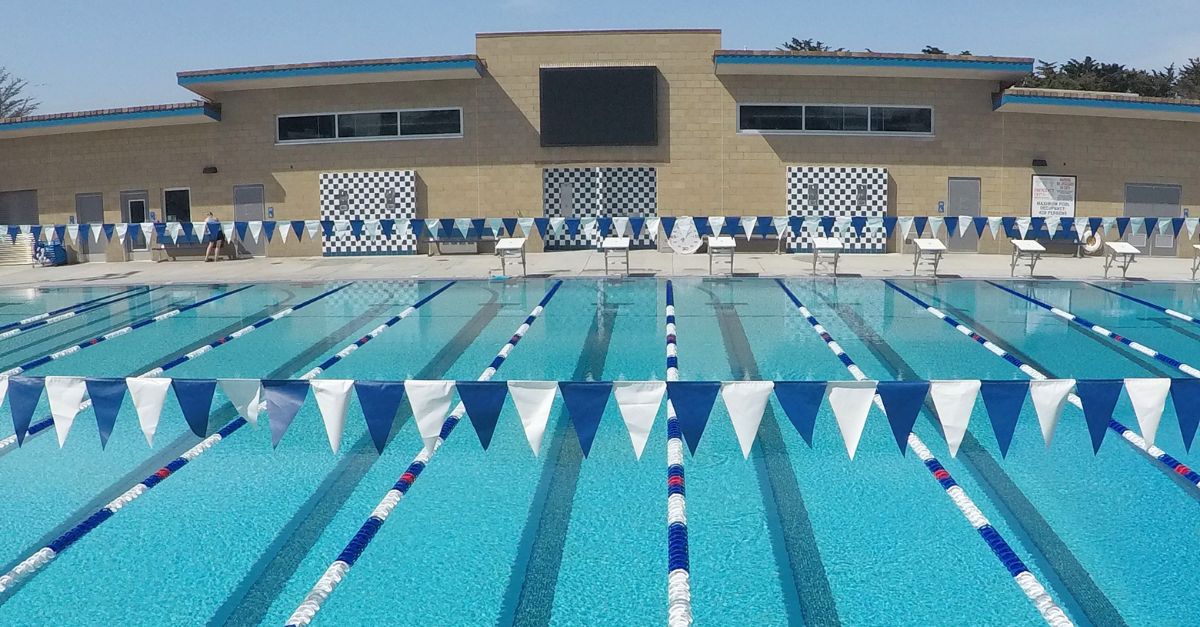
The pool at Morro Bay High School in California that was being constructed when teacher Judith Van Fleet was allegedly exposed to "toxic fumes and dust" (City of Morro Bay).
A California teacher allegedly suffered years of devastating respiratory and cognitive problems — and died — after being exposed to "toxic fumes and dust" during the construction of a school pool, a lawsuit says.
Judith Van Fleet, a 74-year-old math teacher at Morro Bay High School, died in 2024 after becoming "immobile, bedbound, incontinent, unable to speak" and requiring 24-hour care as a result of the exposure, her husband alleges in a civil complaint filed in San Luis Obispo County.
Van Fleet's husband is suing Nadar Inc. — the local contractor responsible for building the Morro Bay Aquatic Center — alleging that it failed to follow required air-quality safeguards "to prevent exposure to hazardous dust and emissions," according to the complaint.
"The design and implementation of the project failed to incorporate feasible safety measures, such as scheduling construction outside of school sessions, providing effective barriers, or ensuring compliance with air quality mitigation requirements, rendering the project unreasonably dangerous to persons on campus," the complaint says. "As a direct and proximate result of the defective and dangerous design and execution of the project, decedent suffered severe injury and death."
Van Fleet was a math teacher at the school when excavation began in August 2016 immediately next to her classroom, according to the complaint. Environmental documents and air-quality officials had raised concerns about construction emissions and dust affecting students and recommended that work be performed when school was not in session.
The project was approved by the city of Morro Bay on the basis that its Air Pollution Control District's mitigation measures were adopted into the project plan and that defendants would comply, per the complaint.
"Despite the adopted APCD mitigation measures strongly recommending against undergoing excavation and construction activities generating dust and emissions while school was in session, defendants began excavation and construction activities, which generated dust and emissions while school was in session in August and September 2016," the complaint says.
Workers used "heavy diesel-powered equipment" that allegedly generated "significant amounts of dust and diesel emissions," which seeped into Van Fleet's classroom even when the windows were closed.
"On or about August 19, 2016, through September 13, 2016, decedent was exposed to dust, fumes, and diesel emissions in her classroom for those 17 to 18 workdays," the complaint says. "Shortly after the excavation phase of the project commenced, decedent developed immediate symptoms of excessive dust and diesel emissions exposure including cough, wheezing, difficulty breathing, sinus congestion, headache, hoarse voice, weakness, memory loss and cognitive decline."
Van Fleet sought "urgent medical care" for breathing difficulties on Sept. 11, 2016, and returned to school the next day. She allegedly struggled to remember students' names and follow her lesson plan, according to the complaint. Her condition allegedly continued to deteriorate and she was eventually diagnosed with occupational asthma and other respiratory conditions, as well as a persistent cognitive disorder.
The complaint states that neuropsychological testing later documented severe deficits in memory, language, concentration, processing speed and other areas.
By June 2024, Van Fleet was immobile and dependent on 24-hour care. She died two months later, on Aug. 12, 2024.
"The death certificate and medical records indicate that decedent suffered from an anoxic brain injury and resultant encephalopathy, with severe, progressive, and permanent cognitive impairment," the complaint says.
A neurologist allegedly concluded in 2026 that Van Fleet's "severe progressive neurocognitive disorder" was a major contributing factor in her death and attributed her neurocognitive impairment to toxic fumes and dust exposure at work during the 2016 construction period.
Van Fleet's husband is suing for negligence and wrongful death, strict liability for failure to warn and design defect, loss of consortium and survival damages. The complaint also seeks punitive damages, alleging the defendants acted with "willful and conscious disregard" for Van Fleet's safety.
"Defendants are liable to plaintiff for punitive damages based upon their willful and conscious disregard of the rights and safety of decedent, in that defendants proceeded with excavation and use of heavy equipment which generated hazardous dust and diesel emissions immediately adjacent to occupied classrooms during the school year despite knowledge that such construction activities would expose students and staff to dangerous emissions and fugitive dust," the complaint concludes. "Defendants' conduct, as described above, was intentional, willful, wanton, reckless, malicious, oppressive, extreme, and outrageous, and displayed an entire want of care and a conscious and depraved indifference to the consequences of its conduct, including to the health, safety, and welfare of decedent."
Nadar Inc. told the San Luis Obispo Tribune last week that it had not been served and could not comment. San Luis Coastal School District Assistant Superintendent of Business Services Ryan Pinkerton told the local newspaper that Nadar was contracted for the two-year construction period.
"When an employee feels that they are injured at work, they go through the state mandated workers' compensation system that is highly regulated," Pinkerton said in a statement.






Comments