
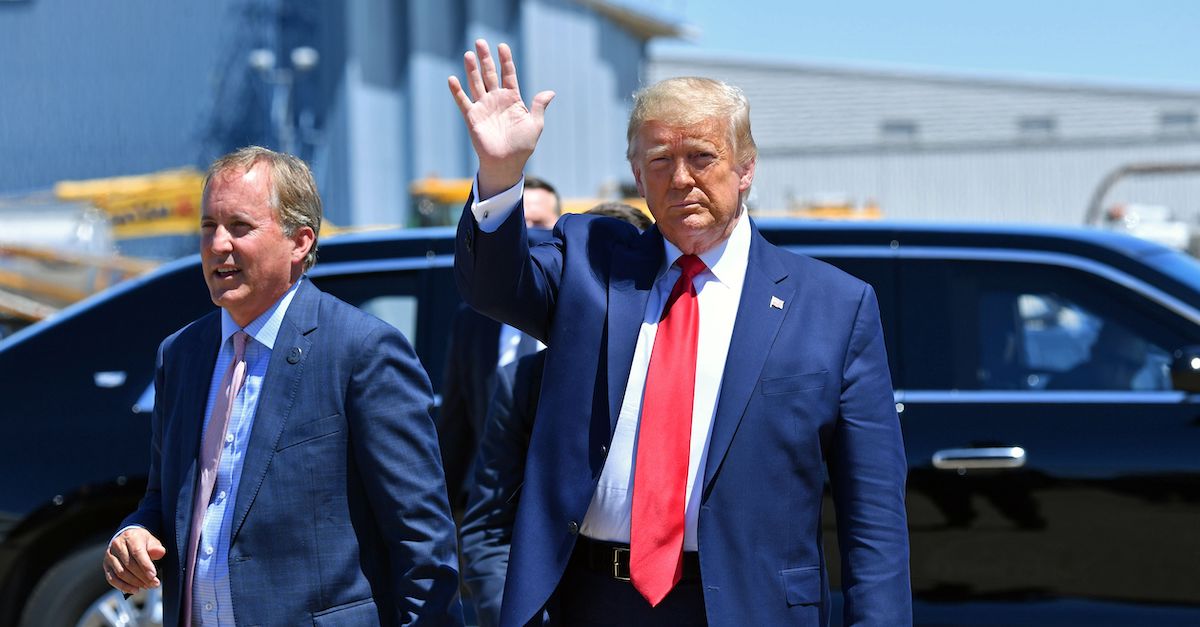
Texas Attorney General Ken Paxton, seen here with President Trump in June 2021 in Dallas, Tex. (Nicholas Kamm; AFP via Getty Images).
The Trump administration is trying to force through a "collusive" settlement with Texas to stop immigration judges from closing certain kinds of cases, a recent federal court filing argues.
The underlying case was brought by Texas Attorney General Ken Paxton on June 22 — and settled with haste on the exact same day.
The 43-page complaint challenges the Executive Office for Immigration Review (EOIR), a subagency within the U.S. Department of Justice, over an internal rule that allows immigration judges to remove deportation cases from their dockets under a process called "administrative closure." The rule went into effect in September 2023.
Now, in a 34-page emergency motion to intervene, several states say the all-but-immediate resolution of the lawsuit should be reversed.
"Texas did not even have to serve its lawsuit—and did not request any summonses with their complaint, or file an executed waiver of service; DOJ was ready and waiting," the motion reads. "Hours later, the Parties filed a Joint Motion for Consent Judgment asking the Court to declare the Final Rule unlawful and vacate it, and to permanently enjoin Defendants and their officers both from enforcing the Rule and from promulgating similar regulations in the future."
The would-be intervenors are the cities of Baltimore, Columbus, and New Haven, as well as Oakland, California-based legal services provider Centro Legal de la Raza.
To hear the intervenors tell it, the timing is more than suspicious. Rather, they say, the Trump administration and Texas worked together to bypass the usual method for rescinding an administrative rule.
The usual method would be rescission under "the scrutiny of the notice-and-comment process" of the Administrative Procedure Act (APA), the filing says. Instead, the Trump administration embraced "rulemaking-by-collusive-acquiescence," the motion claims.
"Texas challenged the Final Rule and the United States immediately conceded—flouting longstanding Department of Justice norms and forgoing available arguments that the United States routinely raises when confronted with similar challenges to federal regulations," the motion goes on. "Denied the benefit of adversarial presentation, this Court entered a consent judgment on the same day suit was filed."
One chapter heading makes the allegation plain: "The Parties Reached a Collusive Settlement."
The intervention motion argues there are several problems here – with both the approach and the outcome endorsed by U.S. District Judge Reed Charles O'Connor, a George W. Bush appointee.
At the heart of the matter, they say the court simply lacks jurisdiction because there was not a "genuine" case or controversy.
"A true case or controversy requires parties with adverse legal interests who pursue 'an honest and actual antagonistic assertion of rights' against each other," the motion argues. "When 'both litigants desire precisely the same result,' there is no case or controversy."
To support this argument, the potential intervenors note that Trump's own head of the EOIR "issued a policy memorandum criticizing" the administrative closure rule in April 2025.
The behavior of the parties after that announcement essentially proves the lack of adversity, the motion to intervene claims.
The motion elaborates:
Even before the inception of this suit, the parties have not only agreed on all the relevant legal questions regarding the legality of the Final Rule, but they have both affirmatively sought precisely the same relief: a judgment declaring the Final Rule unlawful and vacating the Rule. That the parties jointly moved for this relief on the same day the suit was filed underscores its "friendly" nature. Indeed, the federal government all but invited this suit by issuing a public memorandum stating conclusively that it would not defend the Final Rule if it were challenged…
"When Texas predictably took up that invitation, the parties had no divergent interests whatsoever," the motion continues. "DOJ's failure to vigorously press arguments it would ordinarily make when defending a federal rule illustrates the absence of a genuine case or controversy."
Dovetailing with the jurisdictional argument, the municipalities and law firm say the APA demands more of the government here.
"Under the APA, a federal regulation adopted through notice-and-comment rulemaking can be rescinded only through notice-and-comment rulemaking," the motion states. "The consent judgment's form as a court order does not place it beyond that requirement."
The filing also points out that the Immigration and Nationality Act (INA) "does not prohibit administrative closure" and notes that EOIR's rule was actually just a formalization of a process used for decades.
"Texas is incorrect in arguing that administrative closure is generally unavailable as a matter of law," the motion continues. "The INA affirmatively delegates the docket-management authority the Final Rule regularizes…In fact, [immigration judges] and the [Bureau of Immigration Affairs] have employed administrative closure as a device to promote efficiency and reduce docket congestion since at least the 1980s."





Comments