
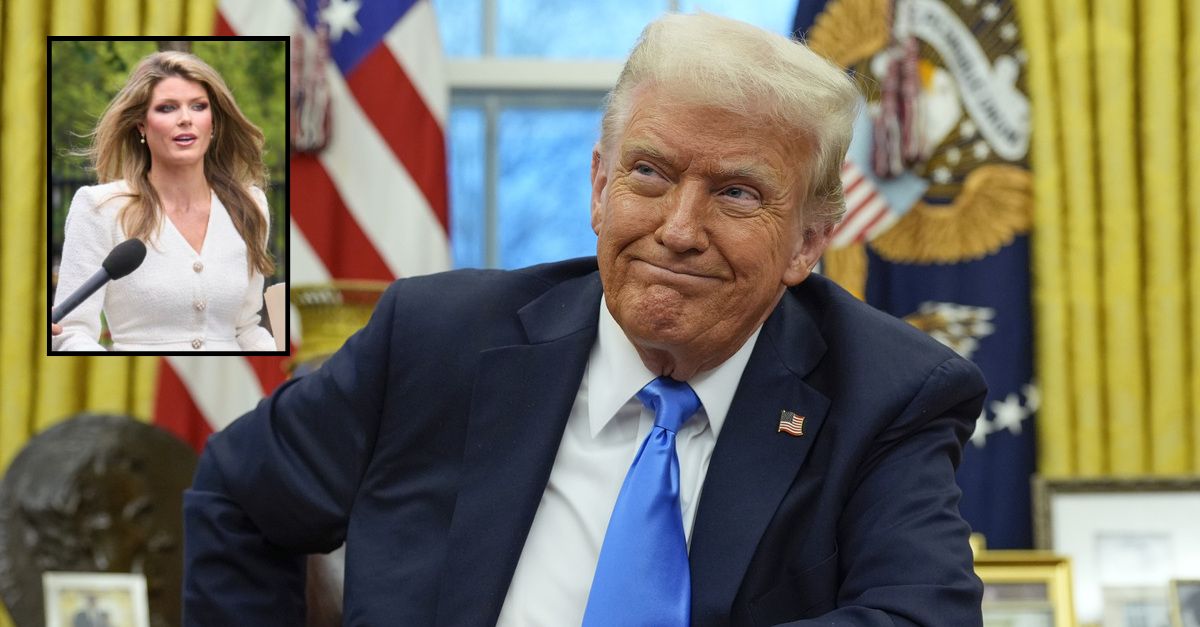
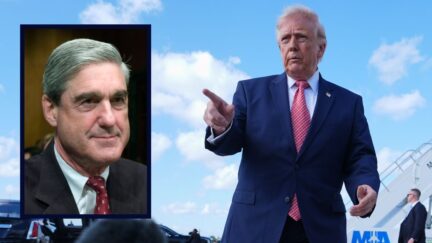
Inset: Lindsey Halligan, special assistant to the president, speaks with a reporter outside of the White House, Wednesday, Aug. 20, 2025, in Washington. (AP Photo/Jacquelyn Martin). Background: President Donald Trump speaks with reporters in the Oval Office at the White House, Tuesday, Feb. 11, 2025, in Washington, D.C. (Photo/Alex Brandon).
A federal judge in Virginia would like the Trump administration to explain itself for its choice of prosecutor in an ongoing criminal case.
For now, at least, Lindsey Halligan, a private citizen, is listed on the relevant indictment as "United States Attorney & Special Attorney."
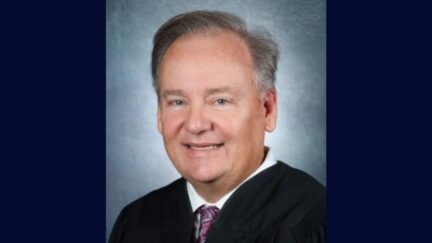
On Tuesday, U.S. District Judge David J. Novak, who was appointed by President Donald Trump, instructed Halligan to file a pleading addressing this apparent nomenclature mishap.
The three-page order directing a government filing is the latest chapter in the ongoing dispute over whether Halligan has any prosecutorial power whatsoever. Novak seems to think she does not.
And, notably, the judge himself raised the issue.
"This matter comes before the Court on its own initiative," the order reads. "The Court has reviewed the Indictment in this matter, which was returned by the grand jury on December 2, 2025, and observes that Ms. Halligan identified herself therein as the United States Attorney for this District. Ms. Halligan did so despite a binding Court Order entered by Senior United States District Judge Cameron McGowan Currie on November 24, 2025, in which Judge Currie found that the 'appointment of Ms. Halligan as Interim U.S. Attorney violated [federal law] and the Appointments Clause of the U.S. Constitution.'"
In late November of last year, Currie found Halligan was a "private citizen" who was never validly appointed to serve as Interim U.S. Attorney for the Eastern District of Virginia. The upshot for the prosecutions of New York Attorney General Letitia James and former FBI director James Comey was clear and explicit: Halligan's participation fatally nixed each of those high-profile indictments.
Less clear, however, was what the invalid appointment meant for nearly three dozen cases in which Halligan's name appeared as "U.S. Attorney" on federal criminal and civil charging documents. The subject matter of those cases runs the gamut to include allegations of fraud, conspiracy, theft, vehicle and traffic offenses.
At least one legal expert told Law&Crime it was incumbent on defense attorneys to raise the issues for their clients in those cases.
Now, a court is asking a related question: Why is Halligan continuing to sign her name with the defunct title on such documents?
Law&Crime has confirmed that Halligan's name appears on at least one other government filing in the present case – which is a rather run-of-the-mill case about a "carjacking and attempted bank robbery that occurred in the City of Richmond on September 13, 2025."
Surprising no one, the DOJ filed an appeal of Halligan's invalidation, but, as Novak noted, the invalidation order still stands.
"While the United States of America has appealed Judge Currie's Opinion and Order, no stay has been issued in conjunction with that appeal," the Tuesday order continues. "Consequently, it remains the binding precedent in this district and is not subject to being ignored."
Now, Halligan has seven days to explain "the basis" for her "identification of herself as the United States Attorney, notwithstanding Judge Currie's contrary ruling," according to the court.
The judge, for his part, seems somewhat inclined to resolve the matter by simply removing Halligan's name from the charging document – but will give her a chance to keep her name there.
"She shall also set forth the reasons why this Court should not strike Ms. Halligan's identification of herself as United States Attorney from the indictment in this matter," the order goes on.
Novak, perhaps most seriously, spends considerable time — almost an entire page out of the relatively terse order — citing authorities that say lawyers should not make false statements and that such statements can be punished by courts as violations of ethical rules.
"Ms. Halligan shall further explain why her identification does not constitute a false or misleading statement," the order continues.
To be clear, in the indictment in question, Halligan's name and incorrect title appear in the typed-out signature block area — she does not appear to have physically signed the charging document.
But, for her response due next week, the court wants Halligan to actually use a pen and ink.
"The Government's pleading shall be signed by Ms. Halligan," the order concludes.

Comments