
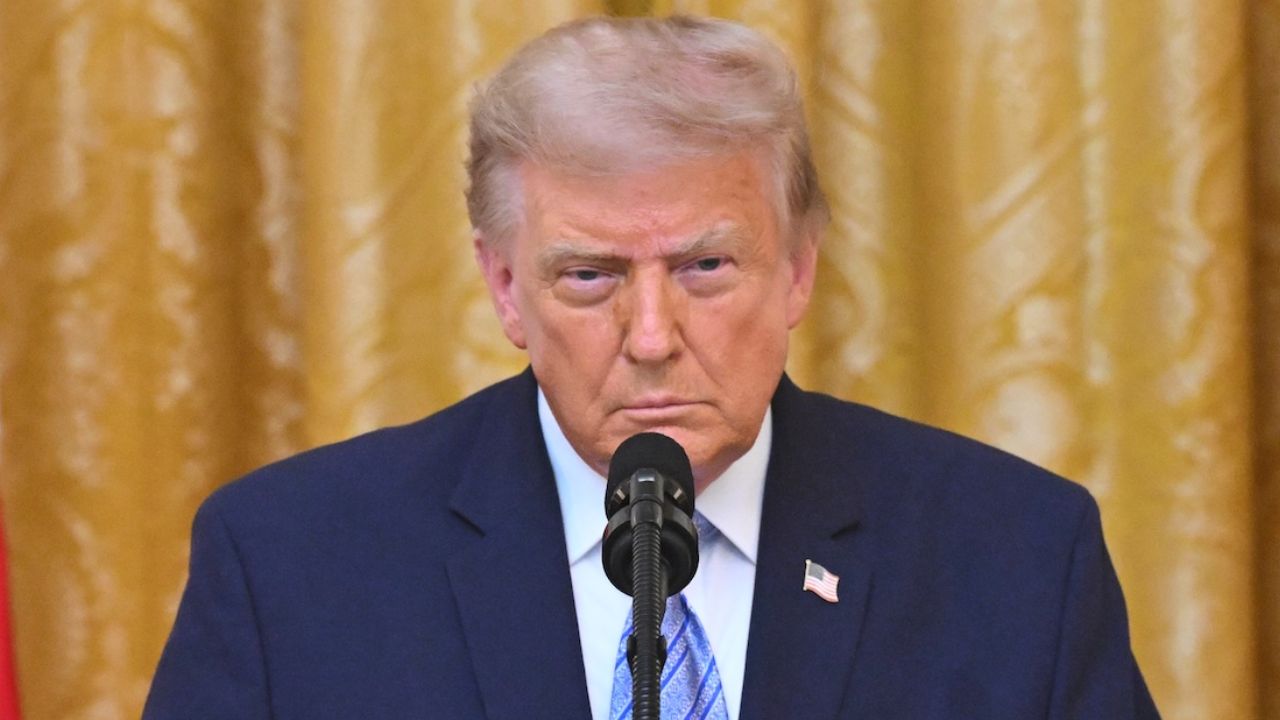
President Donald Trump speaks in the East Room of the White House, July 16, 2026, in Washington, D.C. (Saul Loeb/Pool via AP, File).
A federal judge has categorically rejected a request by the Trump administration to disqualify the law firm of Susman Godfrey in a high-profile case over the government's targeting of law firms.
In the underlying case, the American Bar Association (ABA) sued over President Donald Trump's series of executive orders that "used the vast powers of the Executive Branch to coerce lawyers and law firms to abandon clients, causes, and policy positions the President does not like," according to the 93-page complaint filed in June 2025.
The court, in a six-page order, described the lawsuit in terms that might offer a clue as to the overall trajectory of the case.
"The ABA's complaint details a 14-week period leading up to this suit in which the government launched and executed a coordinated campaign to intimidate and punish law firms and their lawyers based on their speech," U.S. District Judge Amir Ali, a Joe Biden appointee, wrote.
In those executive orders, the 45th and 47th president attempted to impose "virtually identical sanctions on law firms and their lawyers," resulting in several law firms making concessions to the government to avoid such sanctions. Others, however, sued for relief.
"Susman Godfrey was one of the law firms targeted for sanctions by an executive order, and it obtained a permanent injunction against that order," the judge notes. "Susman Godfrey later filed this suit as counsel for the ABA. Because one of the executive orders targeted Susman Godfrey, some of the discovery in this case has sought information related to that order."
In July, the DOJ moved to disqualify Susman Godfrey on the basis that the law firm was violating legal ethics rules in D.C.
Now, the court has said the government's effort "is not persuasive for a few reasons."
To hear the government tell it, the situation was "the textbook case where the rules of professional conduct prohibit…a lawyer from serving as both advocate and witness."
In other words, the DOJ claimed the operative ethical rule restricts Susman Godfrey's representation because an attorney in the firm might be called as a witness.
The judge said there was no indication of that being the case.
"Here, the government does not identify any lawyer at Susman Godfrey who is likely to be a necessary witness at trial," the order goes on. "To the contrary, the government concedes it cannot identify any lawyer who fits that description."
Ali, for his part, was unwilling to interpolate just because the law firm itself was previously targeted by Trump and won in court.
"That the ABA's discovery requests include inquiries about an executive order that targeted Susman Godfrey does not establish that any Susman Godfrey lawyer is 'likely to be a necessary witness,'" the order continues. "Indeed, the government does not explain which party is likely to call a Susman Godfrey lawyer as a witness or what subject that lawyer would testify about, let alone that the lawyer's testimony would be necessary to a contested issue in the case."
The court notes that the government's main argument was that Susman Godfrey is a "central player" and "essential actor" in the underlying litigation. This, the DOJ argued, means the ABA's discovery request into the government's executive order targeting Susman Godfrey "effectively concedes [the law firm's] attorneys are material fact witnesses."
Here, the court found another reason to reject the Trump administration's "unpersuasive" disqualification bid.
From the order, at length:
Rule 3.7(a) restricts representation by individual lawyers, not by their law firms. So even if the ABA identified a Susman Godfrey lawyer who was likely to be a necessary witness, the rule, by its text, would not disqualify the rest of the firm. And the comments to the rule make clear "there is no general rule of imputed disqualification applicable to Rule 3.7." In fact, Rule 3.7 specifically says that a lawyer's disqualification under Rule 3.7(a) is imputed to another lawyer at their firm only "if the other lawyer would be precluded from acting as advocate in the trial by [other rules]."
"The court finds the lawyers representing the ABA in this case are not likely to be necessary witnesses," the order goes on. "Indeed, based on the record before the court, none were even involved in representing Susman Godfrey in its challenge to the executive order targeting the firm."
The court's order is likely to clear the path toward resolving a long-simmering discovery dispute between the DOJ and the ABA.
The judge took note of that dispute in the order.
"That the ABA seeks discovery about communications related to Susman Godfrey does not indicate the lawyers representing the ABA here, who may not have even been involved in the communications, are likely to be necessary witnesses," Ali wrote.


Comments