
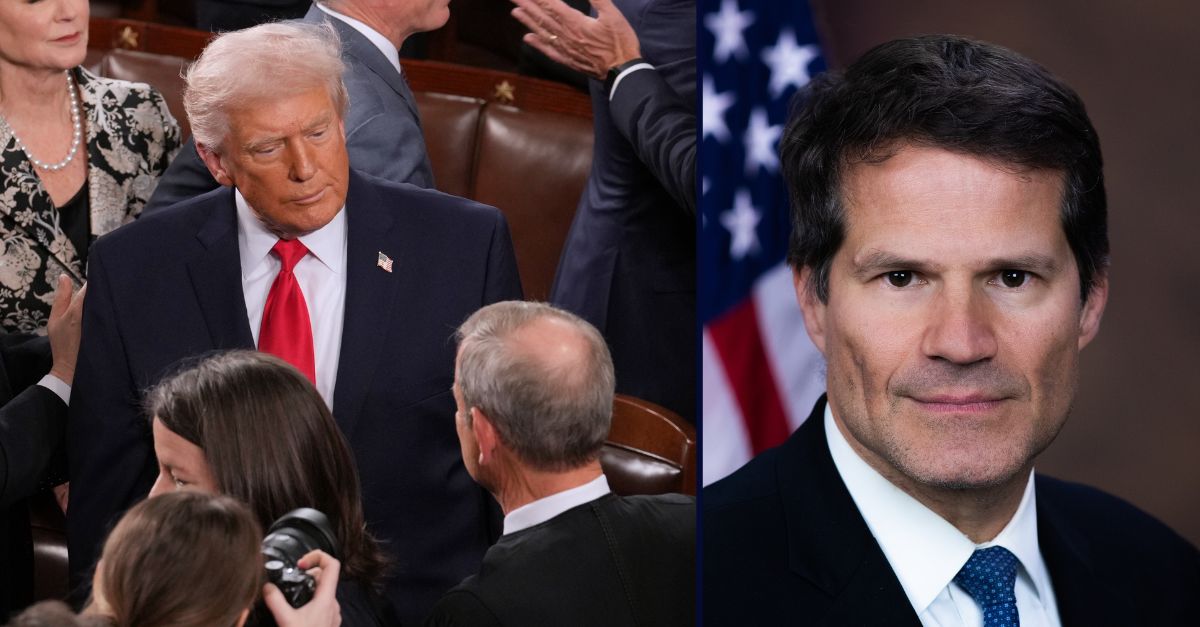
Left: President Donald Trump is greeted by Supreme Court Chief Justice John Roberts as he arrives on the House floor to give his State of the Union address to a joint session of Congress, at the Capitol in Washington, Tuesday, Feb. 24, 2026. (AP Photo/J. Scott Applewhite). Right: U.S. Solicitor General D. John Sauer (DOJ).
With the commander in chief in attendance, a former attorney for President Donald Trump turned high-ranking DOJ official was briefly taken aback Wednesday when the chief justice of the Supreme Court sharply parried his one-liner about a "new world" crying out to end birthright citizenship as we know it.
Early in arguments, U.S. Solicitor General D. John Sauer attempted to make the case before the majority conservative court that times have changed and, thus, a new reading of the law of the land is needed to support the Trump administration's immigration policy aims, as articulated in his executive order to protect the "meaning and value of American citizenship."
Under the citizenship clause of the 14th Amendment, "[a]ll persons born or naturalized in the United States and subject to the jurisdiction thereof, are citizens of the United States and of the State wherein they reside," other than the children of foreign diplomats, with few exceptions.
In Trump v. Barbara, the administration claimed that "near-automatic" birthright citizenship has led to multiple "problems," whether national security concerns or a "modern 'birth tourism'" industry, whereby "foreigners travel to the United States solely for the purpose of giving birth here and obtaining citizenship for their children." The president has referred to those children as "anchor babies."
Chief Justice John Roberts, while apparently not seeing it as relevant to deciding the legal question at hand, nonetheless thought it would be good to know how big of a problem "birth tourism" is in reality. He did not get that answer.
"Do you have any information about how common that it is or how significant a problem it is?" Roberts asked.
"No one knows for sure," Sauer answered, before referring to "media reports" and estimates of over a million examples from China alone, with hundreds of "birth tourism" companies, and some Russian elite "hot spots" in Miami.
WATCH: Chief Justice John Roberts asks the U.S. solicitor general about birth tourism:
D. John Sauer: "We're in a new world now … where 8 billion people are one plane ride away from having a child who's a U.S. citizen."
Roberts: "Well, it's a new world. It's the same… pic.twitter.com/G68qGH1YfA
— PBS News (@NewsHour) April 1, 2026
It was then that Sauer flirted with living constitutionalism, remarking, "But of course, we're in a new world now, as Justice Alito pointed out to you, where 8 billion people are one plane ride away from having a child as a U.S. citizen."
"Well, it's a new world, but it's the same Constitution," Roberts fired back.
Seemingly stung, Sauer had to pause a moment before he could respond with, "It is."
"And as Justice Scalia said, I think in the case that just Alito was referring to, you've got a constitutional provision that addresses certain evils, and it should be extended to reasonably comparable evils. You said that about statutory interpretation. I think the same principle applies here," the solicitor general finished his thought.
Sauer insisted, as he did in his brief, that the "children of aliens temporarily visiting the United States or of illegal aliens" cannot have birthright citizenship when their parents lack "a permanent domicile." That, the solicitor general said, is a far cry from granting citizenship to "freed slaves and their children" after the Civil War.
Later on, when Justice Brett Kavanaugh was questioning ACLU attorney Cecillia Wang, he said the whole ballgame boiled down to whether the court said her reading of precedent was the right one. The ACLU's brief emphasized that the 1898 case of United States v. Wong Kim Ark "correctly interpreted" the citizenship clause to "include children of foreign nationals without regard to parental domicile."
Wong, the son of Chinese immigrants with "permanent domicil and residence," was barred from reentering the U.S. under the Chinese Exclusion Act despite having been born here. Ultimately, the Supreme Court affirmed that Wong was an American citizen, under the 14th Amendment.
While it was unclear which way Kavanaugh was leaning, he was already envisioning how the case might end in the ACLU's favor, to the attorney's apparent delight.
"I think Mr. Sauer acknowledged, and you mentioned this in your opening, that if we agree with you on how to read Wong Kim Ark, then you win," Kavanaugh said. "That could be just a short opinion, right, that says 'the better reading is respondents' reading, the government doesn't ask us to overrule, affirmed'?"
"Yes," Wang quickly replied, to audible laughter in the courtroom.
That joyful sentiment was not shared by the president.
"We are the only Country in the World STUPID enough to allow 'Birthright' Citizenship!" Trump posted.
Follow Law&Crime:


Comments