
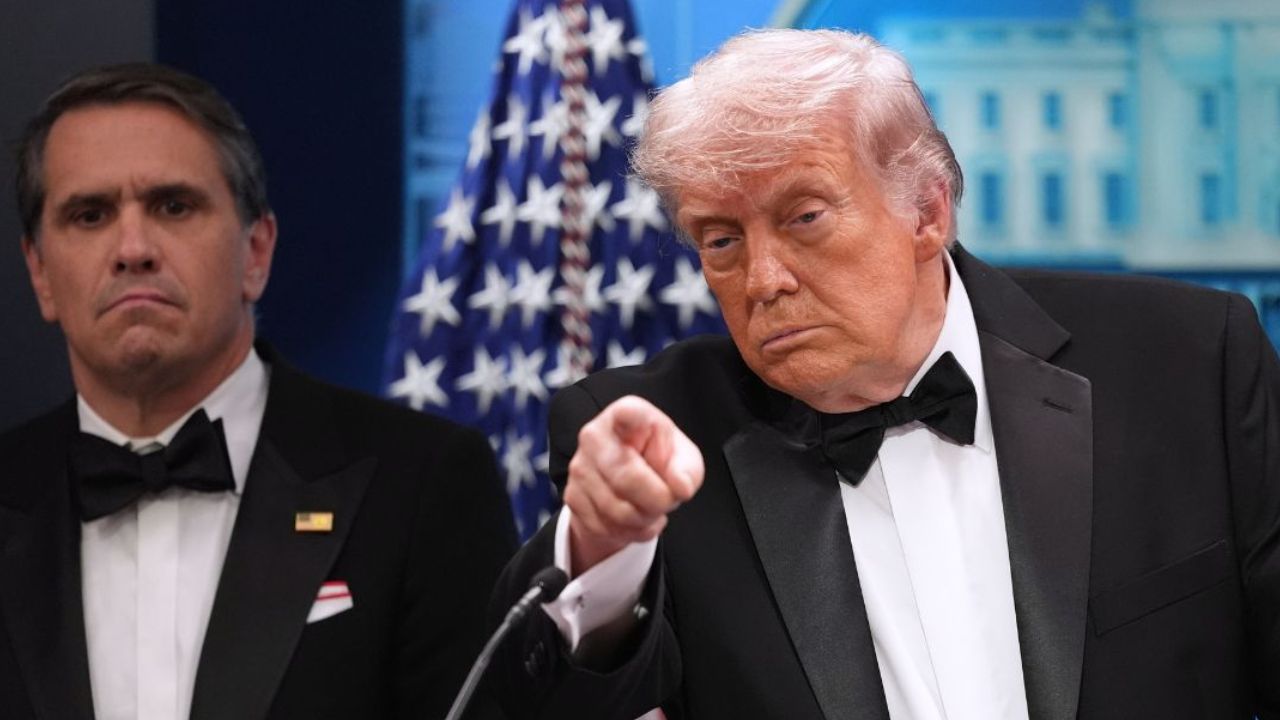
President Donald Trump speaks in the James Brady Press Briefing Room at the White House after an unspecified threat at the annual White House Correspondents' Association Dinner in Washington, Saturday, April 25, 2026, as acting Attorney General Todd Blanche looks on (AP Photo/Alex Brandon).
The U.S. Department of Justice wants a federal court of appeals to unwind sanctions issued by a lower court over the Trump administration's failed gambit to collect $1.776 billion from taxpayers for President Donald Trump's planned "anti-weaponization fund."
In a 64-page appellate brief, DOJ official R. Trent McCotter complains that the sanctions issued in the case are "unprecedented" and "based on a bevy of clear legal and factual errors."
In January, Trump filed his original lawsuit against the IRS. By May, the case was closed — on the plaintiff's own request — with the 45th and 47th president opting instead for a publicly subsidized fund earmarked for pro-Trump stalwarts and others similarly situated.
In her order closing the case, U.S. District Judge Kathleen Williams, a Barack Obama appointee, expressed a number of doubts about the finality of the process but seemed inclined to let things go — at least for a while. Meanwhile, at least four other lawsuits and claims were filed aiming to pump the brakes on what critics termed a "slush fund."
One of those claims — which started off as an intervention by amicus curiae and later became a discrete case — was filed by 35 former federal judges who implored Williams to disregard the "fraudulent nature" of Trump's voluntary dismissal, "reopen" the case, and look into "exactly what happened," as Law&Crime previously reported.
The court, faced with new information — specifically, the fund itself — complied with that request and motions practice continued for months.
In July, Williams found the president's attorneys filed a "non-adversarial, collusive" lawsuit to "manipulate the judicial process" and improperly force the IRS into a settlement that "had no viable basis in law or fact." In turn, the court put Trump and his legal team on the hook for attorneys fees of nonparty amici who opposed the lawsuit.
Now, the DOJ is asking the U.S. Court of Appeals for the 11th Circuit to reverse the sanctions order — which the agency claims is "riddled with legal and factual errors" — and reassign the case to a different judge.
"To start, the District Court's theory—that Plaintiffs brought this litigation 'to provide cover for a collusive settlement'—makes no sense," the brief reads. "The government frequently settles claims that are never presented in court. And here, the District Court had no role to play with respect to the Parties' agreement."
To hear the government tell it, "[m]uch of" the district court's order "consists of an incorrect analysis" that concluded the parties "were not sufficiently adverse" for constitutional jurisdiction.
The brief argues that Williams "brushed aside the facts" that Trump sued in his personal capacity but not his official capacity.
The government also says the fact that the anti-weaponization fund did not ultimately materialize works against the sanctions.
"The District Court's conclusion that the President (in his official capacity) could have directed Defendants to grant his requested relief is a red herring, because it is undisputed that did not happen here," the appellate brief goes on. "Plaintiffs sought at least $10 billion in this lawsuit but settled without receiving any money."
The DOJ goes on to say that even "if there were anything to" the "collusion theory," sanctions would not have been proper.
Here, the government takes issue with a gag order that bars the IRS and Treasury Department "from referring to the purported" settlement "or using, offering, admitting, or citing any of its provisions in any judicial, administrative, regulatory, arbitration, or any other official proceeding as evidence of" a settlement.
"The IRS and Treasury never represented anything to (or otherwise took action in) the District Court," the appellate brief continues. "The court identified no authority to sanction them anyway—least of all in the form of a gag order—for entering a private settlement, which is a decision committed to agency discretion by law. There is none. The District Court's Order is unsupportable and must be reversed."
In light of what the government views as an "extraordinary" order that "cannot stand," the DOJ wants Williams off the case, accusing the judge of "seemingly intentionally" violating the rules of civil procedure "for the purpose of inflicting political damage on Executive Branch officials."
To that end, the appellate brief cites outside authorities to argue the judge "deliberately" timed her order "for political purposes."
The DOJ quotes Rep. Jim Jordan, a Republican representing Ohio, to argue that Williams' order "appears to be an abuse of judicial authority and motivated by partisan animus" and that the court "unnecessarily maligned Attorney General Blanche."
"The District Court's actions have rightfully already given rise to the view among reasonable members of the public that the District Court was acting in an improper political manner," the brief argues. "This Court need not conclude that the District Court's actions were improperly motivated, but rather only that reasonable members of the public would view them that way."




Comments