
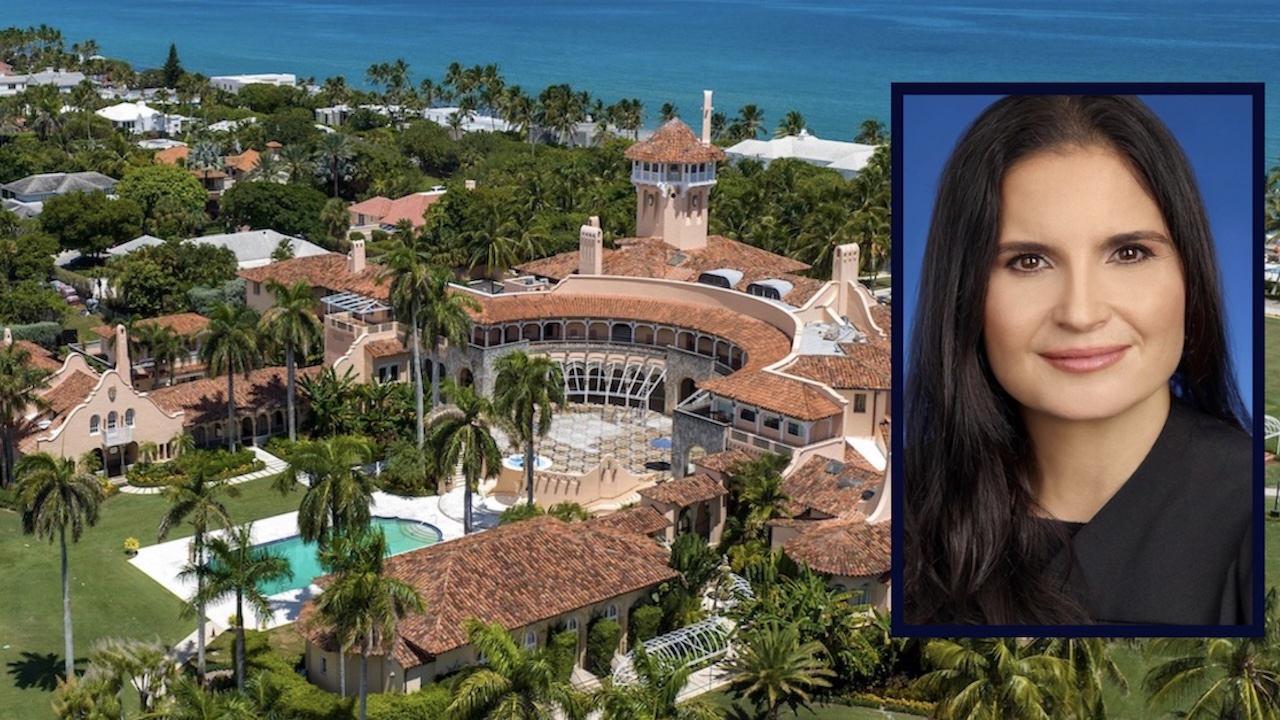
Main: An aerial view of former President Donald Trump's Mar-a-Lago club in Palm Beach, Fla., on Aug. 31, 2022 (AP Photo/Steve Helber/File). Right inset: U.S. District Judge Aileen Cannon (U.S. District Court for the Southern District of Florida).
The Trump administration's Justice Department on Friday asked U.S. District Judge Aileen Cannon to reject, for a second time, an urgent plea for clarification that current and fired FBI agents involved in the Mar-a-Lago investigation submitted to her.
The 20-page motion to dismiss, describing the agents' renewed request as resting on "nothing more but conjecture, fear-mongering, and an apparent motive to delay," was filed by Acting Deputy Attorney General R. Trent McCotter and U.S. Attorney for the Southern District of Florida Jason Reding Quiñones.
Cannon quickly struck the first request for clarification from the docket for violating a local rule, but the agents and their attorneys returned last week with a compliant motion.
The agents identified as "experts in the handling of classified information" reiterated that they want to testify in the DOJ's "grand conspiracy" probe about the contents of former special counsel Jack Smith's Mar-a-Lago report but do not want to violate Cannon's order barring all disclosures about Volume II.
The Trump-appointed jurist permanently buried Smith's report on the probe after she tossed then-candidate Trump's indictment, reasoning that all of "private citizen" Smith's acts were invalidated as a consequence of an unlawful appointment.
In his public testimony, a muzzled Smith never spoke about Volume II because of Cannon's orders.
The FBI agents, many of whom were "abruptly and unlawfully fired" by FBI Director Kash Patel after his return from the Olympic Games, similarly believe they could face "court-imposed sanctions" for which they "could be held in contempt" unless Cannon clarified her order.
The DOJ argues the "grand conspiracy" probe witnesses' "hypothetical fears that they may be questioned about Volume II" amount to "fear-mongering" about the "possibility or risk of future harm" — an "improper" motion well short of establishing standing.
"[I]n the guise of seeking clarification, the Witnesses actually seek to chip away at this Court's straightforward prohibition against the disclosure of Volume II and the improperly derived information and conclusions contained in the so-called Special Counsel Report," the DOJ said, calling Smith's case an "unlawful and since dismissed prosecution."
"The Witnesses also seek to forestall—even dictate—what questions the grand jury can ask of them and to publicly telecast the details of those protected proceedings," the filing added. "Those asks alone are extraordinary."
While the FBI agents have said that they "cannot rely on DOJ's assertions" about what Cannon's order allows, the DOJ said Cannon "should not allow any free sneak previews or negotiations about what the grand jury may or should ask."
Follow Law&Crime:





Comments