
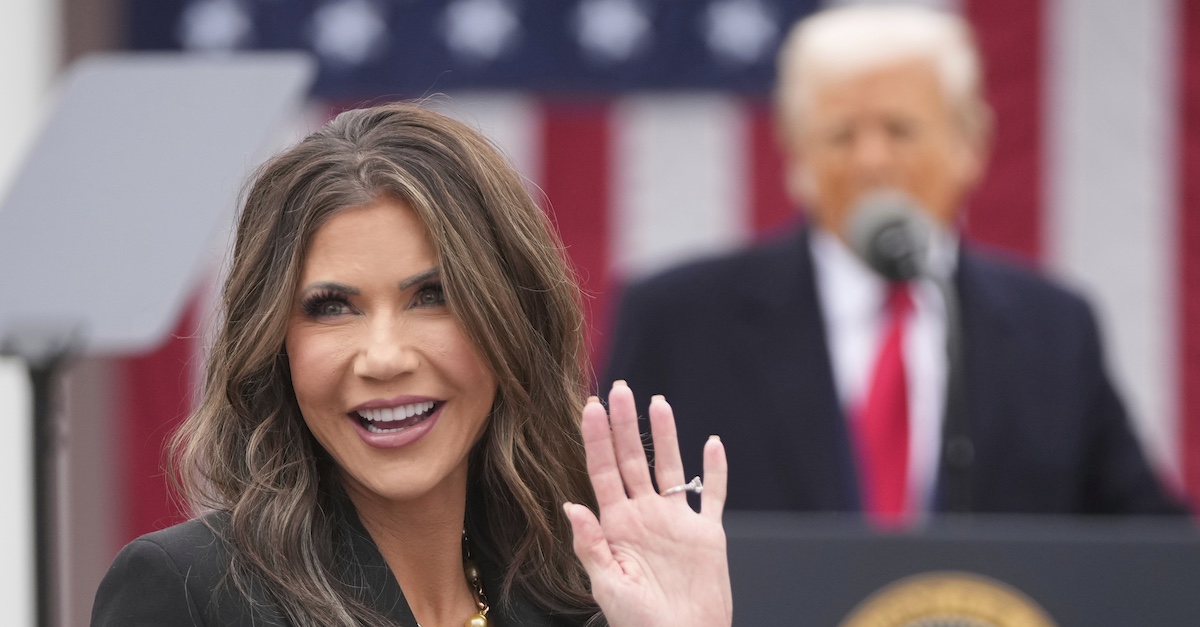
FILE – Homeland Security Secretary Kristi Noem is recognized as President Donald Trump speaks during an event to announce new tariffs in the Rose Garden at the White House, April 2, 2025, in Washington (AP Photo/Mark Schiefelbein, File).
Attorneys representing several immigrant children say Kristi Noem and other Trump administration officials should be held in contempt for trying to summarily deport them in violation of a court order.
In the underlying case, filed in late August within an hour of the initial deportation effort, the class action lawsuit represents "hundreds of Guatemalan children at imminent risk of unlawful removal" premised on several alleged statutory and constitutional violations.
Some two weeks later, U.S. District Judge Timothy J. Kelly, who was appointed by President Donald Trump during his first term, issued an injunction barring the deportations and accusing the government of lying. The court also certified a class made up of all Guatemalan children "in (and who will be in)" the custody of the Office of Refugee Resettlement (ORR) "who have not received a final order of removal" or permission to "voluntarily depart" under applicable laws and rules.
Now, the plaintiffs say Customs and Border Protection (CBP) officials are "coercing unaccompanied minors into accepting expedited 'voluntary' return" in violation of the court's September 2025 injunction.
The motion begins by summarizing the heart of the allegation:
After a temporary restraining order narrowly thwarted the government's secret, middle-of-the-night attempt to expel unaccompanied Guatemalan children from the United States over Labor Day weekend, this Court certified a provisional class of certain Guatemalan children who are or will be in the custody of the Department of Homeland Security (DHS) and other Defendants and enjoined Defendants from "transferring, repatriating, removing, or otherwise facilitating the transport" of class members from the United States. Defendants declined to appeal that injunction and it remains in place while this matter proceeds to final judgment. But Plaintiffs have learned that Defendants are engaged in a practice that openly flouts the plain text of the Court's injunction.
In their 17-page motion for an order to show cause, the plaintiffs say CBP is "using a new, secretive process 'to intimidate and bully young people out of exercising their statutory rights' under" the Trafficking Victims Protection Reauthorization Act (TVPRA) by way of a document circulated at ORR-run youth shelters which was first brought to the attention of attorneys in late November 2025.
"Specifically, the [CBP document] tells unaccompanied children (in English and Spanish) that they have 'the option to voluntarily return to your country of origin … within 72 hours,'" the motion reads. "But for those who decline to be immediately returned, the document threatens dire consequences."
The motion catalogues those alleged threats, at length:
For children who "choose to seek a hearing with an immigration judge or indicate a fear of returning to" their home country, the [CBP document] warns: (i) "You will be detained in the custody of the United States Government for a prolonged period of time"; (ii) your sponsor may "be subject to arrest and removal from the United States" and "subject to criminal prosecution for aiding your illegal entry"; and (iii) "if you cannot substantiate your claim of fear of returning to your country, you can be barred from legally applying for a visa."
And for those who "turn 18 years of age while in U.S. Government custody," the [CBP document] contends, "you will be turned over to Immigration and Customs Enforcement for removal (deportation) from the United States," resulting "in being barred from applying for a visa in the future."
"These threats can only be read as an attempt to scare children into signing paperwork that relinquishes their rights under the TVPRA before they are transferred to ORR custody, provided any opportunity to consult with legal counsel, or given the opportunity to seek immigration relief before a judge," the motion argues.
The plaintiffs say they were not initially aware of how widely the CBP document was being circulated or whether it was formalized policy by the Trump administration — while still concerned that its use, in whatever form, might "both violate the plain language of the Court's injunction and be used as a disingenuous way to seek to prevent newly arrived children from receiving the protections of the Court's order."
In the intervening months, the plaintiffs say they have collected several allegations that show the order is being directly violated.
"Defendants' own admissions have confirmed that Defendants are officially and systematically using these tactics to attempt to expel unaccompanied children from noncontiguous countries without providing the protections of the TVPRA," the motion goes on. "CBP is using misinformation, extreme coercion, threats, and fear to persuade children to relinquish their rights."
The motion goes on to claim "at least" 13 such instances in which children have been targeted under the new policy. And, they say, it's not just a matter of talking to them about the paperwork.
Several children described "CBP officers behaving aggressively—shouting, insulting, cursing, grabbing, threatening, and handcuffing," according to the motion. In one instance, a child said "CBP agents shouted, cursed, and threatened [him] with a dog and a stun gun" and then "told him he could accept a 'voluntary return' or he could remain detained for an extended period" and "refused his request to speak with his family before signing away his rights," the filing claims.
The expansiveness of the injunction precludes such tactics, the plaintiffs argue.
"Defendants are systematically violating the plain terms of this Court's preliminary injunction by pursuing policies to expeditiously expel unaccompanied children, including those from noncontiguous countries," the motion goes on. "[T]hey are doing so through a coercive, threatening, and misleading 'Processing Advisal' that seeks to persuade vulnerable children to relinquish the protections afforded by the TVPRA."
The motion argues the Trump administration "cannot dispute having engaged in this course of conduct" because a CBP official recently testified under oath that the document in question was being provided, or read aloud, to "all children" who an agent has deemed "capable of making an independent decision."
"Defendants have openly, publicly, and in sworn testimony admitted that they are engaging in conduct…that is squarely prohibited by the Court's Order," the filing continues. "That is enough to warrant an order to show cause for civil contempt."



Comments