
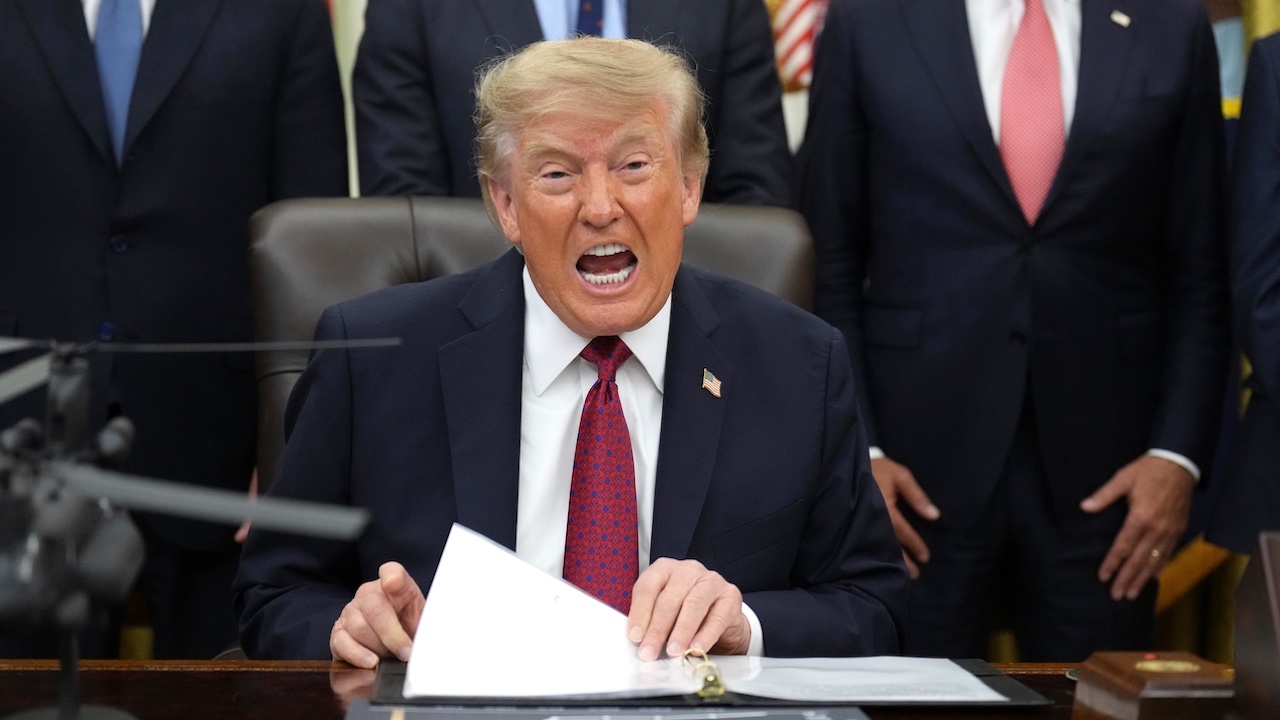
President Donald Trump speaks at a campaign rally for Sen. Darline Graham, R-S.C., at the Myrtle Beach Convention Center in Myrtle Beach, S.C., Friday, Aug. 21, 2026. (AP Photo/Jacquelyn Martin).
The state of California on Tuesday implored a federal judge to shut down the Trump administration's eleventh-hour request to throw out or set aside vote-by-mail ballots cast by some 20,000 Californians.
In the case, the U.S. Department of Justice said it provided Los Angeles elections officials with a list of people the government refers to as "likely noncitizens," many of whom live in Los Angeles County.
Local officials declined the federal push to have those names removed from voting rolls and, two days later, the DOJ sued, alleging the state was "knowingly" facilitating "unlawful voting."
The Trump administration also moved for a temporary restraining order that would result in election officials being "restrained from tabulating" the votes of the names on the government's list.
In a 41-page opposition motion, attorneys for the Golden State argued against the government's requested relief by noting that the 2026 midterm election is already "well underway."
In California, counties began sending out vote-by-mail ballots weeks ago, with a dispatch deadline of Oct. 5, meaning every mail ballot has already been sent out to voters and that many have already been returned to elections offices directly or dropped in the mail.
The Trump administration, for its part, wants any returned ballots cast by those 20,000-odd voters not to be added to vote totals. California rejected this demand as both impossible and unserious.
"Plaintiff demands that California sequester and refuse to tabulate ballots cast by duly registered voters outside of any statutory procedure and in the absence of any individualized evidence," the motion reads. "Such an order would unquestionably have a devastating disenfranchising effect. Plaintiff does not set out a standard by which citizenship can be 'verif[ied],' and concedes that it 'is not practicable or feasible for the United States' to carry out that confirmation process 'before the 2026 election concludes.'"
In other words, California says the government has not offered to help confirm or deny the citizenship status of the people on the list.
The motion also says the government conceded there is no way for verification to occur before the midterms. The upshot, California argues, is that those votes would simply not count if the DOJ got its way.
"The risk—if not certainty—of disenfranchisement is plain," the opposition motion continues. "The public has a strong interest in preventing the irreparable harm of disenfranchisement and late-stage disruptions to election administration."
California also takes issue with how the Trump administration tried to effectuate these efforts in the first place, saying the DOJ actually "failed to provide state officials" with the "suspect data."
"Instead, the California Secretary of State received a letter from DOJ demanding that she work to identify the citizenship of an unspecified list of individuals, or else direct elections officials to refuse to tabulate their ballots," the motion explains. "This lawsuit followed less than 48 hours later."
To hear California tell it, the Trump administration's lawsuit is part of "a comprehensive effort to interfere in state elections based on unsupported claims of voter fraud."
The motion notes that of 30 states sued by the DOJ in an attempt to obtain unredacted voter rolls, every single case to have reached a final decision has ended with a loss for the government. To date, 26 out of those 30 voter roll lawsuits have been decided.
California also notes that several additional efforts to "impose onerous new rules on mail voting just weeks before the election" have been rejected, again, by every court to consider them.
The opposition motion questions the lawsuit's purpose.
"At best, this litigation is a reckless political stunt. At worst, it threatens to disenfranchise thousands of Californians this election. Plaintiff's sole claim—that a federal criminal prohibition on individual noncitizen voting preempts large swaths of California's election administration—borders on the absurd. The relief Plaintiff seeks is as unlawful as it is untenable."



Comments