
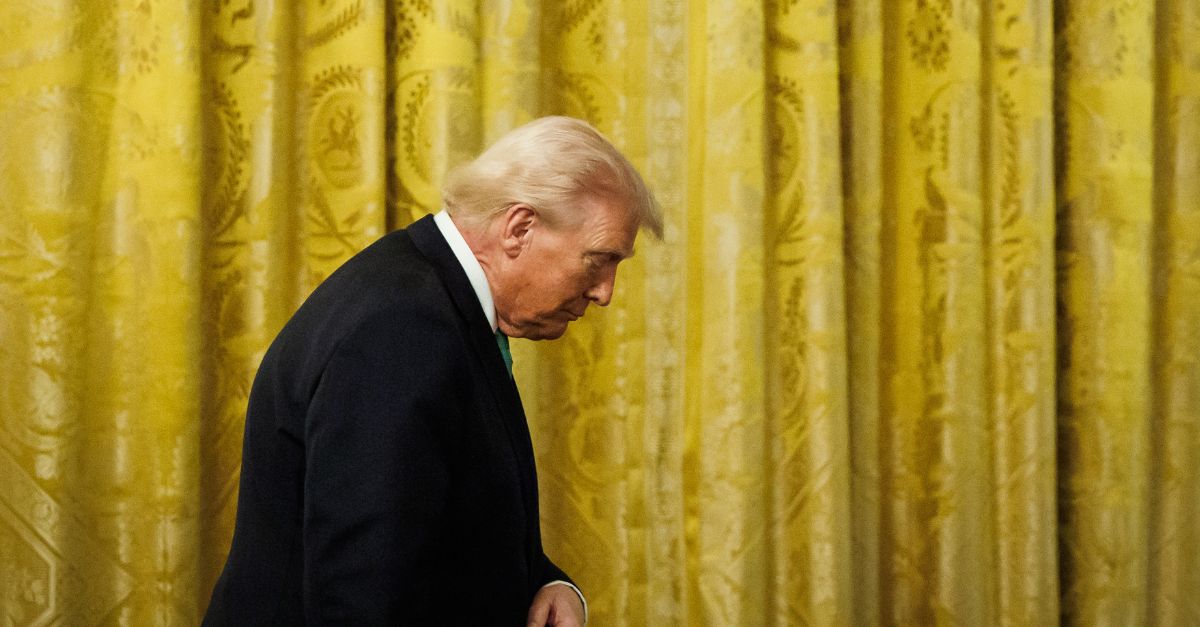
U.S. President Donald Trump leaves a St. Patrick's Day event in the East Room of the White House on March 17, 2026, in Washington, D.C. (Photo by Samuel Corum/Sipa USA)(Sipa via AP Images).
The Trump administration cannot move forward with firing U.S. intelligence agents who were temporarily assigned to diversity, equity, and inclusion (DEI) projects, a court of appeals ruled on Thursday.
In January 2025, President Donald Trump issued a series of executive orders seeking to uproot DEI-related initiatives from the federal government. In one such order, agencies were directed to "terminate, to the maximum extent allowed by law" all DEI-related positions.
Within days, the plaintiffs were placed on administrative leave, according to the original petition filed in the Eastern District of Virginia. On Valentine's Day 2025, the plaintiffs were told they had four days to report to their respective offices and turn in their intelligence community (IC) access badges, according to the lawsuit.
"In Plaintiffs' many years of experience within the IC, this summons means they are imminently to be terminated or placed on leave without pay," the lawsuit — filed one day before the deadline — reads.
An amended complaint adding additional plaintiffs was filed in late February 2025. The intelligence officers worked for the CIA and the Office of the Director of National Intelligence (DNI) where they were tasked with "implementing federal civil rights laws within the Executive Branch as mandated by Congress."
In March, Senior U.S. District Judge Anthony Trenga, a George W. Bush appointee, issued a preliminary injunction barring the government from "effectuating or implementing any decision to terminate" the plaintiffs while keeping them on administrative leave with pay.
In turn, the CIA and DNI appealed.
Now, the U.S. Court of Appeals for the 4th Circuit has partially sided with the plaintiffs and affirmed the lower court's order.
In the 48-page opinion penned by Circuit Judge Nicole G. Berner, a Joe Biden appointee, the appellate court found the Trump administration did not follow internal agency regulations for instituting reductions in force (RIFs). To that end, the court said the agents should have been given an opportunity for reassignment or to appeal their terminations.
"The rights to reassignment and appeal are triggered not only when lower-level Agency employees direct a termination, but also when termination is directed from the top," the opinion reads. "Because, as the district court aptly found, the terminations took place as part of RIFs, the Agencies must follow those sections of the Termination Regulation respecting RIF terminations."
Notably, the agents did not sue on the premise that they are owed continued employment, an idea the court rejects as something of a straw man argument made by the government in its defense.
From the opinion:
[T]he Agencies note that the Termination Regulation repeatedly reaffirms that the Directors possess broad discretion to terminate employees. This is beside the point. The Intelligence Officers do not claim a right to continued employment, and the district court did not rule on this basis. It is undisputed that no such right exists. Rather, the Intelligence Officers claim entitlement to two specific rights, both of which, as explained above, are prescribed in the Termination Regulation.
"The fact that the Directors possess discretion to terminate employees thus bears no relevance to the question of whether the Intelligence Officers are entitled to the rights of reassignment and appeal," the court writes.
The Trump administration also argued that by ignoring the termination regulation at issue, it does not need to provide the reassignment and appeal rights afforded to employees.
The court rejected that argument out of hand.
"To be sure, the Agencies did not follow these procedures," the opinion continues. "Prior failure to follow the Termination Regulation, however, does not absolve the Agencies of their duty to it going forward. The Agencies may not ignore their own procedures and then use such noncompliance as an excuse to evade future obligations."
The 4th Circuit panel also found the intelligence agents were likely to succeed on their claim that they had been denied a constitutional right, which further supported affirming the lower court's order.
Finally, the appeals court declined to disrupt the scope of the order. The government complained that the district court prohibited the agencies from firing the agents. Again, the appeals court said, that claim was wrong.
"The district court's injunction does not prevent the Directors from terminating the Intelligence Officers," the opinion goes on. "Rather, it simply prevents the Directors from implementing such decisions without notifying the court in advance. Such notification would provide an opportunity for the court to confirm that the Agencies complied with the Termination Regulation."





Comments