
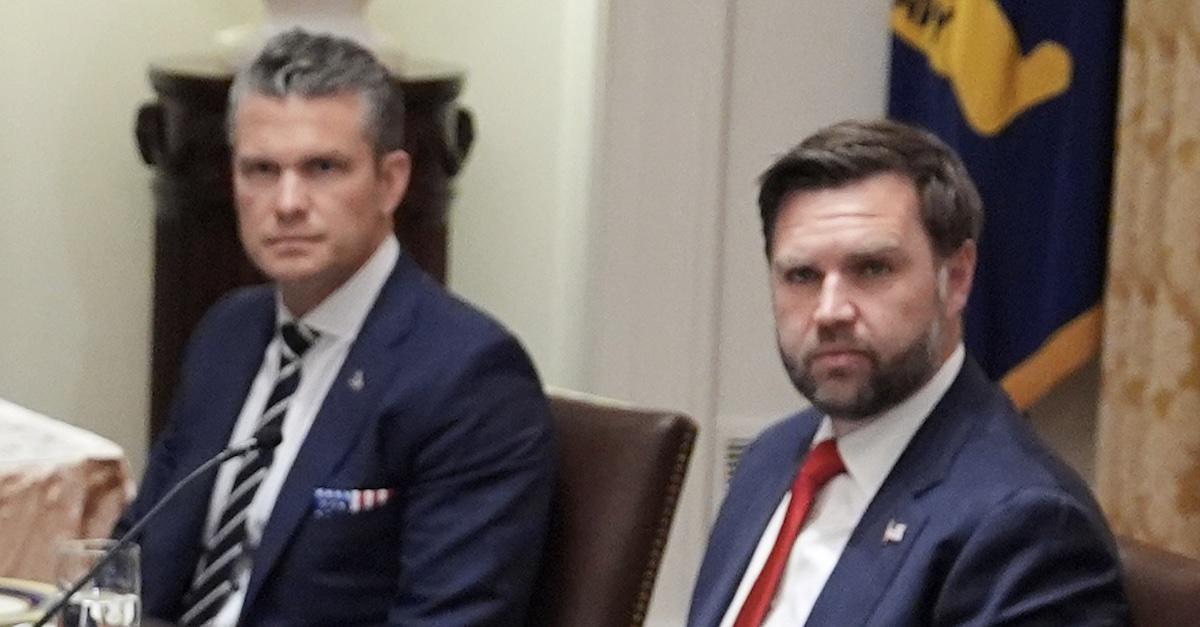
Defense Secretary Pete Hegseth and Vice President JD Vance listen in the Cabinet Room of the White House, Friday, Nov. 7, 2025, in Washington as President Donald Trump meets with Hungary's Prime Minister Viktor Orban (AP Photo/Evan Vucci).
Secretary of Defense Pete Hegseth was too busy to comply with a federal record preservation law after using his private cellphone and the Signal app to brief group chat members, including editor-in-chief of the Atlantic Jeffrey Goldberg, on sensitive details of then-imminent U.S. military strikes on Yemen in mid-March, a DoD inspector general report revealed Thursday.
The expected Signalgate report's top-line conclusions were that Hegseth, the Pentagon head and cabinet member for commander-in-chief President Donald Trump, "sent sensitive, nonpublic, operational information over Signal from his personal cell phone 2 to 4 hours before the strikes occurred" — not complying with DoD Instruction 8170.01 on "Online Information Management and Electronic Messaging" — and, in doing so, "risk[ed] potential compromise of sensitive DoD information, which could cause harm to DoD personnel and mission objectives."
In addition, Acting Inspector General Steven Stebbins wrote that Hegseth did not comply with 44 U.S. Code § 2911, the record preservation requirements that the secretary of defense was apparently too busy to uphold.
In fact, the inspector general had to rely on Jeffrey Goldberg's more complete account in The Atlantic of the Signal group chat "Houthi PC small group." Then-National Security Advisor Mike Waltz infamously and erroneously added Goldberg into the chat, making the journalist privy to classified information marked as "SECRET and not releasable to foreign nationals (SECRET//NOFORN)."
Love true crime? Sign up for our newsletter, The Law&Crime Docket, to get the latest real-life crime stories delivered right to your inbox
Vice President JD Vance, Director of National Intelligence Tulsi Gabbard, Secretary of State Marco Rubio, Treasury Secretary Scott Bessent and White House deputy chief of staff Stephen Miller, to name a few, were also in the group chat.
The report noted that Hegseth and the Office of the Secretary of Defense did not provide access to his personal cellphone as part of the investigation, but instead handed over a transcript that matched what The Atlantic reported on March 24 and March 26. Keep these dates in mind, as they are relevant for a Vance cameo.
According to the report, however, what Hegseth's office provided of the chat "exclude[d] a number of messages that had auto-deleted by the time the information was captured from the Secretary's phone because of settings in the chat."
Following a federal lawsuit by American Oversight, the White House Counsel's Office in May sent "a consolidated version of the group chat based in part on publicly available information and information saved from participants' phones" to DoD. Still, the agency declined Stebbins' request for a copy of the complete transcript "because it was not a DoD-created record."
As a result, the report continued, the inspector general "relied on The Atlantic's version of the Signal group chat."
Notably, a few pages later, the report concluded that Hegseth and his office "did not retain records of the Secretary's conversations on Signal discussing official government business, as required by 44 U.S.C. § 2911 and DoDI 5015.02, 'DoD Records Management Program.'"
Under 44 U.S. Code § 2911, an "officer or employee of an executive agency may not create or send a record using a non-official electronic messaging account," such as Signal, "unless such officer or employee […] forwards a complete copy of the record to an official electronic messaging account of the officer or employee not later than 20 days after the original creation or transmission of the record," which did not happen, according to the report.
Rather, Jeffrey Goldberg had more info than Hegseth provided in screenshots taken on March 27, with messages gone because of Signal's autodelete feature, the report said:
In response to our request, the DoD provided a partial transcript of the Signal messages based on screenshots taken from the Secretary's personal cell phone on March 27, but this record did not include a significant portion of the Secretary's conversations disclosed by The Atlantic. When we asked whether the information provided represented the information the DoD preserved from the Secretary's cell phone, an OSD official stated that the DoD had provided all messages that were available at the time the screenshots were taken.
"Because we sent our request for copies of the messages more than 20 days after the messages were sent from the Secretary's personal cell phone, we concluded that the Secretary and OSD did not comply with 44 U.S.C. § 2911 and DoDI 5015.02," the report continued. "Specifically, those regulations require officers and employees of Executive Branch agencies and DoD employees to forward a complete copy of any record created on a nonofficial electronic messaging account to an official account within 20 days of the original creation or transmission of the record."
Despite the violation of federal law, the inspector general made no "recommendation on this topic[.]"
Why? Because records management issues arising from the use of Signal and other commercially available messaging applications are a DoD-wide issue, a separate IG report was issued to address them and ensure compliance with records retention laws and policies.
And what was Hegseth's explanation for running afoul of the law? The secretary of defense was really busy after the Yemen strikes, details of which he unwittingly leaked to a journalist:
Specifically, the Deputy General Counsel cited the Secretary's pressing work and travel schedule following the March 15 strikes as preventing him from retaining copies of all of the chat messages in accordance with law and policy.
Now, back to the aforementioned March 24 to March 26 time period, when Goldberg's first and second reports dropped. One part of the group chat that was screenshotted from Hegseth's phone and preserved was a message from Vance, with the timestamp of 2:26 a.m. on March 25.
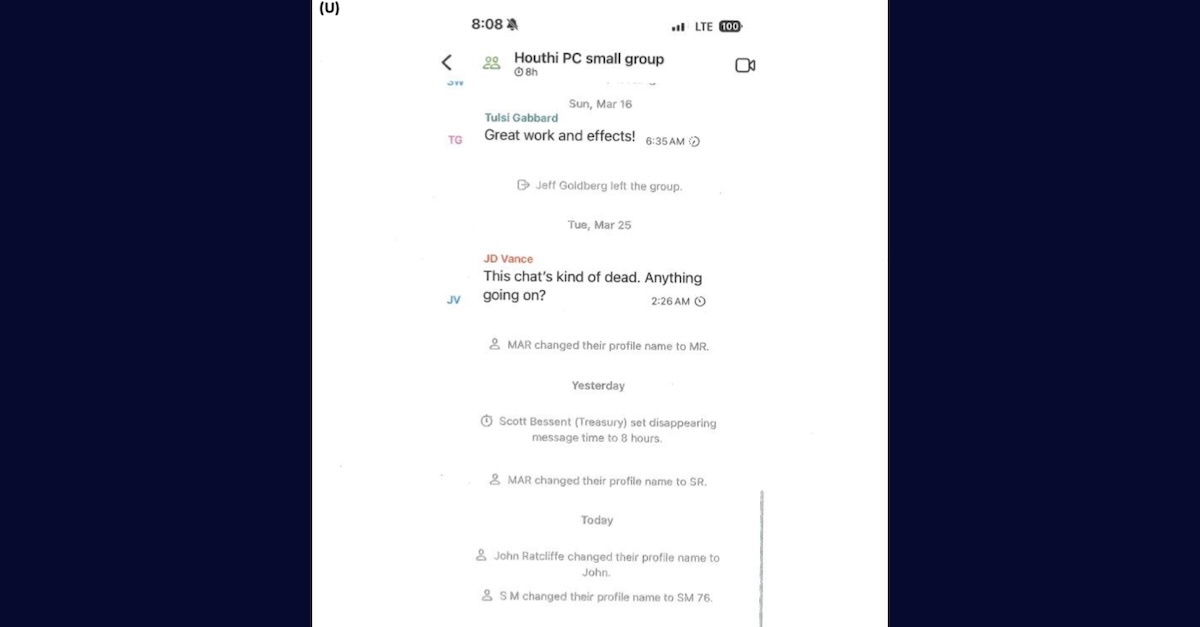
JD Vance's input in the Signalgate chat (DoD Inspector General).
"This chat's kind of dead. Anything going on?" the message said. Based on context, it seems as if the vice president was potentially trolling.
Prior to the report's release to the public, Chief Pentagon Spokesman Sean Parnell claimed it was a "TOTAL exoneration" because Hegseth, an original classification authority, shared "no classified information[.]"
Follow Law&Crime:






Comments