
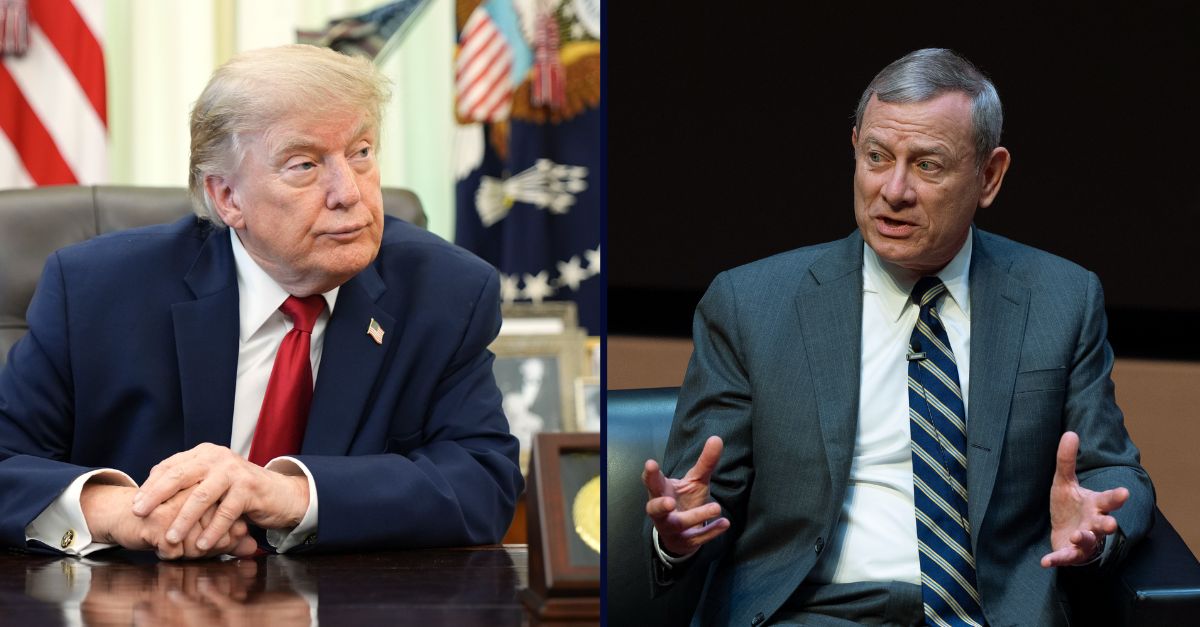
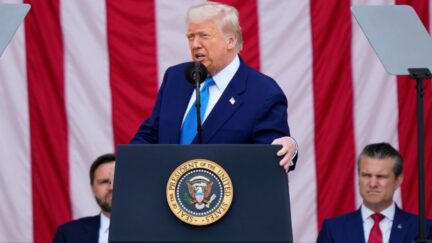
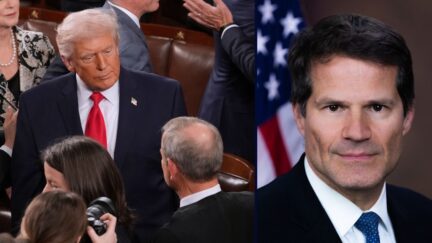
Left: President Donald Trump speaks before signing a presidential memo to the EPA on pollution control in vehicles, in the Oval Office of the White House, Monday, June 29, 2026, in Washington (AP Photo/Jacquelyn Martin). Right: John Roberts, Chief Justice of the U.S. Supreme Court, speaks during a lecture to the Georgetown Law School graduating class of 2025, in Washington, Monday, May 12, 2025 (AP Photo/Manuel Balce Ceneta).
Chief Justice John Roberts, evidently not intimidated by Donald Trump's claims that declining to end birthright citizenship would be a pro-China move, sided against the president on Tuesday, rejecting a "dramatically revisionist view" for which there was "scant evidence" of support.
Roberts, joined by Justices Amy Coney Barrett, Sonia Sotomayor, Elena Kagan, and Ketanji Brown Jackson, answered Tuesday that it was the Trump administration that reached the wrong conclusion in the case Trump v. Barbara.
After all, the chief justice wrote, the whole purpose of the 14th Amendment was to "repudiate Dred Scott," the "odious decision" that made "blood, not soil," the "rule" for citizenship and excluded descendants of slaves.
"Chief Justice Taney, writing for the Court, concluded that 'the words 'people of the United States' and 'citizen[s]' had an unexpressed (and atextual) racial component—one that excluded all those descended from slaves," Roberts explained. "They were 'born in the country,' Chief Justice Taney acknowledged, and thus 'did owe allegiance to the Government'—the precise criteria for citizenship at common law. But they were 'not included, and were not intended to be included, under the word 'citizens' in the Constitution."
"Dred Scott was met with shock," Roberts went on.
Next, Roberts turned to the 1898 case of United States v. Wong Kim Ark, which interpreted the citizenship clause to "include children of foreign nationals without regard to parental domicile."
Wong, the son of Chinese immigrants with "permanent domicil and residence," was barred from reentering the U.S. under the Chinese Exclusion Act despite having been born in California. Ultimately, the Supreme Court affirmed that Wong was an American citizen under the 14th Amendment.
"We see no reason to depart from that view today," Roberts' majority said, while also criticizing the Trump administration's "dramatically revisionist view" of domicile-based "allegiance."
"The only evidence the Government and the principal dissent can muster to show that some alternative ('primary') conception of allegiance displaced the common law is a 'funeral oration' for President Lincoln," Roberts said. "Ahistorical modifiers aside, the Government and the dissent identify no source that defined allegiance at birth as being based on domicile in the period from 1776 to 1868."
Under the citizenship clause of the 14th Amendment, "[a]ll persons born or naturalized in the United States and subject to the jurisdiction thereof, are citizens of the United States and of the State wherein they reside," except the children of foreign diplomats. The Trump administration had maintained birthright citizenship created an "incentive" for illegal immigration, and prior to oral arguments, Trump predicted that the Supreme Court would "find a way to come to the wrong conclusion."
Upon Trump's inauguration last year, he issued an executive order claiming to protect the "meaning and value of American citizenship."
"It is the policy of the United States that no department or agency of the United States government shall issue documents recognizing United States citizenship, or accept documents issued by State, local, or other governments or authorities purporting to recognize United States citizenship, to persons: (1) when that person's mother was unlawfully present in the United States and the person's father was not a United States citizen or lawful permanent resident at the time of said person's birth, or (2) when that person's mother's presence in the United States was lawful but temporary, and the person's father was not a United States citizen or lawful permanent resident at the time of said person's birth," the order said.
During oral arguments, the chief justice had an exchange with U.S. Solicitor General D. John Sauer that proved to be a sign of things to come. He directly asked the government for facts about how big of a problem "birth tourism" is in reality.
"Do you have any information about how common that it is or how significant a problem it is?" Roberts asked.
"No one knows for sure," Sauer answered, before adding, "But of course, we're in a new world now, as Justice Alito pointed out to you, where 8 billion people are one plane ride away from having a child as a U.S. citizen."
"Well, it's a new world, but it's the same Constitution," Roberts answered.
On Tuesday, Roberts said he "traced an unbroken line from the English common law, into the founding and antebellum eras, and through the debates, to the Clause's ratification" and "[y]et at no point did the Court identify any evidence in the historical record that the ratifiers of the Fourteenth Amendment thought themselves to be imposing a domicile limitation."
Follow Law&Crime:

Comments