
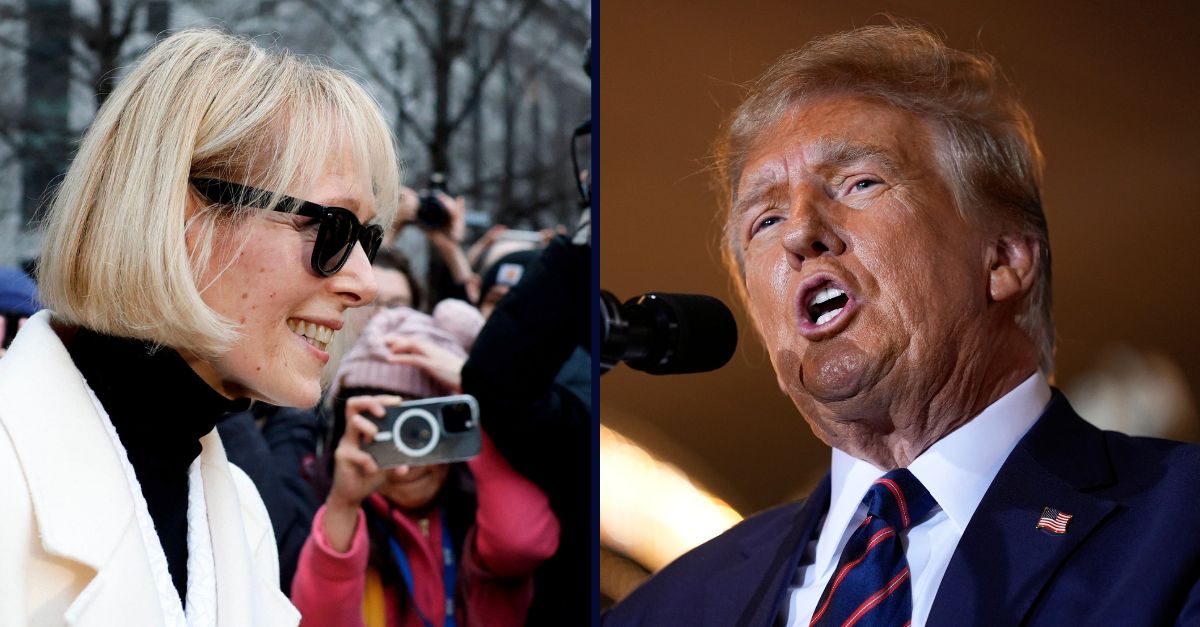
Left: Journalist E. Jean Carroll departs from the courthouse after the conclusion of the damages trial against Donald Trump at Manhattan Federal Court on Friday, January 26, 2024 in New York City (John Angelillo, Alamy Live News via AP). Right: Republican former President Donald Trump speaks at a primary election night party in Nashua, N.H., Jan. 23, 2024. (AP Photo/Matt Rourke).
Update: On Wednesday afternoon, the U.S. District Court for the Southern District of New York ordered the clerk to disburse the $5 million judgment as well as "the value of the post-judgment interest" to a trust account maintained by E. Jean Carroll's attorney.
The court's order did not offer any analysis of President Donald Trump's motion in opposition. The order by U.S. District Judge Lewis A. Kaplan bases its directive on the U.S. Supreme Court's denial of Trump's petition for a writ of certiorari issued June 29.
In quick fashion, Trump's attorneys filed a notice of appeal, previewing an effort to stop the $5.77 million disbursement by pleading with the U.S. Court of Appeals for the Second Circuit.
Law&Crime's original story follows below.
***
President Donald Trump is imploring a federal court not to release millions of dollars he owes in the long-running defamation case brought and won by writer E. Jean Carroll.
In a 15-page memorandum of law filed late Tuesday, the 45th and 47th president argued that Carroll's recent efforts to unlock and dispense a $5 million bond posted by Trump to pursue his appeals run afoul of a June 2023 stipulation agreement between the parties.
Earlier this month, Carroll's attorney Roberta Kaplan asked U.S. District Judge Lewis A. Kaplan to issue an order directing the immediate disbursement of the debt owed — plus some $770,000 in interest — from the Court Registry Investment System (CRIS).
That request for payment came after the U.S. Supreme Court declined to hear Trump's appeal of the $5 million verdict in a late June orders list issued without a word of explanation or ceremony.
In a memo for the plaintiff, Kaplan argued the high court's denial of Trump's petition for a writ of certiorari was "a final outcome that, as the Parties agreed and this Court expressly ordered, entitles Carroll to 'collect any moneys owed by Defendant to Plaintiff.'"
Not so, says Trump in his Tuesday filing.
The latest foray into presidential stonewalling marks the formalization of an argument Trump's legal team already signaled to Carroll's legal team, as Law&Crime reported last week.
Earlier, Trump's attorneys asked Carroll's attorney if the plaintiff would consent to the defense's request to stay the enforcement of the defamation award. Carroll flatly declined.
Now, Trump is alerting Judge Kaplan to what the defense views as the current state of the yearslong appeal process.
"President Trump's timely petition for rehearing remains pending before the Supreme Court," the Tuesday memo reads. "Plaintiff's request violates the plain terms of the parties' Stipulation and Order, and would cause President Trump irreparable harm while not improperly disadvantaging Plaintiff in any way."
To hear Trump tell it, Carroll's request to disburse the funds misreads a three-pronged section of the stipulation agreement as a disjunctive series of events, wherein one condition being met will allow the defamation verdict award to be unlocked and paid out.
Instead, Trump says, the relevant section of the agreement is a conjunctive series of events — requiring all three relevant actions to occur before the court can sign off on Carroll actually being paid.
In real terms, this means Carroll can only access the millions owed to her once the 2nd U.S. Circuit Court of Appeals issues a mandate, the Supreme Court declines the case, and the Supreme Court issues a final order, according to Trump. And, though all of those events occurred, Trump quickly filed a petition for rehearing with the nine justices.
Since that rehearing request is pending, the final prong "remains a live condition unless and until the Supreme Court denies rehearing, because a grant of rehearing would place the case back before the Court and would require a further order in connection with the Appeal," according to the Trump memo.
Trump also notes that a fourth, stand-alone section of the agreement "remains operative as an option." This section covers an instance in which the original verdict is overturned in Trump's favor.
Here's how Trump views the agreement:
Read together, Subparagraphs 8(a), 8(b), and 8(c) establish a sequential framework keyed to how appellate review unfolds: if review ends with the Second Circuit's mandate, Subparagraph 8(a) governs; if a timely certiorari petition is filed, and the petition and rehearing are fully denied, Subparagraph 8(b) governs; and if certiorari is granted, it is impossible to currently know whether 8(b), 8(c), or 10 will become the operative provision, and thus Plaintiff's motion must be denied.
"Plaintiff's motion rests on her wrongful contention that the second enumerated event—'denial of a timely filed petition for writ of certiorari'—has occurred. It has not," the Trump memo goes on. "A timely petition for rehearing from the denial of certiorari is part of the Supreme Court proceedings in connection with that same appeal."
Trump goes on to argue that his preferred "framework explains why no party treated" the Second Circuit's July 2025 ruling "as triggering collection" under the agreement.
"The status quo must remain," Trump's memo goes on. "Plaintiff's position contradicts the plain text and purpose of a security arrangement designed to preserve the status quo during appellate review. Plaintiff faces only temporary delay, fully compensable by interest, unless judgment is overturned on appeal. That has been the status quo throughout the appellate process in this case, and it must remain so pending resolution of the petition for rehearing."
Adding a further wrinkle, Trump's petition for rehearing refers to another case between himself and Carroll — and could very well form the basis for the nation's high court to eventually reconsider.
As of July 7, however, Trump's petition for rehearing was "not accepted for filing."
Comments