
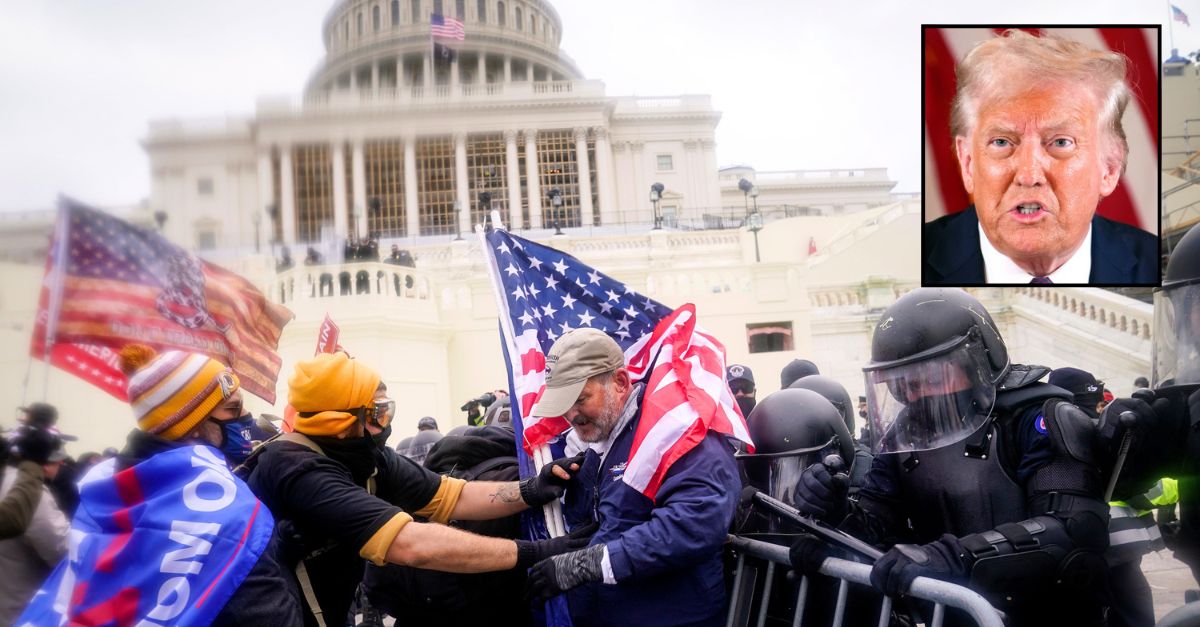
Background: Rioters try to break through a police barrier at the Capitol on Jan. 6, 2021, in Washington. (AP Photo/John Minchillo, File). Inset: Then-President-elect Donald Trump speaks during a meeting with Republican governors at Mar-a-Lago, Thursday, Jan. 9, 2025, in Palm Beach, Fla. (AP Photo/Evan Vucci).
Donald Trump wants to block evidence and testimony from being shared in a civil case against him that argues the president bears responsibility for the Jan. 6 riot.
In a 17-page motion submitted on Wednesday, Trump contends that U.S. District Judge Amit Mehta's order that the case may continue to the discovery stage is moot because the commander in chief has since appealed the decision. This appeal in pursuit of a finding that he had presidential immunity on that day, Trump argues, necessitates that "the entire case is effectively on appeal because it involves broad, false conspiracy allegations" that cannot be separated from the president himself.
The yearslong case began in February 2021 when lawmakers, including former California representative and current Oakland Mayor Barbara Lee, sued Trump, alleging he incited violence on Jan. 6, 2021, notably through his speech at the Ellipse in Washington, D.C. Though Trump claimed he had presidential immunity, Mehta dismissed this defense, finding that the president's actions were political in nature.
The Barack Obama appointee's ruling meant that the consolidated civil cases serving as among the "last vestiges of litigation concerning the events at the United States Capitol on January 6, 2021" would continue.
Weeks later, Mehta ordered Trump to explain "why merits discovery should not proceed against him," as Law&Crime previously reported. Mehta told the Democratic lawmakers and Capitol Police officers suing Trump that discovery against the president — including a deposition — remained on hold.
Trump appealed Mehta's decision to the U.S. Court of Appeals for the District of Columbia Circuit. His Wednesday filing served as his response to Mehta's April 20 discovery order. He wrote that precedents "establish that President Trump cannot be required to bear the burdens of merits discovery before final resolution of his immunity defense."
"[T]his Court lacks jurisdiction while President Trump's claim of absolute immunity is on appeal," the filing goes on. "An automatic stay of further proceedings is in effect, and the Court must refrain from taking any action which moves towards resolution of the merits."
But the president went further. He maintains that the "contours of this stay must extend beyond a mere prohibition of discovery against" him personally. Because the lawmakers' "conspiracy allegations" are "far reaching" and "inextricably intertwined" with claims against other defendants — including former Trump attorney Rudy Giuliani and the Proud Boys and Oath Keepers — the stay must extend to "any claim touching on" Trump.
In arguing his point, the 45th and 47th president stated that the "public has a vested interest in safeguarding the President from unnecessary distractions."
"[I]f any discovery moves forward ostensibly only as to the claims against other defendants—which mirror those against President Trump—without the President's participation, if his appeal were denied, discovery would have to be re-conducted with his participation or else he would seek to preclude Plaintiffs from using against him any discovery taken without his participation," the filing adds. "A complete stay avoids this dilemma and the potential for duplicative litigation, is necessary to vindicate the President's absolute immunity rights, and will allow the case to proceed efficiently and with full participation of the appropriate parties at the appropriate time."
Comments