
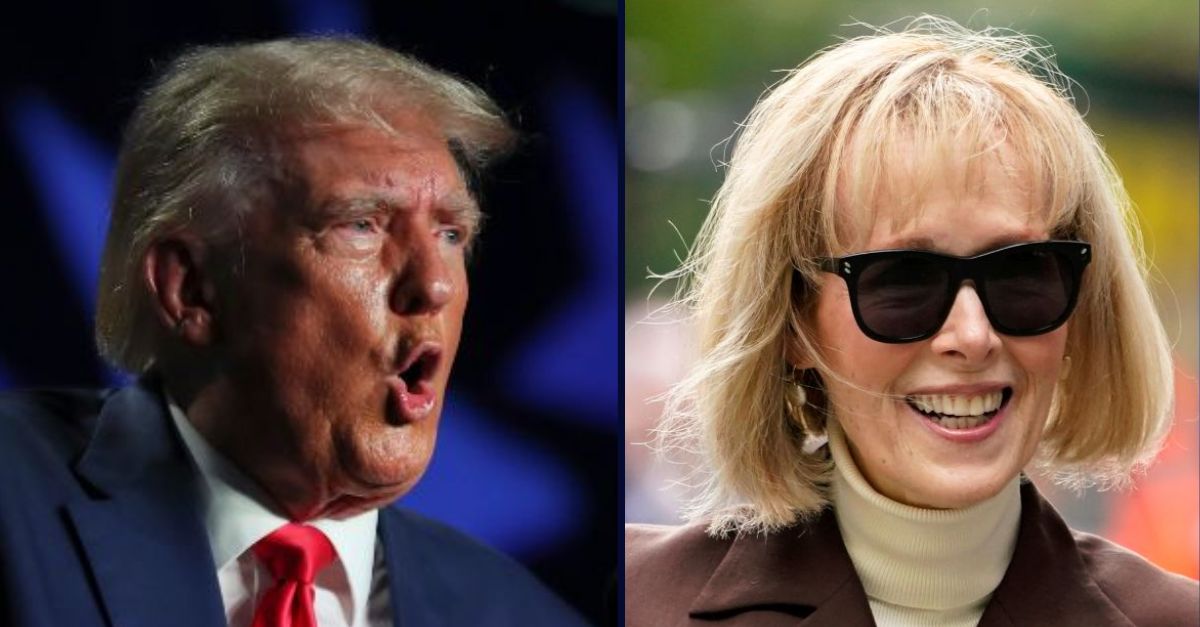
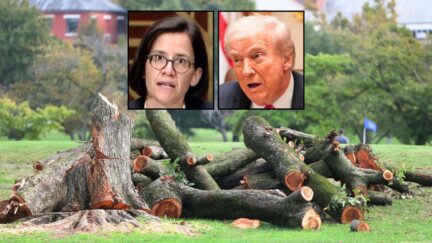
Left: President Donald Trump speaks during the 56th annual Silver Elephant Gala in Columbia, S.C., Saturday, Aug. 5, 2023 (AP /Artie Walker Jr.). Right: E. Jean Carroll arrives at Manhattan federal court, Tuesday, May 9, 2023, in New York (AP, John Minchillo).
President Donald Trump and the U.S. Department of Justice are asking the U.S. Supreme Court to void an $83 million verdict won by writer E. Jean Carroll in her first defamation case against the president.
In a 36-page petition for a writ of certiorari — a filing that includes 298 additional pages of prior court decisions — Trump says he is immune from the litigation due to his status as the 45th president.
"This is the first case in our Nation's history in which a court has imposed damages liability on a President for his conduct in office," the petition begins, calling the judgment for Carroll "exorbitant" and excoriating the U.S. Court of Appeals for the 2nd Circuit for declining to rule on the presidential immunity issues raised by Trump.
The petition goes on to chide the appellate court for refusing to apply the high court's nascent presidential immunity doctrine, which came by way of an opinion from Chief Justice John Roberts in 2024.
Trump's attorneys insist the comments at issue were "made from the White House, in response to press questions, denying allegations of personal misconduct directly questioning his fitness for office," and therefore entitled to the expansive protections outlined by Roberts.
"If left standing, the decision below will cause significant damage, not only to this President and future Presidents, but also to 'the Nation that the Presidency was designed to serve,'" the petition goes on.
In May 2023, a civil jury of Manhattanites found that Trump sexually abused Carroll in the dressing room of New York City department store Bergdorf Goodman sometime in the late 1990s — and later defamed her when he strongly denied the allegations, and also denied ever knowing Carroll, to the press. While the civil sexual assault finding has zero force of criminal guilt, it was essentially cited as a necessary precursor to the defamation lawsuit. In that first case, the jury ordered Trump to pay his victim $5 million in damages.
In January 2024, another Manhattan jury ruled in Carroll's favor over a markedly similar set of legal complaints over Trump's comments. Jurors would eventually award Carroll $83.3 million in that case.
Procedural issues made the order of the litigation a bit topsy-turvy. The first case filed was the last decided, and is referred to as Carroll I; this is the one that resulted in the $83.3 million verdict. The second case was the first to be decided, and is referred to as Carroll II — and resulted in the $5 million verdict that was paid out earlier this month.
Trump previously petitioned the justices for a reprieve on the $5 million verdict. That effort ultimately went nowhere as the court declined to hear the last-ditch appeal without a word.
Now, the 45th and 47th president says the 2nd Circuit dropped the ball by refusing to consider the high court's ruling that "most of a President's public communications are likely to fall comfortably within" the protections of presidential immunity.
"Because accusations bearing on the President's fitness for office are unquestionably matters of public concern, Presidential statements responding to press questions about such accusations are plainly official," the petition reads. "This Court should say so."
Trump's attorneys frame the filing as an opportunity for the Supreme Court to clarify the extent of the controversial doctrine.
"Here, the President of the United States has been ordered to pay nearly $100 million in damages (including post-judgment interest) for issuing a press release and answering reporters' questions," the petition goes on. "This Court's review is strongly warranted on that basis alone."
Separately, the DOJ is asking the justices to consider whether the government itself can be put on the hook for the judgment.
Specifically, the government wants to apply the Westfall Act of 1988, a law that can force the U.S. Department of Justice to step into the shoes of government officials sued for torts committed within the scope of their official duties.
"Under that statute, if the Attorney General certifies that a federal officer was acting within the 'scope of his office' 'at the time of the incident' at issue, the United States 'shall be substituted' as the defendant," the petition continues. "In 2020, Attorney General Barr issued such a certification in this case. In 2023, as the lower courts were reviewing his determination, Attorney General Garland withdrew that certification."
The 2nd Circuit previously rejected the Westfall Act effort by both Trump and his administrations as "simply too late" because the requisite certifications were filed after the Manhattan jury trial.
Trump and the DOJ want the Supreme Court to reconsider the applicability — or, rather, the reach — of both theories.
"If left uncorrected, the effects of the Second Circuit's mistreatment of Presidential immunity and the Westfall Act will reverberate far beyond this case," the petition says.
Comments