
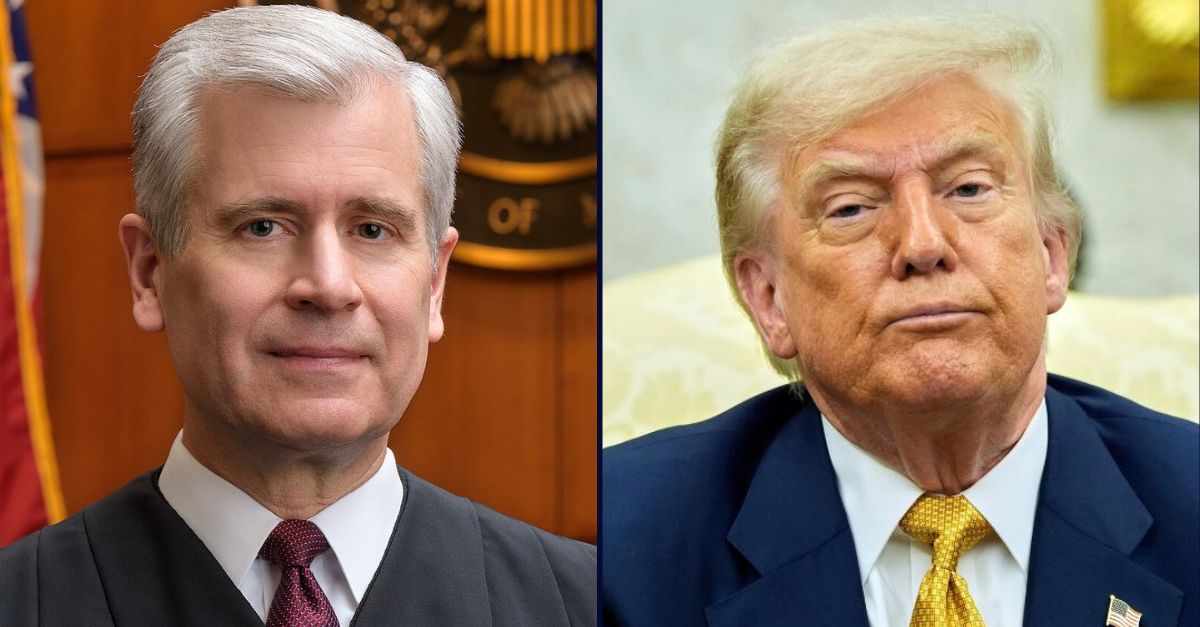
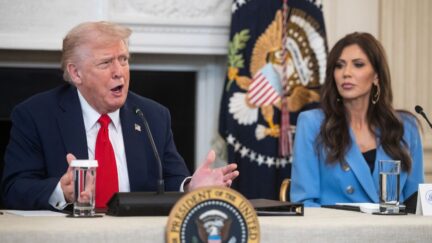
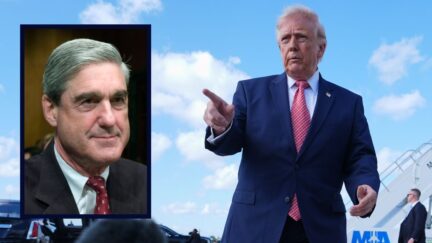
Left: Chief U.S. District Judge Patrick J. Schiltz (U.S. District Court for the District of Minnesota). Right: President Donald Trump listens during a meeting in the Oval Office of the White House, Wednesday, July 16, 2025, in Washington (AP Photo/Alex Brandon).
Days after ordering the leader of U.S. Immigration and Customs Enforcement (ICE) to appear before him, a federal judge in Minnesota has ripped into the agency, accusing it of violating roughly 100 court orders since the start of 2026.
"ICE is not a law unto itself," Chief U.S. District Judge Patrick J. Schiltz declared in a relatively terse four-page order on Wednesday. While acknowledging that the Trump administration satisfied his previous command, he was adamant that such acquiescence "does not end the Court's concerns."
The current case landed on Schiltz's desk on Jan. 8 after a man detained by ICE named Juan Robles sought a writ of habeas corpus — a ruling on whether his detention was lawful. As Law&Crime previously reported, on Jan. 14, the George W. Bush appointee ordered the administration to give Robles a bond hearing within seven days or release him.
The detained man was granted neither, leading to a scathing rebuke of the Department of Homeland Security (DHS) — ICE's parent agency — by the jurist on Monday, in which he wrote "[t]he Court's patience is at an end." Schiltz ordered acting ICE Director Todd Lyons to appear in his Minneapolis courtroom on Friday, threatening contempt if he did not.
However, he also offered another option to DHS: Release Robles, and the hearing requiring Lyons' attendance would be canceled. Two days later, on Wednesday, DHS told the judge that Robles had been released.
Schiltz stuck to his word — canceling the hearing — but he did not do so without expressing his frustration, pointing to an apparent pattern of ICE's noncompliance with court orders.
"Attached to this order is an appendix that identifies 96 court orders that ICE has violated in 74 cases," he wrote. "The extent of ICE's noncompliance is almost certainly substantially understated. This list is confined to orders issued since January 1, 2026, and the list was hurriedly compiled by extraordinarily busy judges. Undoubtedly, mistakes were made, and orders that should have appeared on this list were omitted."
He went on, at length:
This list should give pause to anyone—no matter his or her political beliefs—who cares about the rule of law. ICE has likely violated more court orders in January 2026 than some federal agencies have violated in their entire existence. The Court warns ICE that future noncompliance with court orders may result in future show-cause orders requiring the personal appearances of Lyons or other government officials. ICE is not a law unto itself. ICE has every right to challenge the orders of this Court, but, like any litigant, ICE must follow those orders unless and until they are overturned or vacated.
Schiltz did not grant a request from Robles for a hearing in which he could "present evidence and argument concerning the hardships that he has suffered as a result of respondents' failure to abide" by the judge's original Jan. 14 order. However, he noted that if Robles "wants to seek monetary sanctions, he may file a properly supported motion to that effect."
DHS' activity during its "Operation Metro Surge" in Minnesota has garnered international attention after ICE agents on two separate occasions killed local residents despite them posing no apparent threat to the officers, according to videos of the shootings.
Schiltz has been critical of the department's planning, writing on Monday that "[t]his Court has been extremely patient with respondents, even though respondents decided to send thousands of agents to Minnesota to detain aliens without making any provision for dealing with the hundreds of habeas petitions and other lawsuits that were sure to result."
A different federal judge in Minnesota this week considered whether the Trump administration's immigration effort is an unconstitutional attempt at strong-arming state and local officials into complying with President Donald Trump's policy preferences. Responding to the state's lawsuit seeking a temporary restraining order immediately blocking the operation, U.S. District Judge Katherine M. Menendez appeared skeptical both of the federal government's reason for sending thousands of federal troops into the city and her own authority to curb the campaign.

Comments