
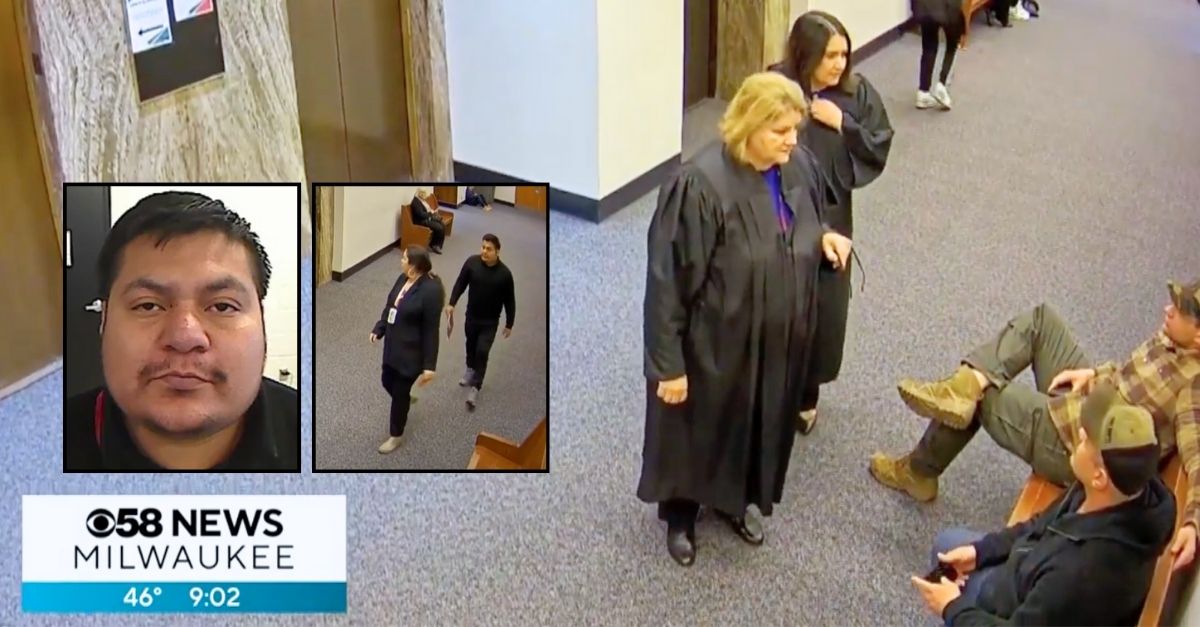
Background: Surveillance video shows Milwaukee County Judge Hannah Dugan speaking with ICE agents before Eduardo Flores-Ruiz's detainment (WDJT/YouTube). Left inset: Eduardo Flores-Ruiz (Department of Homeland Security). Right inset: Surveillance video showing Eduardo Flores-Ruiz leaving the Milwaukee County courthouse (WDJT/YouTube).
ICE agents "violated a longstanding privilege" barring civil arrests from happening in courthouses when they tried to arrest an undocumented immigrant that Hannah Dugan — the former Wisconsin judge who was found guilty last year of impeding agents during a courthouse bust — shielded from arrest, her lawyers say.
"ICE had no lawful right to execute the warrant in a state courthouse against a party with a court appearance that day," Dugan's legal team argues in a Jan. 30 motion for a new trial. "[Dugan's] conviction cannot stand, as a matter of law," the motion charges.
Dugan, 66, was indicted last year for allegedly helping an immigrant, Eduardo Flores-Ruiz, evade federal officers shortly after he appeared in her Milwaukee County Circuit courtroom in connection with a domestic abuse case. A federal jury found Dugan guilty in December of one count of obstructing or impeding a proceeding before a department or agency of the United States, a felony. Jurors found her innocent of one count of concealing an individual to prevent his discovery and arrest, a misdemeanor.
Steve Biskupic, one of Dugan's defense attorneys — and a former U.S. Attorney — told WISN in late December that her legal team had planned to ask U.S. District Judge Lynn Adelman, a Bill Clinton appointee, to set aside Dugan's guilty verdict. Her lawyers filed their motion for a new trial on Friday with claims that recent court cases, including one in November 2025, established a "common-law privilege" that bars civil arrests from happening inside courthouses.
Dugan's legal team cites at least four "well-reasoned" federal district courts and opinions "from California to New York" that have sought to prevent ICE agents from executing administrative warrants against parties in a county courthouse such as hers since 2020. "Since 1894, Wisconsin has joined many other courts — including the U.S. Supreme Court — in establishing a common law privilege against the execution of civil process or civil arrest warrants (e.g. an ICE administrative warrant) on a party appearing in a courthouse," Dugan's lawyers argue.
"This privilege specifically precludes ICE courthouse arrests for deportations or removal," their motion says.
Dugan's team points out how the Southern District of California, for instance, granted non-citizen plaintiffs a temporary restraining order barring ICE from civil arrests in courthouses in a 2020 case. "That court rejected the argument that the privilege does not apply against the federal government," her motion says.
"On April 18, 2025, Hannah Dugan, in her role as a judicial officer, acted consistently with an established privilege barring civil arrests of parties in courthouses," the motion concludes. "Federal and state courts long have recognized that common-law privilege preventing civil arrest or service of civil process for parties and witnesses who are in, entering, or leaving courthouses for a hearing or other proceeding."
Dugan's lawyers describe her as "the first and only judge in United States history to stand trial on an indictment for wholly official, good-faith acts untainted by graft, corruption, or self-dealing and that violated no individual constitutional right that the Reconstruction Amendments protect," per the motion.
The Milwaukee County Circuit Court judge stepped down from the bench last month and officially resigned to keep "pursuing this fight" against the legal system and her guilty verdict "for our independent judiciary," she said.
"I am the subject of unprecedented federal legal proceedings, which are far from concluded but which present immense and complex challenges that threaten the independence of our judiciary," Dugan wrote in a letter to Wisconsin Gov. Tony Evers, which was first shared by local ABC affiliate WISN.
"I am pursuing this fight for myself and for our independent judiciary," Dugan added. "However, the Wisconsin citizens that I cherish deserve to start the year with a judge on the bench in Milwaukee County Branch 31 rather than have the fate of that Court rest in a partisan fight in the state legislature."
Dugan's lawyers noted in interviews that they were requesting a new trial on the grounds that jurors were improperly instructed during her trial.
Specifically, the jury reportedly asked whether Dugan needed to know who ICE agents were looking for that day in order to convict her. For the misdemeanor concealing charge, the jurors said Adelman told them yes. But for the felony charge, jurors claimed he told them no.
"If it came back the same, we all would have found her not guilty, I am sure of it," a juror told the Milwaukee Journal Sentinel after Dugan's conviction. "The jury followed Adelman's instructions faithfully," another juror said.
In their Friday motion, Dugan's team argued that "the jury instructions mistakenly gave no guidance to the jury on how to consider Dugan's legal right to act as she did."
The motion says, "The court's improper response to the jury constructively amended the indictment. … The error was not just in the court's response to the jury, but in the evidence presented."
During her trial, federal prosecutors alleged Dugan impeded ICE agents during the courthouse immigration bust in Milwaukee by helping Flores-Ruiz, a Mexican national who was facing misdemeanor battery charges, leave through a jury door after a hearing in his criminal case. Dugan was accused of "falsely" telling ICE agents they needed to obtain a judicial warrant to take Flores-Ruiz into custody. Later, a deputy working in the courthouse provided information to federal investigators.
The incident occurred on April 18, 2025, and Dugan was charged in a criminal complaint less than a week later and was formally indicted in late May.
Obstruction carries a potential maximum sentence of five years in federal prison, according to federal law. But such an outcome is exceedingly unlikely due to Dugan's lack of a criminal record and the facts of the case itself. The sought-after criminal defendant was eventually detained and then deported in November.
Colin Kalmbacher contributed to this report.




Comments