
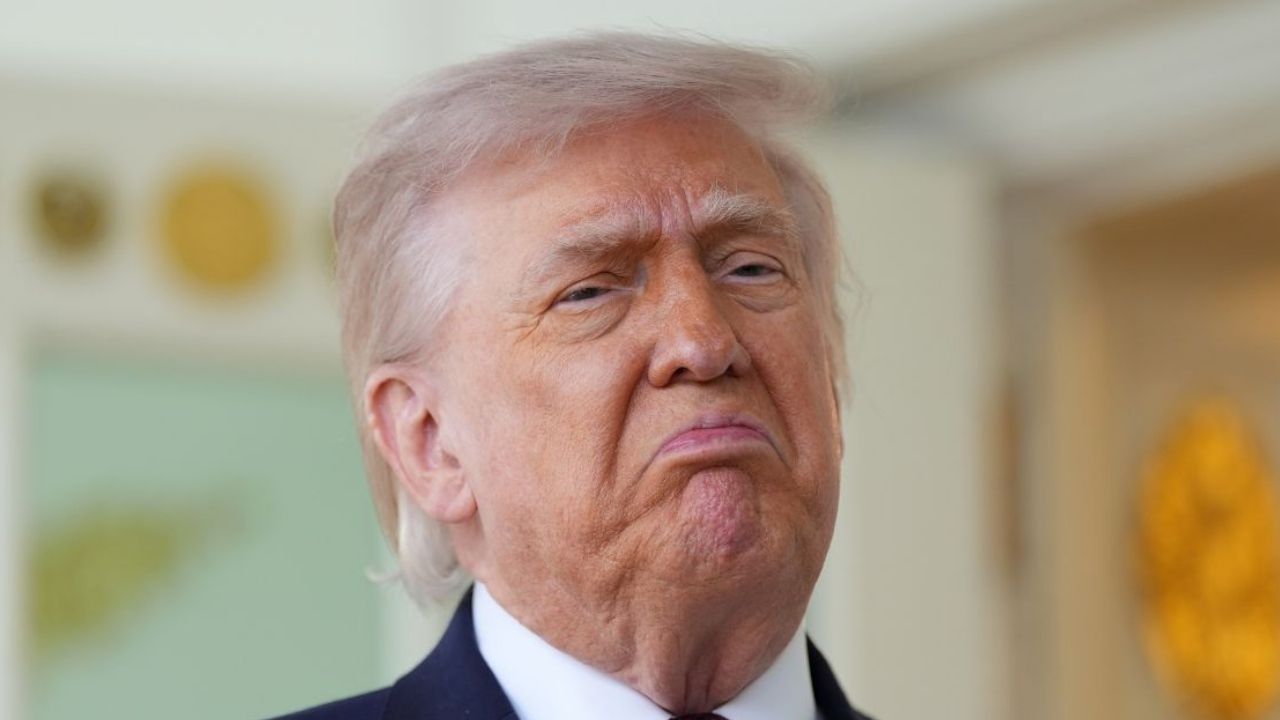
President Donald Trump speaks outside the Oval Office of the White House, Monday, April 13, 2026, in Washington (AP Photo/Alex Brandon).
The immigration system is in a state of chaos as the government deals with a blanket visa freeze that was recently lifted.
On Aug. 21, U.S. District Judge Jeannette Vargas of the Southern District of New York, a Joe Biden appointee, emphatically vacated the 75 country-focused, nationality-based freeze in a case originally filed in February by a Catholic immigration advocacy group.
The Empire State vacatur necessarily had knock-on effects for other lawsuits challenging the visa suspension program.
One such case found its way before U.S. District Judge Timothy J. Kelly of the District of Columbia, who was appointed by President Donald Trump, on Tuesday afternoon.
The hearing began with the judge discussing the latest actions in the New York case — in which Vargas recently took the government to task for "conclusory and evasive" compliance efforts.
The D.C.-based judge noted that the Manhattan-based judge vacated the pause and "vacated the denials" issued under the pause.
"I don't know if there's anything sort of left for me to decide," Kelly said.
Before the parties made their cases, the judge told the plaintiff's attorney it "might make sense" to put the present litigation "in suspended animation" because "there is no such policy" to challenge.
The plaintiff in the case of Roberts v. Rubio had another perspective.
"From where I sit, they've told me they will not do anything unless you order them to," the plaintiff's attorney said.
To hear the attorney tell it, his client was stuck in Guatemala and suffering from continued government inaction.
Kelly suggested it might just be a matter of time.
"As of things sit right now, there isn't any barrier to your client being processed as you and your client desire," the judge said.
The court stressed there is still confusion about what will happen in the New York case: whether or not the State Department would appeal.
To that end, Kelly suggested he was leaning toward holding the plaintiff's current motion in abeyance — or putting the case on hiatus.
The judge said pausing the present case briefly would allow time in case there is "any order from the appellate court that would impact the status quo and then we could all resume litigating this if we needed to."
The Department of Justice was inclined to that disposition of the matter — at least for the time being, as the administration was "trying to balance" various "competing interests."
"The government would agree with you that the best course of action in this case would be to stay or put this on ice," a DOJ lawyer said.
The plaintiff, however, strongly rejected a pause in the case.
The immigration attorney said that in other cases impacted by the New York cases, other judges "ordered the government to do something" to comply with the vacatur.
"That's what we're asking for here," the plaintiff's lawyer went on, saying that one of his clients was abroad recuperating from an appendectomy in a "third-world country" and said that "it's not getting better."
"Holding this in abeyance would only perpetuate the irreparable harm," the lawyer continued. "I'd hate to think that other clients winning a case and a court deeming this illegal would hurt my clients. Abeyance would be a loss."
The hearing moved on to practical implications as the parties discussed what steps need to be taken for relief to happen in real life.
"We would have expected it within a week of the interview," the plaintiff's lawyer said, noting his client was approved, then the ban was issued, then the process stalled out.
Kelly pressed the DOJ about the operative timeline.
"The plaintiffs should have some relief within a week, does that sound about right to you?" the judge asked the government.
The government lawyer demurred, saying there is "ongoing coordination" between agencies about "how best" to process visa interviews.
"Any kind of harm here would be speculative," the DOJ lawyer went on. "I think it would be best to wait to see what actually happens."
The plaintiff's attorney suggested this answer was unacceptable.
"What I hear is all speculation," the immigration lawyer said. "I am not hearing anything about what's on the ground…Despite the DOJ's position on fun issues for administrative law class, this court has a responsibility."
The plaintiff's lawyer went on to say the current state of affairs is a "refusal based on an unlawful order."
"That's an unlawful withhold," the immigration lawyer said, arguing the only action available for the judge is to "compel" a visa "issuance."
At one point, Kelly noted the litigation is active due to the present case and said how fast the government chooses to comply would have some bearing on the court's eventual order.
"I'm going to take all you've told me under advisement and get back to you quickly," the judge said as the hearing drew to a close.



Comments