
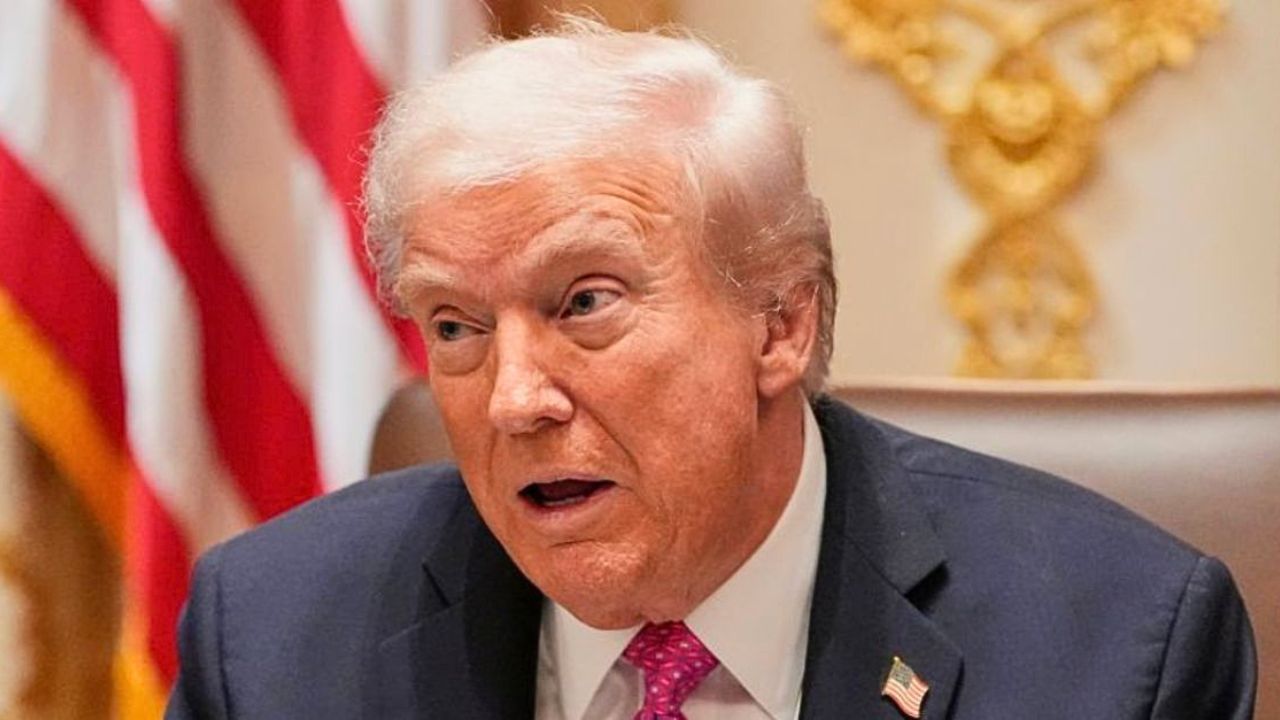
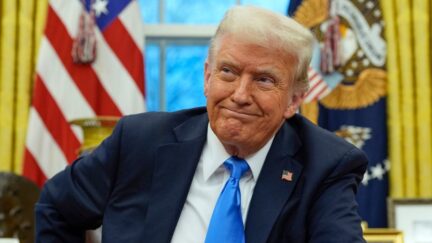
President Donald Trump speaks in the Cabinet Room of the White House, Friday, Oct. 17, 2025, in Washington (AP Photo/Alex Brandon).
A few days after the midterm elections, a Wisconsin federal court ruled that a federal law against noncitizen voting is unconstitutional in a blow to the Trump administration's recent crackdown.
In the underlying case, Allan Savier Tejeda Murillo was charged by the U.S. Attorney's Office in the Western District of Wisconsin with one count of unlawful voting by an alien over a ballot cast in the 2024 presidential election, according to an information filed in January.
The statute at issue is 18 U.S.C. § 611(a), and it contains a broad prohibition against noncitizens voting in federal elections, with a series of carveouts that allow for such voting in state or local elections if a jurisdiction authorizes it and abides by certain conditions.
The defendant, in an 11-page motion to dismiss filed in April, argued the statute itself "is unauthorized by the Constitution and usurps powers granted exclusively to the States" which allow them to "establish the qualifications of electors for federal elections."
To hear Tejeda Murillo tell it, the issue is a straightforward case of congressional infringement on states' rights.
"What part of the Constitution authorizes Congress to exclude certain classes of people from the franchise?" the motion to dismiss reads. "The answer is no part. No enumerated power in the Constitution or its Amendments allows Congress to establish voter qualifications. That power was retained by the States when the Founders 'split the atom of sovereignty.'"
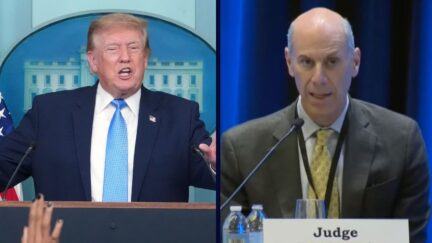
Now, in a 24-page opinion and order, U.S. Magistrate Judge Anita Boor largely agreed with the defendant's reasoning. In the order, however, the judge rejected Tejeda Murillo's facial challenge but granted dismissal based on his as-applied challenge.
Government action can typically be challenged facially, meaning in general, or as-applied, meaning in a specific circumstance.
In the case, the U.S. Department of Justice tried to claim the defendant lacked standing to challenge the statute.
The court dismissed the standing argument by noting that "the government's prosecution of defendant under §611 constitutes sufficient injury for defendant to challenge the statute."
On the merits, the government fared no better.
The court's order essentially mirrors the arguments advanced by the motion to dismiss.
"The U.S. Constitution unambiguously reserves to the states the power to set voter qualifications in federal elections," the order reads.
The judge says constitutional history offers no dispute that the framers intended for the states to define their own electorates.
The opinion first goes through general U.S. history to support this conclusion. Then, Boor takes stock of specific Wisconsin history to show that the state previously allowed noncitizen voting.
That permissive attitude changed first with a 1908 statute and then with a 2024 constitutional amendment, the court notes. And now, in line with all other U.S. states, Wisconsin bans noncitizen voting.
"While the states are now aligned in their requirements that their voters be U.S. citizens, that is the practical effect of their individual choices not a result of a federal rule," the court explains. "If any state decided to change their approach, it constitutionally could. These historical notes confirm that the states alone are empowered to decide their electorates."
The order goes on to find that along with constitutional history and text, the "statutory text" itself is "clear." That is, the statute is not aiming to do much of anything beyond defining the electorate.
"Section 611 sets a voter qualification because it was designed to shape the federal electorate," the judge says.
The opinion goes on like this:
It does not provide for election notices or voter registration. It does not concern supervision of voting, protection of voters, counting votes, or publishing election returns. Nor does it concern inspectors or canvassers. It bans noncitizens from voting, regardless of their legal status. As noted above, there is a long history of states allowing noncitizens to lawfully vote in federal elections, so there is nothing inherently fraudulent about this activity. In short, issuing a blanket ban on noncitizen voting isn't a direct approach to tamping down on fraud or fighting corrupt practices.
The court concedes that the statute was, when envisioned by its author, tied to some immigration functions. But the judge dismisses that legislative history as both "incidental" and ultimately irrelevant because it "cannot paper over otherwise unconstitutional excesses of authority."
The judge further rejects immigration arguments from the DOJ by noting that "Congress cannot rely on its plenary power" over immigration "to usurp authority reserved to the states."
"The problem with this statute is that Congress didn't have the power to enact it," Boor concludes. "The Constitution is clear that the states, and only the states, may set voter requirements. Congress cannot infringe that right."
Comments