
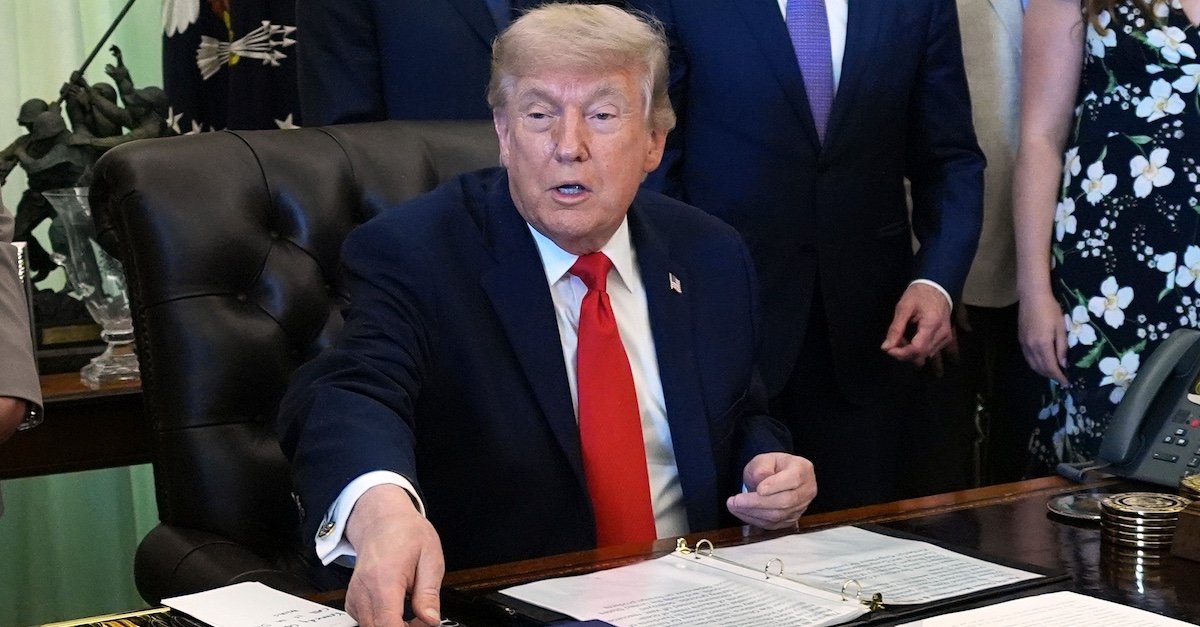
President Donald Trump speaks before signing a proclamation about the fishing industry, in the Oval Office of the White House, Thursday, June 11, 2026, in Washington (AP Photo/Jacquelyn Martin)
The Trump administration is suing Maryland over a recent law barring state and local law enforcement from cooperating with federal immigration authorities like Immigration and Customs Enforcement (ICE).
The 33-page complaint, filed Thursday, seeks to have Senate Bill 791, or the Community Trust Act, declared unconstitutional and asks a judge to enter an injunction blocking the state from enforcing the law.
"Despite the known dangers of such sanctuary policies, the State of Maryland insists on placing obstacles in the way of federal enforcement," the lawsuit reads. "Such blatant disregard for federal laws that have been on the books for decades is not merely a political disagreement or passive abstention; it is deliberate, disruptive action that jeopardizes the public safety for all Americans."
The lawsuit filed by the U.S. Department of Justice is largely premised on the federal preemption doctrine — a legal concept sourced from the Supremacy Clause of the U.S. Constitution.
"The United States has well-established, preeminent, and preemptive authority to regulate immigration matters," the filing goes on. "This authority derives from the U.S. Constitution, numerous acts of Congress, and binding U.S. Supreme Court precedent. Indeed, Congress last year strengthened that authority with the enactment of the Laken Riley Act."
To hear the DOJ tell it, the government is both expressly able to preempt state law regarding immigration and can implicitly override Maryland because the state law conflicts with federal authority.
"The challenged provisions of Maryland law reflect an effort to obstruct the operation of federal immigration law and to impede the consultation and communication between federal, state, and local law enforcement officials that is necessary for federal officials to carry out federal immigration law and keep Americans safe," the lawsuit continues.
Specifically, the government says the Laken Riley Act "mandates the federal detention of illegal immigrants who are accused of theft, burglary, assaulting a law enforcement officer, and any crime that causes death or serious bodily injury."
The DOJ also claims there are problems with the Community Trust Act that, while not spelled out, could affect immigration agents.
From the lawsuit, at length:
Under these laws, state and local officers and facilities are unable to comply with immigration detainers and civil immigration warrants in most instances. They are also generally prohibited from providing information to federal immigration authorities at all, including regarding the custody status or release of a targeted illegal alien. And the Community Trust Act limits the ability of state and local law enforcement officers to work with federal officers to effect the safe transfer of such individuals to federal immigration custody, even when federal officials present a federal administrative warrant.
The DOJ also insists the "harms visited by the Community Trust Act's obstructive innovations are not merely theoretical."
Again, the filing at length:
On May 29, 2026, a warden of the Worcester County Jail in Snow Hill, Maryland—a local correctional facility that had historically cooperated with ICE—contacted an acting Supervisory Detention and Deportation Officer to explain that, in accordance with the Community Trust Act, the facility would no longer honor ICE detainers, release individuals to ICE custody, or notify ICE when individuals are in custody and ready for release. As a direct result, the facility denied a scheduled ICE pickup that morning and did not release the individual in question to ICE custody.
State officials have made clear that Worcester County Jail's approach is the right one under the Community Trust Act.
The lawsuit also contains two counts premised on immunity – alleging the Maryland law attempts to unlawfully regulate federal law enforcement and discriminates against immigration agents.
"Federal immigration officers merely enforce the laws that our Nation's elected representatives in Congress passed, reflecting the will of We the People," Associate Attorney General Stanley Woodward said in a press release announcing the litigation. "When sanctuary jurisdictions enact laws to shield illegal aliens from federal law enforcement, it is not merely federal law that is violated, but the voices of everyday American voters silenced."






Comments