
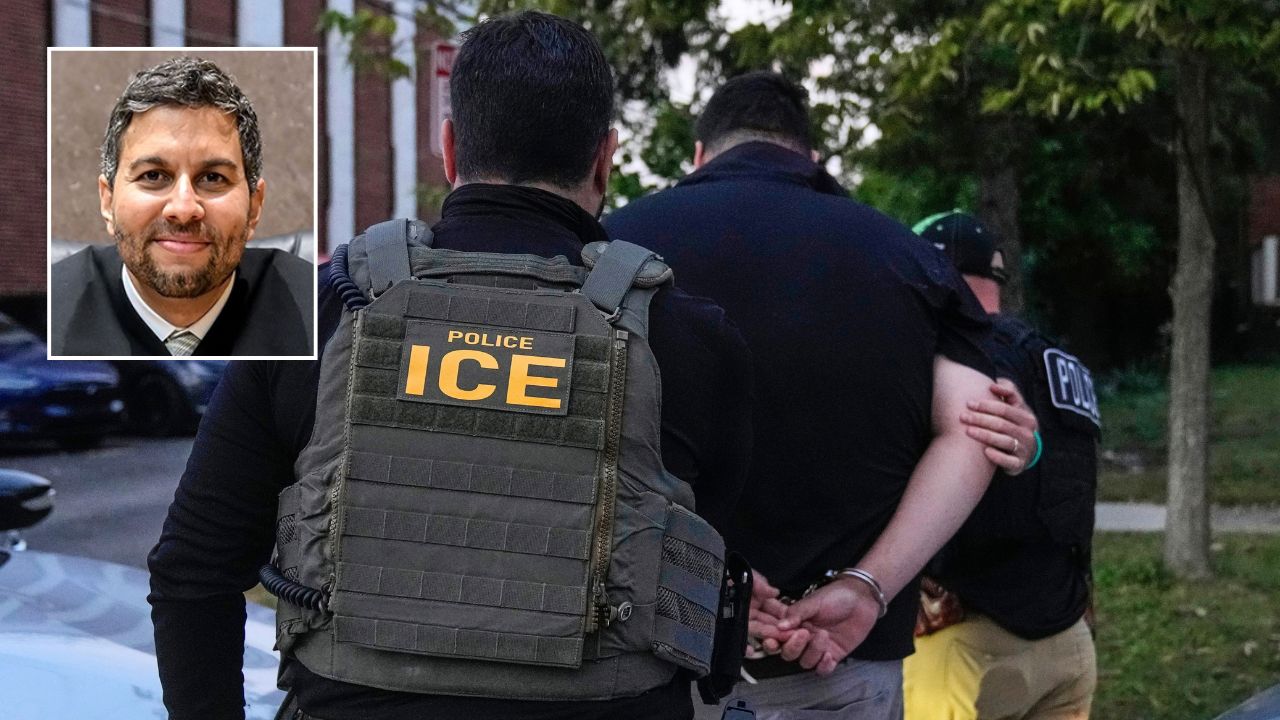
U.S. Immigration and Customs Enforcement agents make an arrest during an early morning operation in Park Ridge, Ill., Sept. 19, 2025. (AP Photo/Erin Hooley, File). Inset: Judge Amir H. Ali (U.S. District Court for the District of Columbia).
A federal judge has ordered the Trump administration to halt its policy telling immigration authorities they will not take biometric data — such as fingerprints and photographs — from detainees that is necessary for them to move forward in their applications for lawful status.
The policy from the U.S. Department of Homeland Security (DHS) must be stayed, U.S. District Judge Amir Ali declared on Wednesday, finding that it likely violates the Administrative Procedure Act (APA), the federal statute governing how agencies may make decisions.
The Joe Biden appointee wrote in his 23-page order that the detainees have sufficiently shown that the policy "is preventing them from pursuing immigration applications that, if granted, would preclude their detention and deportation."
On Dec. 5, 2025, U.S. Citizenship and Immigration Services (USCIS) — an agency under DHS — announced that immigration authorities "generally will not take biometrics of detained aliens" except for limited exceptions. USCIS gave several reasons for the policy, including "to deter the filing of frivolous claims."
As Ali outlined in his ruling, people "who have applied for immigration status and have been detained" by Immigration and Customs Enforcement (ICE) filed a lawsuit against DHS challenging this policy. In addition to saying it violated the APA, the detainees argued the policy "is contrary to the Immigration and Nationality Act" (INA) and violated due process.
Those filing the lawsuit were not simply detainees, though, but people with pending applications "for some type of immigration status," such as those seeking permanent residency, "special immigrant juvenile status for abused, abandoned, and neglected children," or a visa "for human trafficking survivors."
The judge then got to the crux of the issue.
"It is undisputed that most of the plaintiffs could not be detained and would not be deported if USCIS determines they are entitled to the immigration statuses they have applied for," he wrote. "It is also undisputed that for some plaintiffs, the submission of a complete application and satisfactory completion of background checks, which requires the collection of biometrics, can itself be enough to stay deportation or allow deferred action—even before USCIS's adjudication of their application."
In other words, collection of their biometric data is integral to the detainees' applications for the immigration status that they seek.
DHS defended its policy on several fronts.
First, the department said its policy "does not prohibit the plaintiffs' biometrics from being collected" because the detainees are not being held from either "showing up at their USCIS biometrics appointments" or "asking ICE officers to voluntarily collect their biometrics or take them to their biometrics appointments, even though ICE is no longer required to do so."
Ali found that "this argument makes little sense."
"[T]he plaintiffs are detained, so they cannot just go to their biometrics appointments," the judge wrote. "And, while the record indicates there have been some instances in which ICE has collected some biometrics from detained people with pending USCIS applications, the defendants were not able to articulate when ICE would or would not agree to collect biometrics."
He added: "At least some of the instances the defendants point to involve circumstances where ICE collected biometrics in response to litigation or a court order."
"Second, the defendants argue that the plaintiffs do not suffer injury even if the biometrics policy means they will be deported before resolution of their USCIS applications because the plaintiffs have no right to have their applications adjudicated before deportation, and some plaintiffs would be able to pursue their applications after being deported," the judge continued.
But he found that the plaintiffs have indeed "shown injury" from the policy that "acts as a de facto denial of their applications, substantially injuring their ability to obtain the immigration statuses they may be entitled to receive and leading to ongoing detention and the concrete risk of deportation that could not occur under law if their applications are granted."
He concluded on this point: "While it may be true that some plaintiffs could continue to pursue their applications upon deportation, deportation itself is plainly injury in fact. Indeed, in addition to the concrete injury of being removed from the country, the record contains evidence that some plaintiffs face threats to their lives in their home countries."
Finally, any claim that the biometrics policy is not "final agency action" is unpersuasive as federal officials have "publicly announced the decision on their website, updated their policy manual to reflect it, and implemented it by rescinding an agreement that required ICE to collect the biometrics."
Ali wrapped up his order by saying "[e]ach day," the biometrics policy "risks denying" the detainees a decision on their immigration status. "The court therefore sets aside the biometrics policy," he declared, giving the Trump administration until Oct. 21 to show the court that it has complied with his order.




Comments