
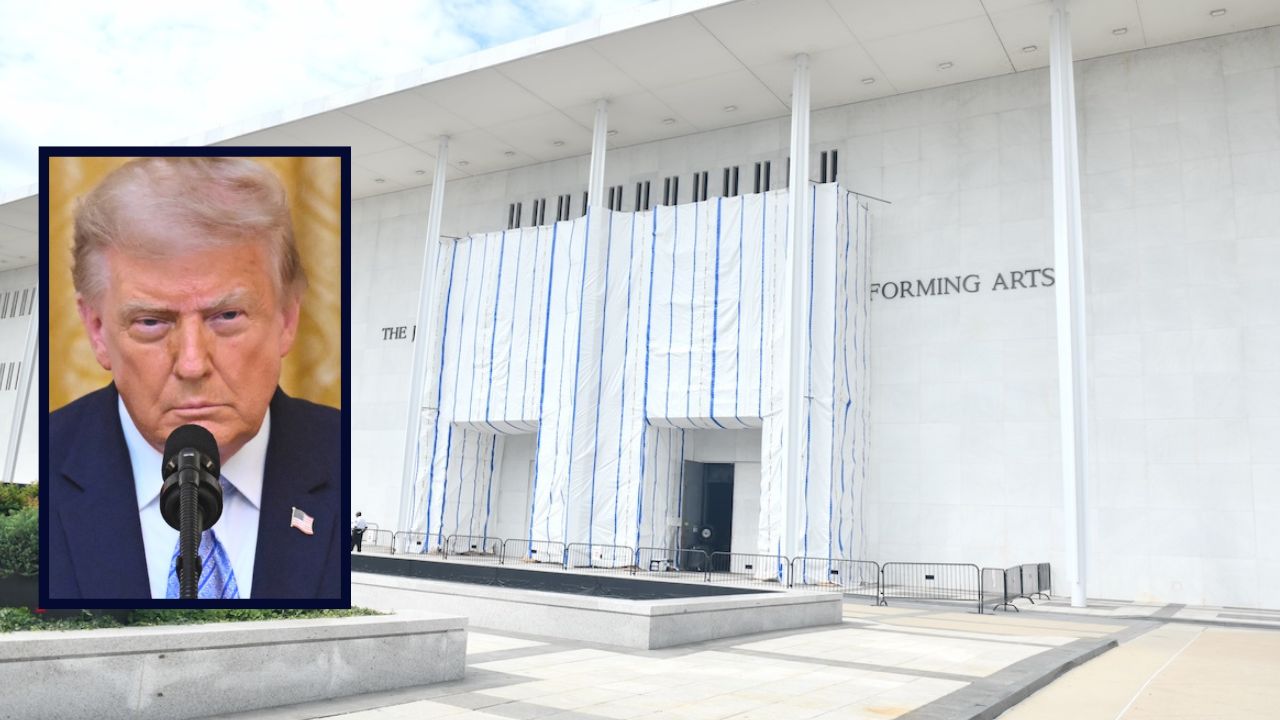
Left inset: President Donald Trump speaks in the East Room of the White House, July 16, 2026, in Washington (Saul Loeb/Pool via AP, File). Main: The front of the Kennedy Center remains covered as US President Donald Trump attempts to add his name to the front of the building despite court rulings against his efforts. (Photo by Dominic Gwinn / SOPA Images/Sipa USA)(Sipa via AP Images).
A federal judge has ordered the Kennedy Center board to provide extensive discovery materials to a lawmaker who sued over President Donald Trump's disputed plans to rename the arts and culture hub.
In a six-page opinion and order, U.S. District Judge Christopher Cooper, a Barack Obama appointee, ordered the board to release a redacted 163-page report prepared by a construction company, as well as "a short PowerPoint presentation" related to the proposed renovations.
"Defendants oppose unsealing, either in full or in part with redactions," the court observed. "Defendants have not met their burden to rebut the presumption of disclosure."
In the long-running case, Rep. Joyce Beatty, a Democrat from Ohio, originally filed a lawsuit over the government's plans to rename the center. As the case progressed — and the court forbade such a renaming — so did the government's position and stated plans.
In May, Cooper issued an order that barred the Trump-appointed board from renaming the center itself to include Trump's name.
In June, the board met again and signed off on more limited proposals to include Trump's name on various signage, including by inscribing "Renovated and Restored by President Donald J. Trump" and "Endowed by the Trump Kennedy Center Fund" on the facade and by naming the center's grounds "President Donald J. Trump Plaza."
The district judge blocked the board's plans in early September. Then, in late September, the Trump administration appealed that ruling to the U.S. Court of Appeals for the District of Columbia Circuit and warned that the center would literally fall apart unless the 45th and 47th president received "appropriate recognition" somewhere on the property.
Meanwhile, Beatty has been involved in a discovery dispute with the government as the underlying merits dispute moves forward.
Earlier this week, the lawmaker complained to the court that the Trump administration has erected a "stone wall of executive privilege" in response to her requests for the "construction plan" and PowerPoint presentation in question.
Notably, Beatty says that those documents were sent to the board 48 hours before an early August meeting resulted in yet another "temporary" closure to address "significant safety hazards" at the center.
In his latest order, Cooper notes the government itself concedes those "two documents informed the Board's deliberations."
As for the PowerPoint, the government also did not oppose releasing the document, the judge noted. At the same time, the Trump administration opposed releasing the construction report by arguing "public release of this kind of physical information of a federal public building of this nature would be unprecedented and could pose a material security risk to the building and those within."
To that end, the court said its analysis "strongly militates toward unsealing" the construction plan largely because it "was created for and used by the Board of a public trust deliberating how to use public funds to renovate a public building."
"Defendants introduced and extensively rely on the [construction plan] in this case," the order reads. "That alone heavily favors unsealing."
Cooper also noted that several media outlets "have already reported at least some of the contents" of the plan — which, along with photographs and building schematics currently part of the case record — means the public already knows much of the plan.
The court did offer one salve to the Trump administration, delaying the release of the plan to provide an opportunity for the government to propose "narrowly tailored redactions" in a follow-up filing.
"Defendants offer no reason why targeted redactions will not suffice to protect any safety and security interests," the order goes on. "The vast majority of the [construction plan] appears to contain information that is non-sensitive or already publicly available."






Comments