
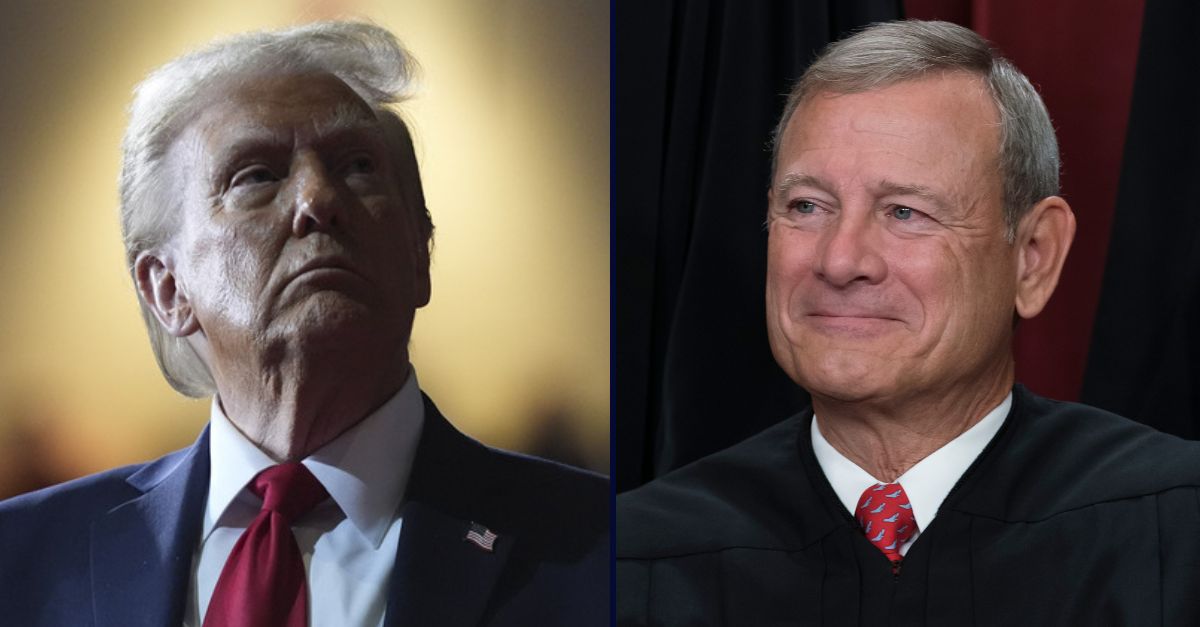
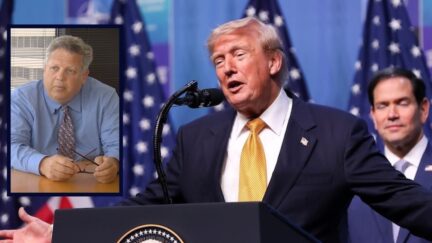
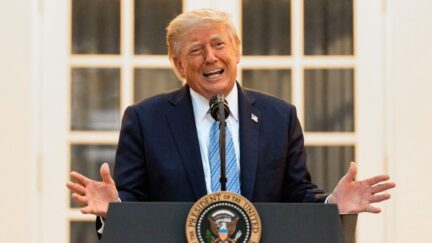
Left: FILE – Republican presidential nominee former President Donald Trump watches a video screen at a campaign rally at the Salem Civic Center, in Salem, Va, Nov. 2, 2024 (AP Photo/Evan Vucci, File). Right: FILE – Chief Justice of the United States John Roberts joins other members of the Supreme Court as they pose for a new group portrait, at the Supreme Court building in Washington, Oct. 7, 2022 (AP Photo/J. Scott Applewhite, File).
In a supreme setback for President Donald Trump on Friday, Supreme Court justices — those not named Clarence Thomas, Samuel Alito, and Brett Kavanaugh — tore apart and struck down the executive's claimed power to unilaterally impose emergency trade deficit and drug trafficking tariffs as unlawful.
The Trump administration had darkly warned the U.S. Supreme Court that siding against the president in the area of national security and foreign policy would put the country on the road to another Great Depression and let Mexico, Canada, and China off the hook. On the eve of oral argument, Trump himself posted that if the justices didn't rule in favor of his International Emergency Economic Powers Act (IEEPA) tariffs it's "literally, LIFE OR DEATH for our Country."
U.S. Solicitor General D. John Sauer during oral arguments in November similarly placed any negative consequences of invalidating the tariffs at the feet of the justices, saying the president must be able to respond to "exploding trade deficits" that "brought us to the brink of an economic and national security catastrophe."
Chief Justice John Roberts and Justices Amy Coney Barrett, Neil Gorsuch, Sonia Sotomayor, Elena Kagan, and Ketanji Brown Jackson were undeterred.
Roberts, penning the opinion of the court, was clear that Trump claimed an authority he doesn't have.
"We claim no special competence in matters of economics or foreign affairs. We claim only, as we must, the limited role assigned to us by Article III of the Constitution," the chief justice wrote. "Fulfilling that role, we hold that IEEPA does not authorize the President to impose tariffs."
The two cases before the Supreme Court were brought by wine and spirits importer and distributor V.O.S. Selections, Inc. and Learning Resources, Inc. In early September, the high court granted the latter petitioner certiorari before judgment, leapfrogging the appellate court to consolidate the case with V.O.S. Selections, in the aftermath of the U.S. Court of Appeals for the Federal Circuit's 7-4 ruling in August that Trump's unilaterally imposed trade deficit emergency tariffs were unconstitutional.
The lower court quickly noticed that the IEEPA, the statute Trump cited, "doesn't mention the word tariffs" and was never used for tariffs in the half-century of the law's existence.
Coming off the major loss at the U.S. Court of International Trade, Sauer insisted to a skeptical Roberts, Barrett, Kagan, and Sotomayor that asserting a power to tariff or "regulate importation" is not the same as a "power to tax."
Roberts, for his part, kept asking about the major questions doctrine, which has served to limit the executive branch from interpreting vague legislative language in a way that would give the president power to effectuate sweeping changes on a national level without the approval of Congress.
"That seems like — I'm not suggesting it's not there — but it does seem like that's major authority, and the basis for the claim seems to be a misfit. So why doesn't it apply again?" the chief asked.
The Supreme Court has applied the major questions doctrine and "rejected agency claims of regulatory authority," a congressional research paper explains, when "(1) the underlying claim of authority concerns an issue of 'vast 'economic and political significance,' and (2) Congress has not clearly empowered the agency with authority over the issue."
A read of the Friday opinion shows why Roberts kept hammering away on the subject, as there was some division on the court. While the liberal wing of the court's majority believed that the Supreme Court's "ordinary tools of statutory interpretation" would "amply support" the conclusion that Trump didn't have tariff authority under IEEPA, Roberts, Barrett, and Gorsuch made a point to invoke the major questions doctrine.
Roberts said the "stakes" are about as high as imaginable, so he was "alert to claims that sweeping delegations—particularly delegations of core congressional powers—'lurk[]' in 'ambiguous statutory text.'"
"The Government points to projections that the tariffs will reduce the national deficit by $4 trillion, and that international agreements reached in reliance on the tariffs could be worth $15 trillion," he said, taking Trump's words seriously. "In the President's view, whether 'we are a rich nation' or a 'poor' one hangs in the balance. These stakes dwarf those of other major questions cases."
The chief justice then stated that Trump "cannot" show Congress delegated its power and authorized him to unilaterally issue tariffs under IEEPA.
"There is no major questions exception to the major questions doctrine," Roberts added. "Accordingly, the President must 'point to clear congressional authorization' to justify his extraordinary assertion of the power to impose tariffs. He cannot."
Gorsuch was of the same mind, that the major questions doctrine "safeguards" against "executive encroachment" on the turf of lawmakers.
Trump cannot tariff "practically any products he wants, from any countries he chooses, in any amounts he selects" in the absence of "clear" authority on an issue this impactful.
"Under the doctrine's terms, the President must identify clear statutory authority for the extraordinary delegated power he claims. And, as the principal opinion explains, that is a standard he cannot meet," Gorsuch wrote in a concurrence. "Whatever else might be said about Congress's work in IEEPA, it did not clearly surrender to the President the sweeping tariff power he seeks to wield."
In a dissent, Kavanaugh said that Trump's tariffs "may or may not be wise policy," but he still backed the president.
"The tariffs at issue here may or may not be wise policy. But as a matter of text, history, and precedent, they are clearly lawful," he said.
Follow Law&Crime:


Comments