
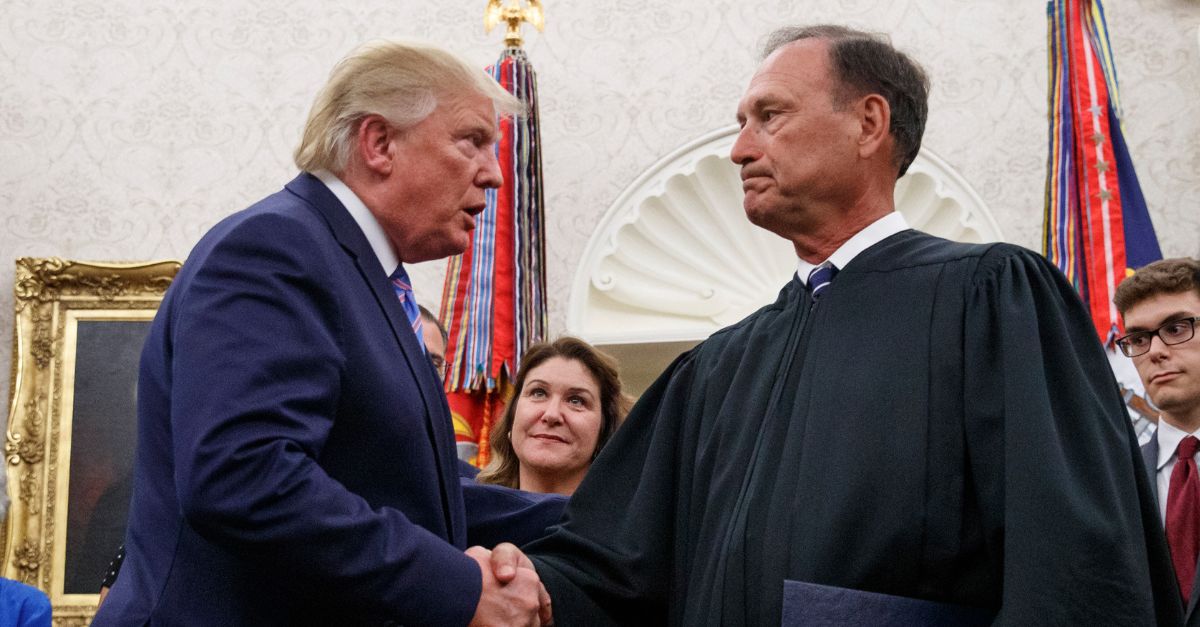
President Donald Trump shakes hands with Supreme Court Justice Samuel Alito after Mark Esper was sworn in as Secretary of Defense during a ceremony in the Oval Office at the White House in Washington, Tuesday, July 23, 2019. (AP Photo/Carolyn Kaster)
The U.S. Supreme Court on Thursday gave the Trump administration permission to revoke protections for hundreds of thousands of Haitians and Syrians who have been in the U.S. for years.
Beginning last year, President Donald Trump and his Department of Homeland Security (DHS) appointees have pushed to end the temporary protected status (TPS) program. Under federal law, TPS offers people fleeing humanitarian disasters a limited reprieve in the form of legal status that allows them to live and work in the country.
Now, after several false starts and stays, the nation's high court has ruled the government can dispense with the program.
Writing for a 6-3 court, Justice Samuel Alito framed the specific procedural issue as to whether the classes of plaintiffs in the underlying lawsuits are "entitled to orders postponing the terminations" while the litigation played out before the lower courts.
"We hold that they are not," the opinion reads.
In real terms, some 350,000 Haitians and more than 6,000 Syrians will almost certainly soon find themselves without legal status and facing deportation as a result of the ruling. The government will also likely move to revoke other TPS determinations for other groups.
At the beginning of the merits analysis, Alito says the TPS statute itself offers less than zero in terms of redress once the DHS secretary makes a decision to enact, extend, or terminate a TPS designation.
In fact, the opinion notes, courts are "barred from reviewing" any kind of such claim because of how the TPS statute is written — that is, the law itself says there "is no judicial review" available whatsoever.
In other words, the courts have no role to play when it comes to a TPS designation made by the executive branch, the high court ruled. Internally, the statute largely insulates DHS from judicial oversight.
"This text is clear, and its plain meaning is very broad," Alito writes.
There are, of course, always external challenges plaintiffs can lodge to any law or government action by way of the U.S. Constitution. The plaintiffs made those, too. Those were also unconvincing.
"The sole constitutional claim before us will likely fail," Alito goes on. "Citing statements made by President Trump and former Secretary of Homeland Security Kristi Noem, one set of respondents advances an equal protection claim that Haiti's TPS designation was terminated because of the racial makeup of that country's population."
At the district court level, in the Haitian termination case, U.S. District Judge Ana C. Reyes, a Joe Biden appointee, endorsed the perspective that Noem "preordained her termination decision and did so because of hostility to nonwhite immigrants."
In the litigation specifically targeting the Syrian termination decision, the plaintiffs added a collection of statements made by the 45th and 47th president to argue racial hostility motivated the government's decision.
The majority, however, rejected those claims out of hand.
"None of the cited statements by either the President or the Secretary was overtly racial, and in substance all expressed policy views that could rest on race-neutral justifications," Alito goes on.
The justice adds that a person can describe the "harshly unfavorable description of living conditions in some" TPS-designated countries without being racist because the criteria for TPS "guarantee that many, if not most, designated countries have such characteristics."
Aside from simply rejecting the statements as racial enough to trigger equal protection problems, the majority also says the plaintiffs ultimately defeated their own constitutional argument.
"[I]ronically, one of respondents' other arguments undermines the equal protection claim by offering a strong, race-neutral explanation for Haiti's termination: namely, that the current administration, which has terminated every TPS designation that has come up for renewal, simply opposes the TPS program, at least as it has been implemented in the past," the majority opinion continues.
Here, Alito says the "preordained" decision to end TPS for Haitians and Syrians had nothing to do with race, but with simply ending TPS as part of the administration's immigration agenda.
"[R]espondents are unlikely to prove that race was a motivating factor in the decision to terminate Haiti's TPS designation," the opinion concludes. "It follows that they are not entitled to interim relief on their equal protection claim."
In dissent, Justice Elena Kagan all but throws up her hands.
"Miot, Doe, and the other plaintiffs before us deserve better than today's decision," the dissent reads. "True enough that TPS is a temporary program, and that it did not promise the plaintiffs never-ending humanitarian protection. But the law prevents the program from ending as it likely did here–without the required consultations about country conditions and, as to Haiti, with impermissible race-based considerations tainting the decision."



Comments