
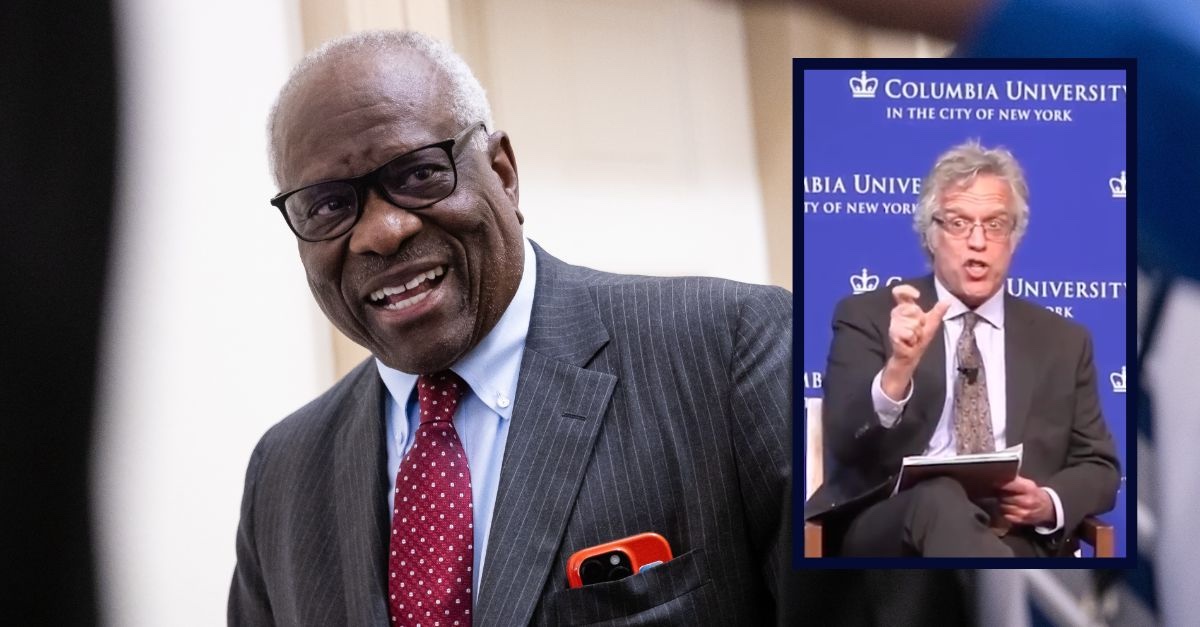
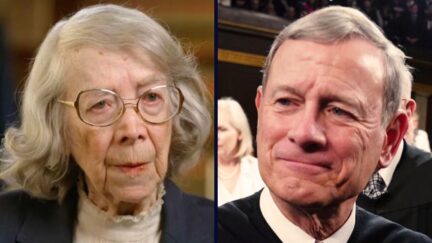
Main: Supreme Court Justice Clarence Thomas speaks with a reporter as he departs the U.S. Capitol on June 29, 2026. (Francis Chung/POLITICO via AP Images). Right inset: U.S. Circuit Judge Stephen Higginson speaks in April 2025 at Columbia University's Institute of Global Politics (Columbia University/Instagram).
A judge warned of "untold consequences" for American law now that the whole 5th U.S. Circuit Court of Appeals has agreed to rehear a gun case, within one month of Justice Clarence Thomas calling for courts to "revisit" the relevant statute's constitutionality.
U.S. Circuit Judge Stephen Higginson on Monday penned a brief dissent, as the 5th Circuit revealed a "member of the court […] requested a poll on the petition for rehearing en banc, and a majority of the circuit judges in regular active service and not disqualified […] voted in favor."
The petition for a rehearing en banc was filed on June 16 by Curtis Squire, a convicted felon who was indicted in Louisiana under 18 U.S.C. § 922(g) after police "found a handgun in his home during a search related to a shooting investigation" not involving the firearm in question.
Notably, Squire's petition raising a "question of exceptional importance" was filed two days before Thomas penned a solo concurrence in U.S. v. Hemani.
In the Supreme Court's ruling from June 18, the majority sided against the federal government, ruling it could not apply the criminal statute to a Texas man who uses marijuana "a few times a week" and also owns a gun. As Law&Crime noted at the time, Thomas on his own expressed doubts that Congress could "criminalize[] possession of firearms apart from any purchase or sale of goods and services across state lines" under the Commerce Clause.
"So, while the issue was not presented in this case, the Court, and lower courts, should revisit the constitutionality of §922(g)," Thomas said.
And that is what the 5th Circuit set in motion on Monday, over the objection of the U.S. Attorney's Office for the Eastern District of Louisiana — to Higginson's dismay.
"Just a few weeks ago, Justice Thomas, writing alone, asked lower courts to reexamine the constitutionality of 18 U.S.C. § 922(g) under the Commerce Clause. Already, our court answers the call. Today, we grant a petition for rehearing in what was a Second Amendment as-applied challenge to § 922(g)(1), now reframed as a facial Commerce Clause challenge. So, rather than clarifying our § 922(g)(1) as-applied precedent to provide fair notice to people in Louisiana, Mississippi, and Texas about whether they can lawfully own guns, we imperil much
of the United States Code," the judge said.
In 2025, Higginson spoke at Columbia University's Institute of Global Politics about disagreements among judges, saying he typically asks himself — in the hopes of reaching compromise — whether a judge he has a disagreement with is concerned about the past, the present or the future.
His dissent on Monday sounded the alarm of "untold consequences," writing that the 5th Circuit "welcomed the possibility of finding that Congress's Commerce Clause authority cannot support § 922(g)" — something that would "have massive import for federal law."
"More broadly, what would come of the countless other federal statutes hinging on Congress's well-settled commerce authority? Can the federal government no longer criminalize possession of child pornography? Of explosive materials? Of biological weapons? Past the Title 18 level, do we lose regulations on financial transactions? On intellectual property? On endangered species?" the judge asked. "All told, this case hazards untold consequences for federal law. What was a Second Amendment as-applied challenge to § 922(g)(1)—where we have studiously avoided taking an inter-circuit split and our own intra-Circuit split en banc—now leaps beyond the felon-in-possession statutes, beyond federal criminal law, and beyond our authority as an inferior court. I dissent."
Higginson, appointed by then-President Barack Obama in 2011, also wondered if the result will be that similarly situated "felons from the other eleven circuits [can] now flood the Gulf Coast to rearm themselves[.]"
Follow Law&Crime:

Comments