
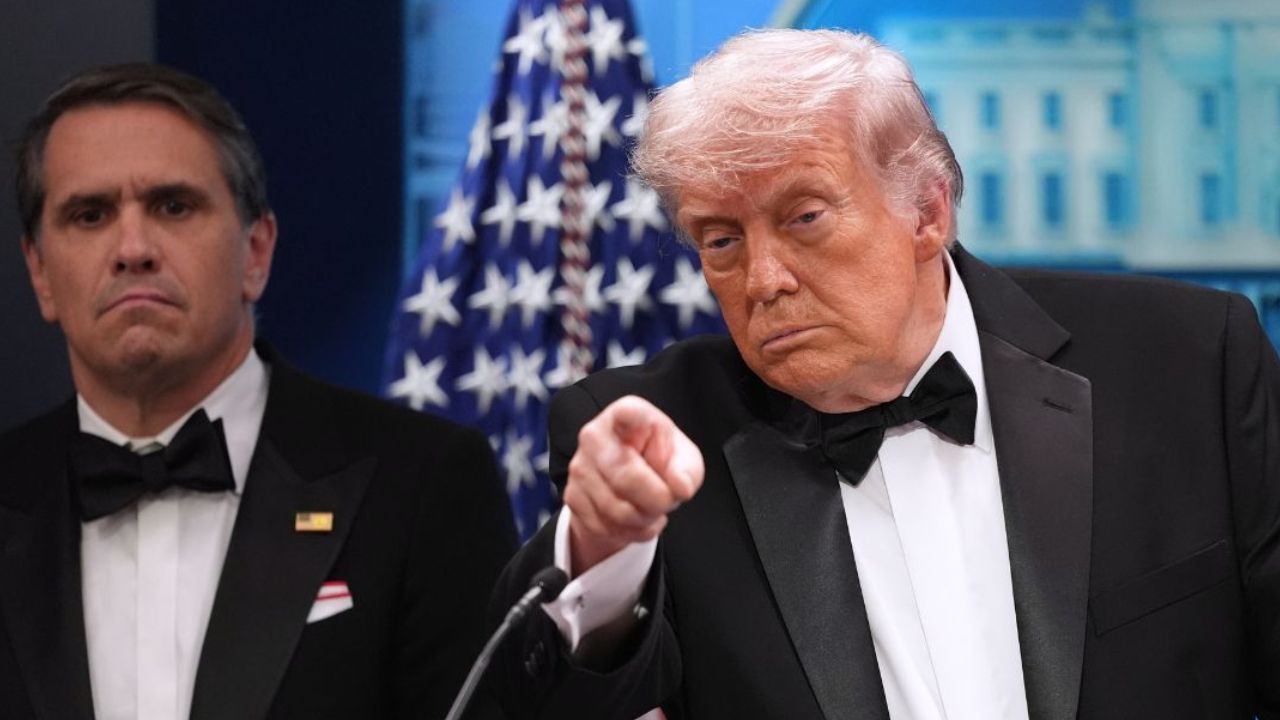
President Donald Trump speaks in the James Brady Press Briefing Room at the White House after an unspecified threat at the annual White House Correspondents' Association Dinner in Washington, Saturday, April 25, 2026, as then-acting Attorney General Todd Blanche looks on (AP Photo/Alex Brandon).
A former high-ranking official in the Department of Justice who was fired by the Trump administration has filed a federal lawsuit in Washington, D.C., alleging she was "unlawfully removed."
In early 2025, Elizabeth Oyer worked as the DOJ pardon attorney, a career position assisting the executive branch with clemency issues.
Once President Donald Trump returned to the White House, however, Oyer was "asked to disregard her duties and facilitate a political favor for the actor Mel Gibson," according to her 32-page complaint.
To hear Oyer tell it, Gibson's "relationship with" Trump resulted in a demand for her to "make it seem like an independent review" determined the actor "who was convicted of a domestic violence offense, should have his gun rights restored," the lawsuit alleges.
"Ms. Oyer declined," the lawsuit continues. "Shortly after, she was fired by then-Deputy Attorney General Todd Blanche."
The only message Blanche gave was that she was out of her job in the Office of the Pardon Attorney "pursuant to Article II of the United States Constitution and the laws of the United States."
This excuse simply was not legal, Oyer says.
"DOJ made no pretense of adhering to statutorily mandated procedures, which required DOJ to provide Ms. Oyer with notice and an opportunity to be heard," the lawsuit goes on. "Nor did DOJ purport to remove Ms. Oyer for any statutorily allowable reason."
Instead, Oyer received the "terse notice" containing the boilerplate claim about the Article II powers, the lawsuit claims.
The plaintiff says her termination violated her constitutional due process rights and her rights under the Civil Service Reform Act (CSRA). The lawsuit also claims a First Amendment violation because the removal was partially based on Oyer's "perceived political affiliation."
Oyer claims a further constitutional violation of the separation of powers doctrine "because 'Article II' does not give DOJ carte blanche to disregard removal protections mandated by Congress."
The plaintiff says the gun rights request for the Hollywood actor was the real reason for her firing.
First, Oyer notes, she was assigned the "unusual task" of developing a list of people whose gun rights were lost due to criminal convictions, but "who merited" consideration for gun rights restoration by the DOJ, according to the lawsuit.
The plaintiff worked in a group to develop a list of 95 such individuals and provided the data to Blanche. In turn, Blanche's office whittled that list down to nine individuals and asked Oyer to develop a memo making the case for restoration, the filing recounts.
"Ms. Oyer drafted the memo, as requested," the lawsuit continues. "Mr. Blanche's staff then came back to Ms. Oyer with another request: they asked her to add the actor Mel Gibson to the list."
The plaintiff says she declined to put Gibson on the list for two reasons. First, she cited the actor's history of domestic violence. Second, she noted that "unlike the other individuals on the recommended list for gun rights restoration, who had undergone a significant amount of background investigation, Mr. Gibson had not been investigated." Oyer said the lack of an investigation meant her team "was not able to assess his likelihood of recidivism."
On March 6, 2025, Oyer sent an email indicating that Gibson would not make the cut, according to the lawsuit.
"Later the same day, a senior official on Mr. Blanche's staff called Ms. Oyer and urged her to recommend reinstatement of Mr. Gibson's gun rights anyway in consideration of the fact that Mr. Gibson had a personal relationship with President Trump," the complaint goes on. "The official employed a bullying tone and suggested to Ms. Oyer that she would be wise to make the recommendation."
The next day, Oyer penned a formal memo relaying her concerns with Gibson's case and noting the attorney general had the ultimate decision in the matter, the lawsuit says.
Later that day, during a meeting on an unrelated issue, a colleague pulled her aside and told her that security was waiting in her office to deliver termination documents, the lawsuit alleges. In her office, she was handed Blanche's short memo while security officers "instructed her to pack up her personal belongings, and escorted her out of the building."
Aside from statutory and constitutional violations, the filing insists the firing was illegally political:
DOJ's perception [was] that Ms. Oyer, who was hired during the Biden Administration, was not politically affiliated with the current Administration. Indeed, when Ms. Oyer declined to disregard her duties in order to perform a favor for her politically-appointed superiors and President Trump, she was summarily terminated.
The plaintiff is requesting a declaratory judgment that her firing violated the law and Constitution. She is also seeking reinstatement, back pay and benefits, and an injunction barring the Trump administration "from taking any further adverse personnel action" against her.


Comments