
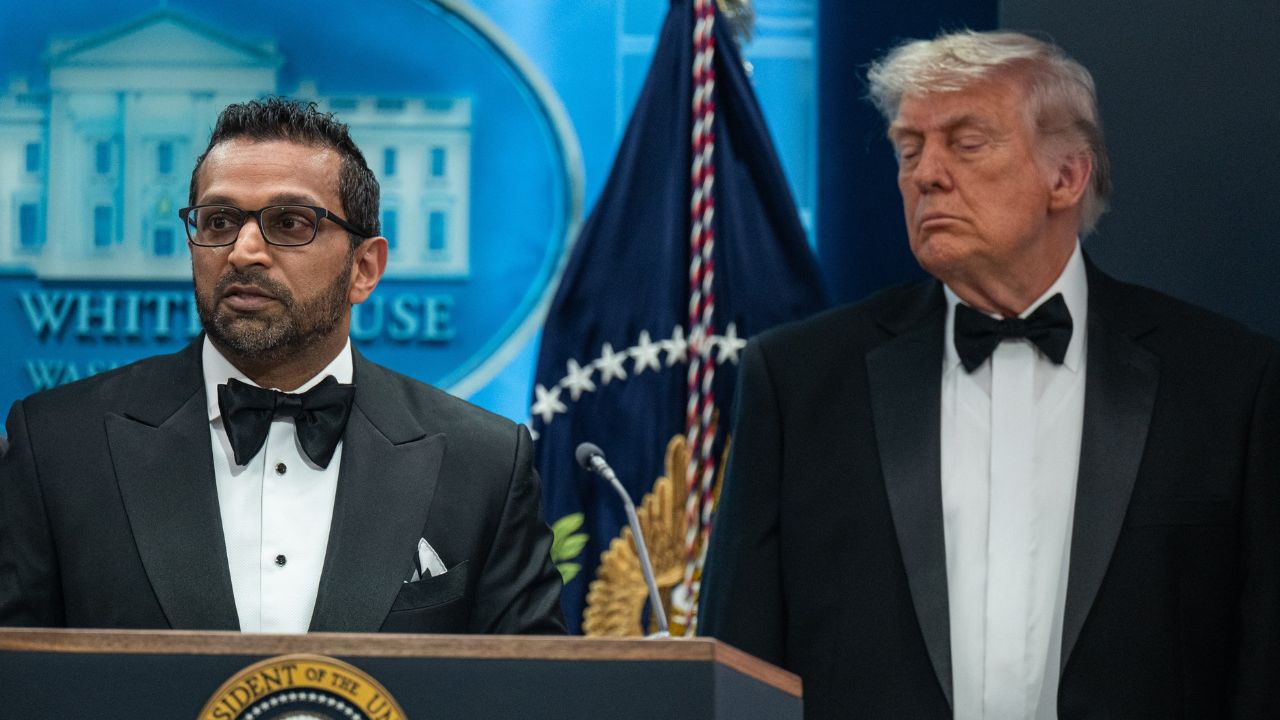
U.S. Director of the Federal Bureau of Investigation of the United States Kash Patel as U.S. President Donald Trump holds a press briefing at the White House after shots were fired at the Washington Hilton in Washington, DC, where he was set to give remarks, on April 26, 2026 (Photo by Annabelle Gordon/Sipa USA/via AP Images).
The Trump administration is violating the Freedom of Information Act (FOIA) by refusing to release records about FBI Director Kash Patel's efforts to purge the bureau of agents deemed disloyal to President Donald Trump, according to a lawsuit filed this week.
In an 11-page complaint filed Wednesday in Washington, D.C., former agent and 16-year veteran Michael Feinberg accuses the FBI of violating statutory deadlines and unlawfully withholding records.
"To date, the FBI has failed to make a determination on Mr. Feinberg's request or produce any of the requested records," the lawsuit reads. "Mr. Feinberg now brings this suit to compel compliance with the requirements of FOIA."
The litigation stems from the circumstances under which Feinberg left the bureau in early 2025.
In the lawsuit, Feinberg contextualizes changes within the FBI as beginning during "the first months" of the second Trump administration, which included "sweeping personnel changes."
"Patel, assisted by a group of employees known as the Director's Advisory Team, specifically targeted agents he perceived as adverse to President Trump," the lawsuit goes on. "Mr. Feinberg was one of those agents."
As the changes took root, Feinberg says, it became clear that he was viewed with suspicion by the new leadership.
"Mr. Feinberg learned that he would likely lose a promotion and instead face a demotion and a polygraph test," the lawsuit continues. "Why? Because Mr. Feinberg counted among his friends a former agent fired during President Trump's first term."
The friend in question was Peter Strzok, the onetime FBI agent who was fired in 2018 after an infamous series of text messages critical of Trump came to light. That association apparently led to questions and a phone call from the Special Agent in Charge "asking him about his friendship."
That phone call, Feinberg claims, came at the behest of Dan Bongino, then-deputy director of the FBI.
From the complaint, at length:
The Special Agent in Charge told Mr. Feinberg that, because of his friendship with Strzok, Mr. Feinberg could no longer expect a promotion and in fact risked demotion … A more senior employee at the FBI subsequently warned Mr. Feinberg that he would be expected to grovel and pledge his loyalty to the political leadership to stay in his position, and that he may be asked for whom he voted.
"Rather than face professional purgatory or worse, Mr. Feinberg resigned," the lawsuit goes on.
The erstwhile agent then became, in his own words, "an outspoken critic of the agency's executive leadership" and began a second life as a contributor for Lawfare, a national-security-focused legal blog. Feinberg also works on FBI-related issues for a nonprofit advocacy organization that supports current and former civil servants at the U.S. Department of Justice.
In May of this year, Feinberg submitted his FOIA request seeking "information related to his tenure at the agency and the circumstances surrounding his departure," the lawsuit notes.
"This information is of significant public interest, as it sheds light on the workings of the nation's preeminent federal law enforcement agency during the current administration," according to the complaint.
The lawsuit suggests the information contained within the requested records is part and parcel of his journalistic and nonprofit work.
"Mr. Feinberg now writes for a popular audience about the FBI," the filing continues. "As part of this work, he seeks to better understand the changes to the agency implemented in this administration … he views his public speaking and writing as an effort to address and ameliorate the FBI's shortcomings."
The FOIA request was quickly derailed by the estimated wait time, Feinberg says.
"The FBI informed Mr. Feinberg that the estimated date of completion for his request would be 2,010 days—or roughly five and a half years—from when the FBI opened the request," the lawsuit goes on. "When Mr. Feinberg asked whether the lengthy processing time had any connection to his public criticism of recent changes at the agency, the FBI refused to answer."
The former agent insists he knows his way around a FOIA request.
"Mr. Feinberg took care to be as granular as possible in crafting his FOIA request given his own prior experience responding to FOIA requests while working at the FBI," the lawsuit continues. "Mr. Feinberg constrained his requests to a narrow time period … Mr. Feinberg specifically requested unclassified or redacted materials to avoid implicating any exemptions under FOIA."
Since the lengthy processing estimate, however, Feinberg has received no further communications, the lawsuit alleges.
The lawsuit asks the court to find an unlawful "failure to comply with FOIA," that Feinberg is "entitled to disclosure of the requested records" and to issue an order directing the FBI to "immediately process Mr. Feinberg's request and to disclose responsive record."


Comments