
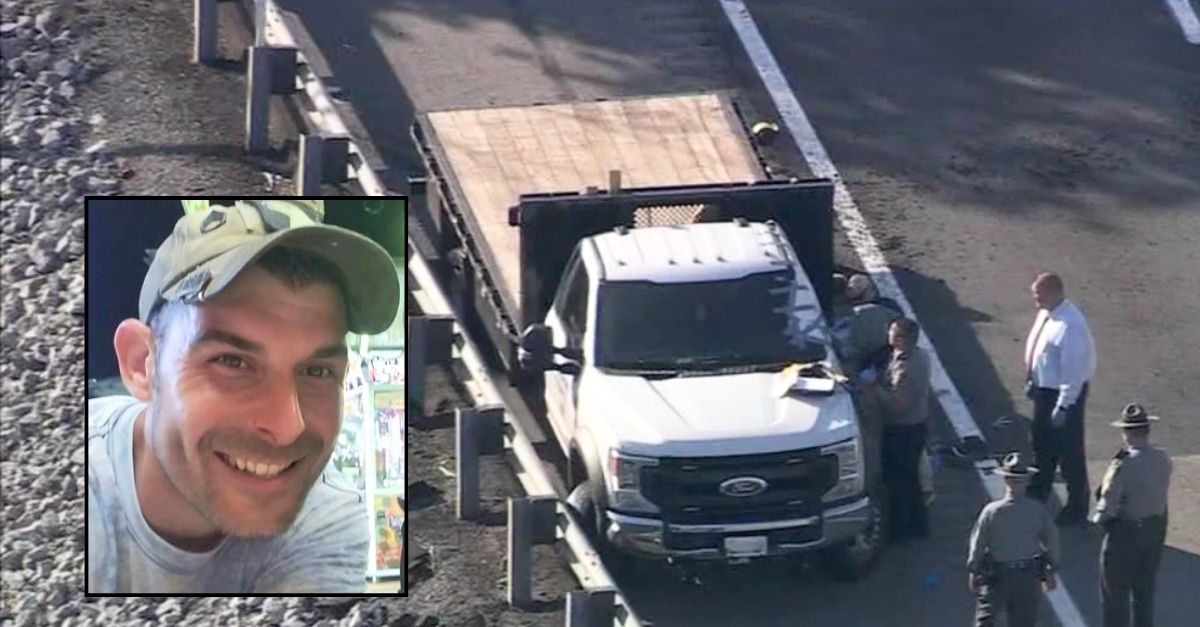
Inset: Michael Alfonse (Legacy.com/Catagnus Funeral Home and Cremation Center). Background: The vehicle that Michael Alfonse was driving when a Walmart truck driver allegedly killed him in a road rage shooting (WPVI/YouTube).
A federal judge in Pennsylvania is allowing a wrongful death lawsuit against Walmart over a road rage killing carried out by one of its truck drivers while he was on the clock to proceed.
"Plaintiff has alleged sufficient factual matter to state plausible claims for vicarious liability and negligent hiring, supervision, training, and retention," wrote U.S. District Court Judge John M. Gallagher in a ruling filed last week in the Eastern District of Pennsylvania.
The father of victim Michael Alfonse sued the retail giant in June, claiming Walmart "failed to conduct an appropriate background check" on its driver, Ivan Hawkes, and "failed to maintain and enforce policies and procedures prohibiting their drivers from possessing and/or carrying firearms or other deadly weapons while on the job."
Hawkes died by suicide after gunning down Alfonse on the Pennsylvania Turnpike in May 2024, according to local ABC affiliate WPVI. He was driving a tractor-trailer when he and Alfonse, who was driving a flatbed truck, got into an altercation on the road that led to Hawkes opening fire.
Alfonse was shot in the head and died at a local hospital.
"On or about May 31, 2024, decedent was shot and killed due to defendants' negligence, when their agent, servant, workman and/or employee shot decedent on the PA Turnpike in Brecknock Township, PA," the complaint filed by Alfonse's dad alleges. "At all times relevant hereto, decedent employee Ivan Hawkes was in the course and scope of his employment for defendants. At all times relevant hereto, defendants were responsible for decedent employee Ivan Hawkes' actions, were responsible to perform proper background checks on same and responsible to hire only competent, safe workers, as well as training and supervising employees."
In addition, the lawsuit says, Walmart "[f]ailed to recognize [Hawkes'] warning signs of propensity to act out with regard to propensities of road rage."
Walmart's lawyers filed a motion to dismiss on June 8 for failure to state a claim. Gallagher noted in his ruling that the store's legal team argues that the complaint "rests on conclusory assertions and lacks sufficient allegations to plausibly state any claim for relief." He listed multiple reasons why Alfonse's father has "alleged sufficient factual matter" to support his claims.
"Defendants contend that Hawkes's alleged conduct was so outrageous and personal in nature that it necessarily falls outside the scope of his employment," Gallagher explained. "Defendants' argument, however, asks the court to resolve factual questions that are not properly addressed at this stage. At this stage, the court's task is limited to whether to determining the complaint contains sufficient factual allegations, accepted as true, to state a claim for relief that is plausible on its face."
Gallagher ruled that Alfonse's father has "plausibly alleged" that Hawkes was acting within the course and scope of his employment by operating a company vehicle and performing "work-related duties." He wrote that the "fatal encounter arose from a driving-related interaction occurring during Walmart's commercial operations," rather than an incident during which Hawkes was off the clock.
"These allegations permit the reasonable inference that Hawkes's conduct was connected to the duties assigned to him," Gallagher said. "Whether Hawkes acted out of personal motives or in furtherance of his employer's business is a fact-intensive question that cannot be resolved at the pleading stage."
Walmart's lawyers argued in the motion to dismiss that the negligent hiring and supervision claims fail because Walmart did not supply Hawkes with the firearm that he used in the shooting.
"That argument is immaterial," Gallagher ruled.
"Liability for negligent hiring and supervision does not turn on whether the employer furnished the instrumentality that caused the harm," the judge said. "The relevant inquiry is whether the employer knew or should have known of the employee's dangerous propensities such that the resulting harm was reasonably foreseeable."
Under Pennsylvania law, an employer may be held directly liable where it knew or should have known of an employee's dangerous propensities and where the resulting harm was reasonably foreseeable, Gallagher noted.
"Plaintiff alleges that defendants failed to address conduct that they 'knew or should have known was occurring' while Hawkes was performing his job duties; failed to recognize Hawkes's 'warning signs of propensity to act out' and 'propensity to act out with regard to road rage;' and 'knew or should have known that [Hawkes] had a propensity to act out violently while performing his job duties," Gallagher concluded. "These allegations, among others, plausibly support the inference that defendants knew or should have known of Hawkes' dangerous propensities yet failed to take appropriate action."
Walmart did not immediately respond to Law&Crime's requests for comment Monday.






Comments