
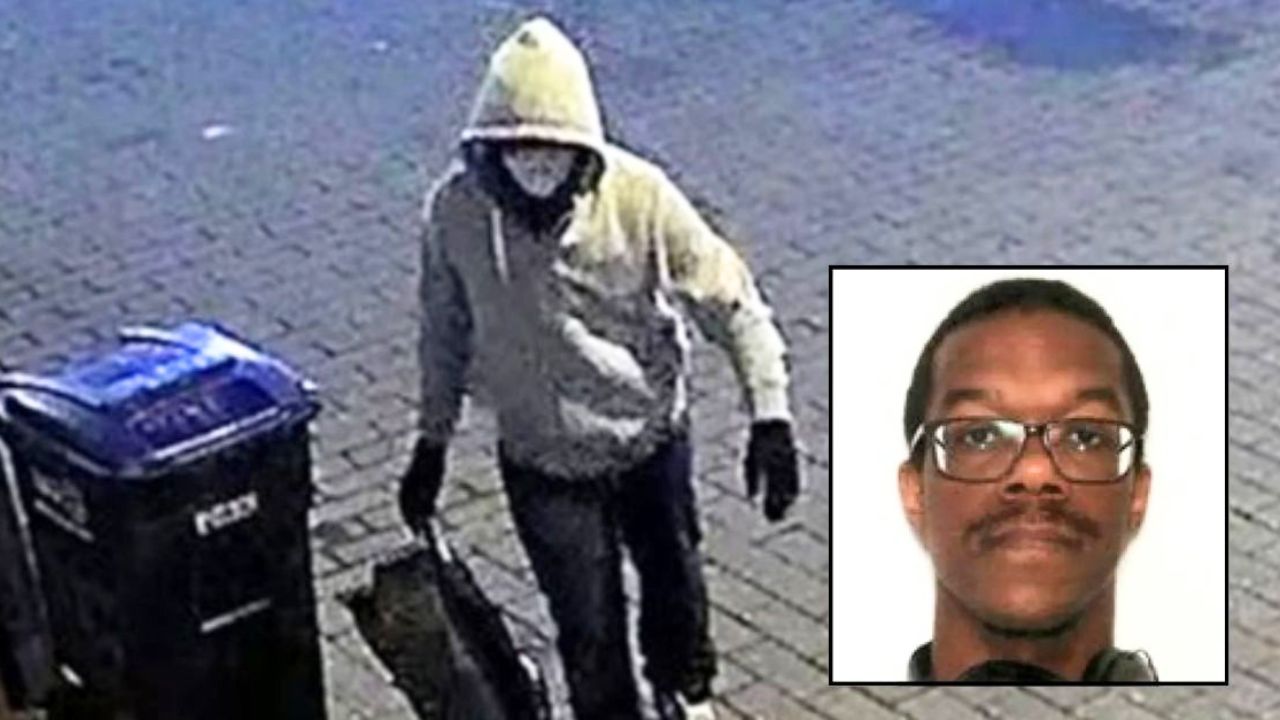
Inset: Brian Cole Jr. (Department of Justice). Background: Surveillance footage allegedly shows Brian Cole Jr. walking around Washington, D.C., while placing pipe bombs at the RNC and DNC headquarters (DOJ).
The man accused of planting pipe bombs near the headquarters of the Republican National Committee (RNC) and the Democratic National Committee (DNC) in Washington, D.C., ahead of the Jan. 6 Capitol attack is asking a federal court to dismiss one of the charges against him.
Brian Cole Jr. argues he should not be charged with an "act of terrorism" — defined by federal authorities as an intent to "influence the policy or conduct of a unit of government by intimidation or coercion" — given that neither the RNC nor DNC are government entities.
The scathing 12-page motion to dismiss the fourth count of the indictment against him says the government has "fail[ed] to provide Mr. Cole with reasonable certainty of the nature of the accusation against him, if indeed there is one." The document adds: "Put simply, if the Government accuses and intends to prove beyond a reasonable doubt that Mr. Cole intended to influence one of the eleven units of government that the D.C. Code specifies, the least it can do is specify which one."
In January, Cole was indicted on charges of interstate transportation of explosives and malicious attempt to use explosives, the Department of Justice announced. In April 2026, a superseding indictment declared two new charges for the then-30-year-old man: using and attempting to use a weapon of mass destruction and — the count at issue in the newest filing — an act of terrorism.
The criminal affidavit in Cole's case alleges that on the evening of Jan. 5, 2021, he placed improvised explosive devices — or "pipe bombs" — in front of the RNC's and DNC's headquarters. The following afternoon, as the Capitol insurrection was intensifying, authorities said they found the bombs.
They did not explode.
This past March, Cole sought to use President Donald Trump's January 2025 clemency order to have the case against him dismissed. The defendant's attorneys argued that the charges against him are "inextricably and demonstrably tethered" to the events of Jan. 6, 2021, events that led to Trump pardoning roughly 1,500 people for their actions that day.
U.S. District Judge Amir H. Ali, a Joe Biden appointee, was unconvinced, saying bluntly in July, "the pardon does not apply to him."
"Even assuming that the conduct Cole is charged with is 'related to events that occurred at or near the United States Capitol on January 6, 2021,' the pardon is expressly limited to people who had been 'convicted of offenses' related to those events," Ali's opinion added. "Cole had not been convicted of the conduct at issue when the President issued the pardon; indeed, he was not charged until many months after the President's proclamation."
Now, Cole argues the accusation of terrorism against him not only lacks specificity, but also contains "duplicity problems" in that the government wants to combine "two or more distinct offenses in a single count."
"Count Four of the Indictment contains two material defects: failure to identify any unit of government that Mr. Cole allegedly intended to influence, and duplicitous charging that invites conviction on a less-than-unanimous basis and threatens to undermine appellate review," his recent filing reads. "Each warrants dismissal of Count Four in part, or, at a minimum, an order compelling the Government to explain its charge and commit to a single theory of prosecution—entreaties it has refused to date."

Comments