
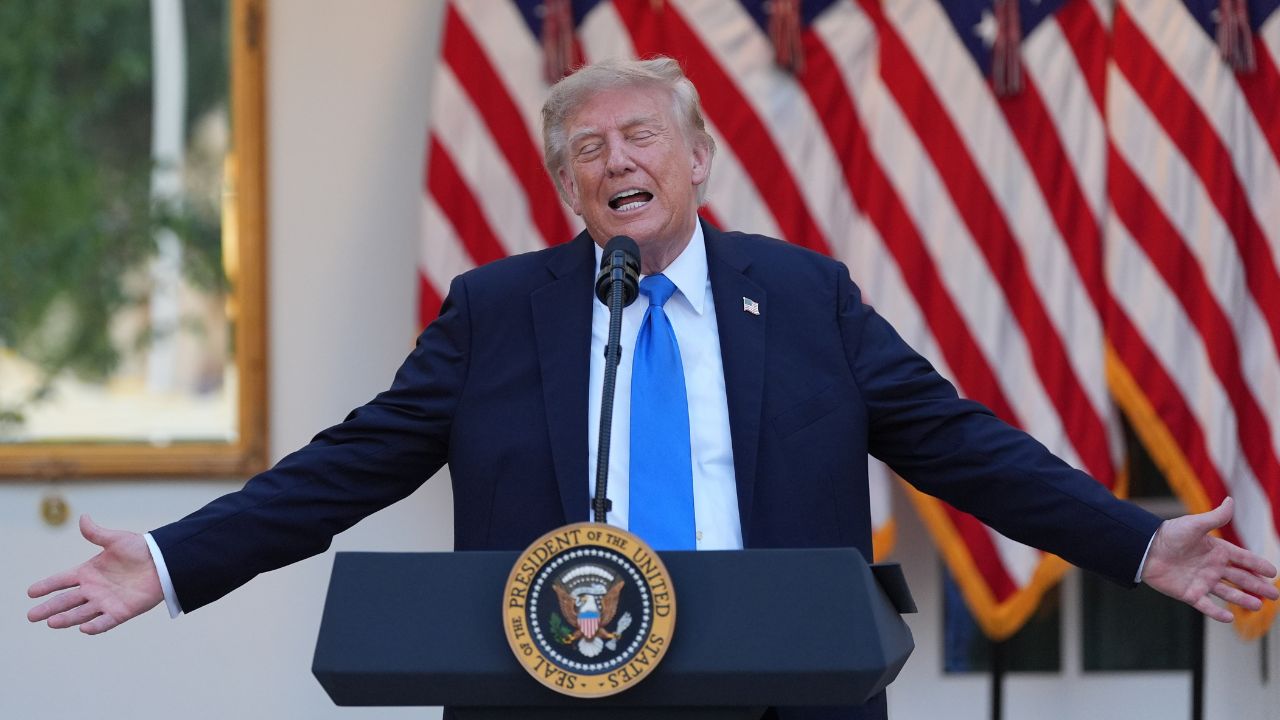
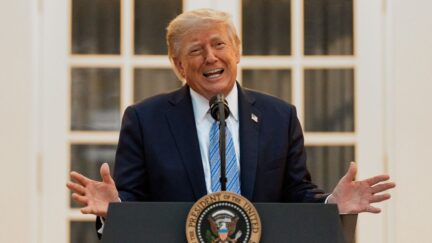
President Donald Trump speaks during an event with Republican lawmakers in the Rose Garden of the White House, Wednesday, Sept. 2, 2026, in Washington (AP Photo/Alex Brandon).
A federal judge with extensive experience considering and ruling against President Donald Trump's efforts to revoke the grant of birthright citizenship has now ruled against the 45th and 47th president's latest effort to undo the constitutional right.
On Wednesday, Baltimore-based U.S. District Judge Deborah L. Boardman, a Joe Biden appointee, issued a narrow injunction barring application of an executive order issued by Trump in August.
The judge framed the new executive order as a futile retread by Trump to force through several kinds of "carveouts" to birthright citizenship after the U.S. Supreme Court rejected his broader effort in the landmark case styled as Trump v. Barbara.
Boardman's ruling comes in a long-running case with a certified class of plaintiffs who challenged the original anti-birthright citizenship executive order in January 2025. The court views the issues as operating on something of a continuum.
"The 2026 Executive Order is almost certainly unconstitutional as applied to the certified class for the simple reason that the Supreme Court in Barbara already decided that the children in the class are citizens at birth," the 35-page opinion reads. "This Court must, once again, preliminarily enjoin enforcement of the President's most recent attempt to strip the right to citizenship from them."
In the CASA Inc. v. Trump case, Boardman has ruled against the Trump administration on three occasions.
In Wednesday's opinion, the court characterized the latest order as a "continued" effort "to abolish birthright citizenship for many Americans." But the judge stressed she was not ruling on the would-be carveouts writ large. Rather, the ruling is confined to the "narrower question" of whether the plaintiffs in the present case "are entitled to preliminary injunctive relief because the 2026 Executive Order is likely unconstitutional as applied to the certified class."
"The answer to that question is yes," the opinion goes on.
Recalling the facts, the judge notes the "provisionally certified class of children in Barbara is identical to the certified class in this case."
In the present posture, the CASA plaintiffs supplemented their original lawsuit. The present iteration of the complaint alleges violations of the 14th Amendment and the Immigration and Nationality Act (INA). Specifically, the plaintiffs say the new executive order "imposes significant additional harm because it provides so little clarity about how or to whom it applies, causing confusion and fear."
In her analysis, Boardman quickly dispenses with ripeness concerns by noting that the government's prior arguments failed.
To hear the government tell it, the executive order is currently a guidance document that is "no more than conjecture at this time."
"The defendants are incorrect," the judge writes. "Contrary to the defendants' insistence, the plaintiffs need not wait for the implementing guidance to bring this challenge. No matter what the guidance says, the 2026 Executive Order commands agencies to deny citizenship documents to several broad categories of children; that command is not contingent upon any future event that may not occur as anticipated."
The court similarly dismisses standing concerns by noting the executive order's broad reach despite its purported carveouts.
"[T]he 2026 Executive Order does not direct different defendants to take different actions," the opinion goes on. "Section 2 [of the order] creates one policy: that citizenship by birth shall not be recognized for certain categories of people. Because Barbara declared all of the children in the class citizens, the named plaintiffs do not (and need not) present distinct claims for each section of the 2026 Executive Order."
On the merits, the court relies heavily on the Barbara opinion.
"[T]he Supreme Court held that…children born of parents unlawfully or temporarily present in the United States who were subject to the 2025 Executive Order—a class identical to the certified class in this case—were 'citizens at birth' under the Citizenship Clause of the Fourteenth Amendment," Boardman notes.
The nation's high court only noted two "narrow exceptions" to the birthright citizenship rule: "the children of foreign ministers and members of 19th-century Indian tribes," the judge explains.
To that end, none of the categories of Trump's carveouts in the latest order satisfy either such exception, the court points out.
"No Presidential Executive Order can undo what the Supreme Court has done," the opinion goes on.
Comments