
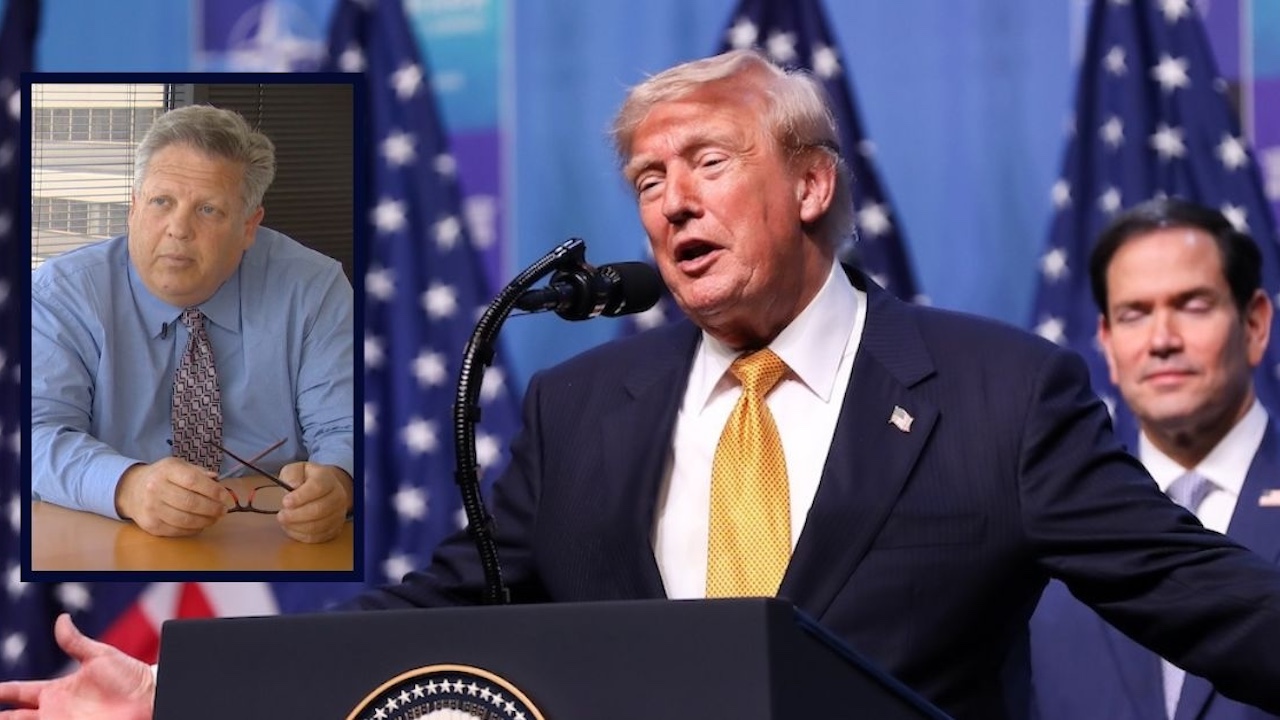
Left inset: Roger Rogoff sits for an interview about his firing on July 15, 2026 (KING). Main: Donald Trump, president of the United States, and Marco Rubio, U.S. secretary of state, attend a press conference at the NATO Summit at the Presidential Complex in Ankara, Turkiye, on July 8, 2026 (Photo by Klaudia Radecka/NurPhoto via AP).
The U.S. Department of Justice on Thursday implored the U.S. Court of Appeals for the 9th Circuit to reject the arguments of a federal prosecutor in Washington state who was appointed to serve as U.S. attorney by district judges in lieu of President Donald Trump.
The appeal seeks a reversal of a lower court order so as to allow the 45th and 47th president to fire Roger Rogoff once and for all.
In the underlying case, a panel of judges in the Western District of Washington chose the longtime Seattle prosecutor to fill a vacancy the Trump administration had simply never addressed. Less than an hour later, however, a White House email nixed the jurists' choice.
In July, in a 24-page complaint, attorneys for the plaintiff argued the president's "purported firing" of their client "was unlawful."
Earlier this month, Chief U.S. District Judge Stanley Bastian, a Barack Obama appointee, agreed with the plaintiff. The court found that under federal law, the president does not have the "authority to remove executive officers that he has not appointed."
The government's appellate arguments came in an Oct. 9 brief that complained about the district judge giving the U.S. Senate an "effective veto" over the president.
Rogoff responded one week later, ridiculing the government for the "veto" language used in its opening brief and noting the Senate has a "constitutionally enshrined advice-and-consent role."
Now, in a 40-page reply brief, the DOJ insists the prosecutor is wrong about his understanding of the constitutional push-pull between the executive branch and the legislative branch.
"Rogoff altogether fails to grapple with the separation-of-powers principles at stake in this case," the latest brief begins. "The power to conduct criminal prosecutions is a core exercise of the President's 'conclusive and preclusive' executive power under Article II."
To hear the government tell it, control over federal prosecutors is a "special province of the Executive Branch."
"U.S. Attorneys are not themselves elected; they are not accountable directly to the people," the brief goes on. "Rather, our Constitution ensures political accountability for the enforcement of the Nation's criminal laws by ensuring that all executive officers are accountable to the President, who may remove them at will."
While the basic contours of presidential appointment are clear and uncontested, the district court and Rogoff believe Trump's own power ran out when the vacancy in the U.S. attorney's office sat unfilled for so long that the judges themselves stepped in.
In turn, Rogoff says, all that remains as an option for the president is the Senate-controlled confirmation process. As for removal, Rogoff says the only way he can legally be fired outside the confirmation process is if those same judges decide to remove him.
The DOJ harshly rejected this understanding, saying this would shift power to judges "who are not politically accountable."
"Neither elected himself nor accountable to anyone who is, Rogoff envisions that he alone would decide, for the millions of U.S. citizens in the Western District of Washington, how and against whom the criminal laws should be enforced, unless the Senate chooses to act on the President's nominee," the government's brief goes on.
The brief elaborates:
Nothing in our constitutional order remotely contemplates such unaccountable power in an executive officer. Unsurprisingly, Rogoff fails to cite any decision from any court suggesting that the chief federal law enforcement officer in a judicial district can wield executive power independent of the President. Nor does Rogoff cite any judicial decision in the 150-plus year history of [the removal statute] interpreting the statute as the district court did.
The DOJ's basic position is that the president can fire any U.S. attorney, at will, for any reason whatsoever, or no reason at all. And, the government insists, the question is not a close call.
"[E]very court to consider the question has agreed that Congress meant what it said: 'Each United States Attorney is subject to removal by the President,'" the brief continues. "Rogoff identifies no ambiguity in that statutory text, nor does he acknowledge the canon of constitutional avoidance which would construe the statute against him."
The question is likely to be answered in Rogoff's case quite soon; the government's brief was filed one day before oral arguments in the dispute are to be held before a three-judge panel.


Comments