
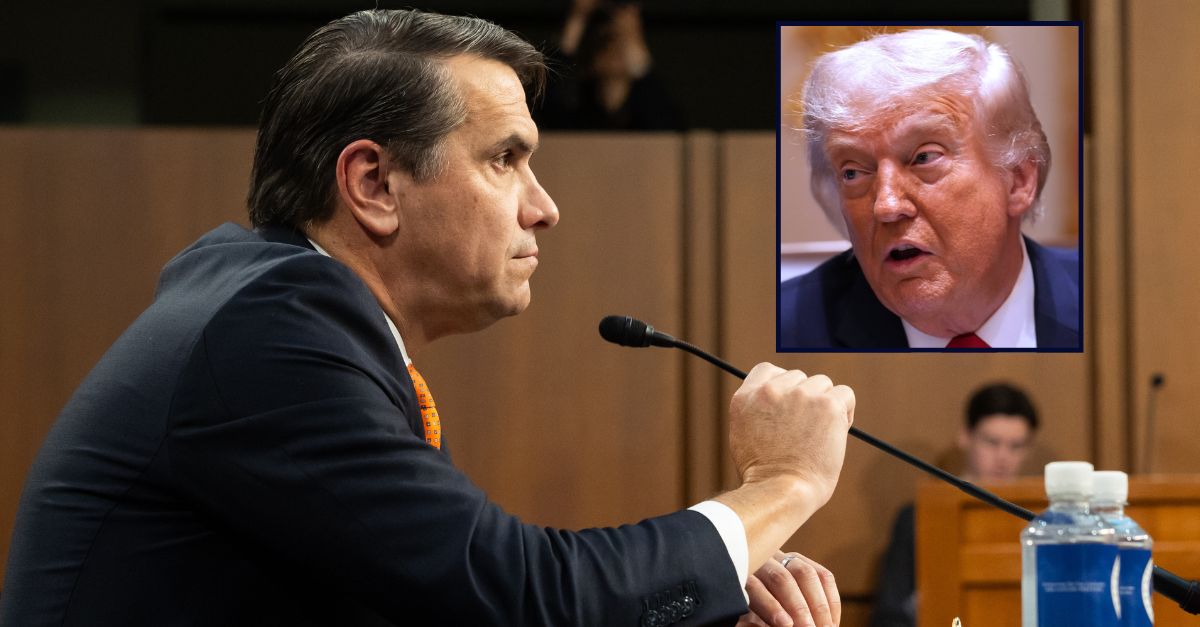
Inset: President Donald Trump speaks during a Cabinet meeting at the White House, Wednesday, May 27, 2026, in Washington. (AP Photo/Jacquelyn Martin). Background: Then-Acting Attorney General Todd Blanche testifies before the Senate Judiciary Committee during a confirmation hearing for permanent appointment to the position, in Washington, D.C., U.S., on July 15, 2026 (Photo by Allison Bailey/NurPhoto via AP).
The Office of Legal Counsel issued a memo this week that offers a broad understanding of executive privilege encompassing President Donald Trump's "informal network of public and private advisers."
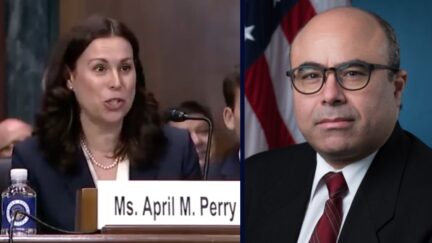
The 21-page slip opinion penned by Assistant Attorney General T. Elliot Gaiser, a former clerk to Justice Samuel Alito, framed the inquiry as an effort to distinguish between traditional executive branch employees and those who occasionally answer to the president.
In the end, Gaiser found the distinction without much of a difference — at least in terms of whether executive privilege remains intact.
"In rendering our advice, we considered whether the lack of a formal, subordinate relationship between the President and private advisers undermines our conclusion that executive privilege applies to their communications," the memo reads. "We conclude that it does not. Although private advisers are not subordinate to the President in the way that Executive Branch employees are, executive privilege resides with the President and is asserted by him."
The memo relies on several U.S. Supreme Court opinions to make its case, including three cases involving Trump himself and three involving Richard Nixon. The memo also relies on one case apiece involving Trump and Nixon from the U.S. Court of Appeals for the District of Columbia Circuit.
The analysis begins, however, by making the case that the broad privilege expressed in the memo has a definite historical pedigree.
Here, the memo relies on the concept of the "Kitchen Cabinet."
"[T]hroughout history, Presidents have relied on private advisers (or, at minimum, advisers outside the Executive Branch) to perform their executive function," the memo reads. "In one well-known example, President Jackson frequently consulted an informal network of public and private advisers, often referred to as his 'Kitchen Cabinet.' At the time, Congress did not provide funding for presidential aides or private secretaries, causing President Jackson to rely on a network of personal associates and family members to fill those roles."
This group "included policy advisers, speech writers, liaisons, and publicists," the memo notes, and likens the "informal network of advisers" to "an early version of the modern White House staff."
Such "outside advisers" served the president's "needs" and shared "his perspective in overseeing" his administration without "any sort of formalized relationship within the government," the memo says.
The OLC says the use of outside advisers continued into the modern era by way of President Franklin Delano Roosevelt's "Brain Trust," which was "a close-knit group of academics." And even though some members of this group joined the FDR White House, the president "continued to receive private advice from some members of the group, including several college professors," the memo notes.
"President Jackson's and Roosevelt's cadre of outside advisers are among the most prominent examples, but are hardly the only ones," the memo goes on. "All too often, circumstances have made such outside expertise imperative."
The memo cites an appellate court's use of the historical argument.
In 1993, the D.C. Circuit determined Hillary Clinton's healthcare reform task force was not subject to the transparency and record-keeping rules of the Federal Advisory Committee Act (FACA).
From the ruling [emphasis in OLC memo]:
Application of FACA to the Task Force clearly would interfere with the President's capacity to solicit direct advice on any subject related to his duties from a group of private citizens, separate from or together with his closest governmental associates. That advice might be sought on a broad range of issues in an informal or formal fashion. Presidents have created advisory groups composed of private citizens (sometimes in conjunction with government officials) to meet periodically and advise them (hence the phrase "kitchen cabinets") on matters such as the conduct of a war. Presidents have even created formal "cabinet committees" composed in part of private citizens. This case is no different.
The memo itself is written in response to a question posed by the counsel to the president.
"You have asked whether the President may assert executive privilege to protect communications between himself and private advisers," the memo notes. "You did not indicate a specific adviser or subject matter, but specified that you were primarily concerned with the presidential communications component of executive privilege."
While the memo, on its own terms, rejects the idea that the rendered opinion is about any specific matter, the advice comes on the heels of a court case in which the American Bar Association (ABA) sued the White House over Trump's efforts to coerce disfavored law firms into providing pro bono legal services to the Trump administration.
Recently, the ABA moved to subpoena Boris Epshteyn, a longtime Trump adviser, over the role he played in the law firm policy.
In July, the White House moved to quash the subpoena by arguing that Trump's communications with Epshteyn are protected by the "presidential communications privilege."


Comments