
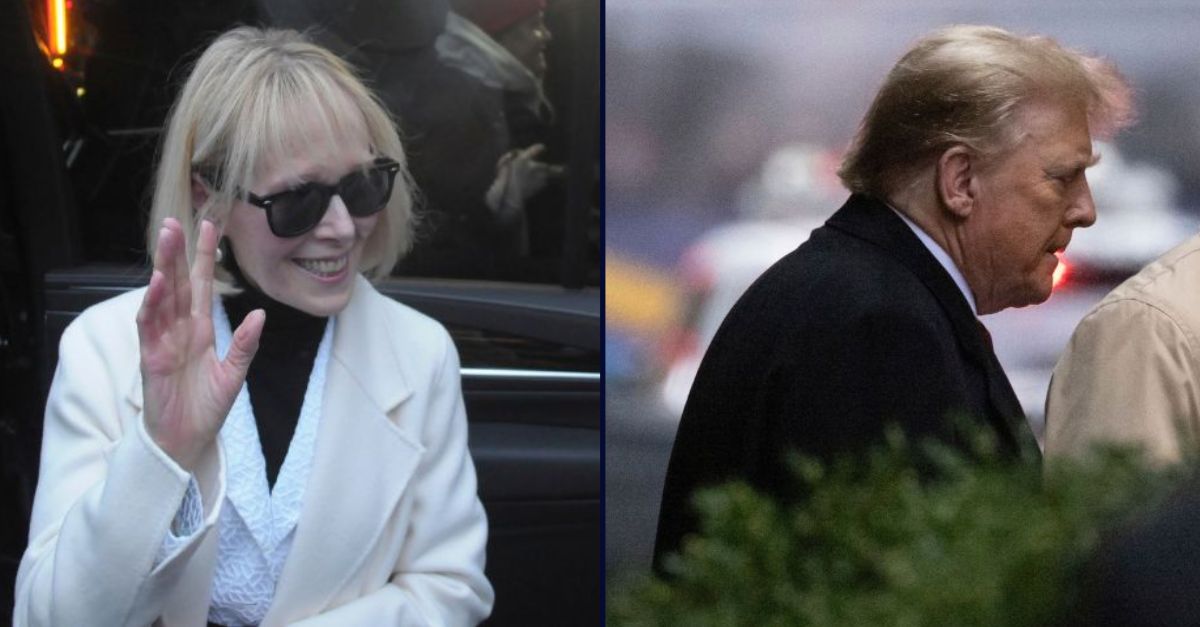
Left: Former magazine columnist, E. Jean Carroll, center, enters a vehicle outside of Manhattan federal court following the verdict in her second defamation trial against former U.S. president, Donald Trump. (Jimin Kim / SOPA Images/Sipa USA via AP Images). Right: President Donald Trump leaves his apartment building, Friday, Jan. 26, 2024, in New York (AP Photo/Yuki Iwamura).
President Donald Trump is complaining to a federal court about the millions of dollars he was recently forced to pay out in the long-running defamation case brought and won by writer E. Jean Carroll.
In a 14-page court filing on Monday, the 45th and 47th president argued that Carroll employed subterfuge in order to have the $5.77 million Trump owed her released by the federal court system.
"Plaintiff obtained the denial of emergency relief through a representation she abandoned once the money was released," the filing before the U.S. Court of Appeals for the 2nd Circuit begins.
In the case, the money had been held from Trump's coffers for several years before Carroll ever saw a cent of it.
In 2023, Trump posted a $5 million-plus bond with the Court Registry Investment System (CRIS) to pursue his appeals under the auspices of a June 2023 stipulation agreement between the parties.
Earlier this month, Carroll's attorney Roberta Kaplan asked U.S. District Judge Lewis A. Kaplan to issue an order directing the disbursement of the debt owed — plus some $770,000 in interest.
Kaplan's ask came because Trump's appeals ran their full course, reaching the U.S. Supreme Court on June 29, when the justices issued a word-free denial of Trump's petition for a writ of certiorari. Trump promptly protested the payout and was essentially ignored when the judge directed his clerk to disburse the $5 million judgment as well as "the value of the post-judgment interest" to a trust account maintained by Carroll's attorney.
Now, with the money already in Carroll's possession, Trump's legal team is alleging that Carroll's legal team misled the court.
"While the funds remained safely in CRIS, counsel assured this Court that they would be placed in an 'interest-bearing account,'" the reply brief goes on. "After securing possession, Plaintiff disclosed that the funds were instead placed in a personal investment account for her retirement—and invoked the S&P 500 to justify keeping them there. That was not a clarification. It was a bait-and-switch on the precise assurance used to resist judicial intervention."
To hear Trump tell it, the placement of the funds in the retirement accounts puts the value of the money at risk.
"Unlike 'interest-bearing accounts,' investments in the stock market are, by definition, 'unsecured,'" the brief goes on. "Having obtained the money through one representation, Plaintiff cannot defeat an injunction with another."
The locus of Trump's complaint is the notion that he will, at some point, be able to claw back the funds from Carroll. Now, the U.S. president suggests the precarious U.S. stock market is exactly why the funds should have remained locked up.
"That reversal confirms why the parties placed the funds under court control in the first place," the brief continues. "More than three years ago, President Trump deposited more than $5.5 million with the district court, ensuring that Plaintiff would be paid in full, with interest, if she ultimately prevailed. In return, the funds would remain under court control until the Stipulation and Order determined who was entitled to them."
In service of the argument that Trump might be able to get back the funds from Carroll, the brief repeats a series of arguments already rejected by the district court. The sum and substance of these arguments is that the terms of the stipulation agreement were not actually met when the nation's high court rejected Trump's petition because Trump immediately filed for reconsideration of his petition. That reconsideration request is still pending as of this writing.
"Plaintiff received every protection she bargained for. President Trump did not," the brief goes on. "The funds are now subject to Plaintiff's whims. They are also now subject to the risk—inherent in any investment in the stock market—that they will decrease or be lost altogether."
The brief goes on:
An investment account exposed to market performance is not the secure arrangement Plaintiff previously represented.
That reversal is devastating to Plaintiff's opposition. She defeated emergency relief with one assurance, obtained the funds, and changed the arrangement after judicial control was lost. Her latest promise that the money will remain available is unsupportable, she cannot have any idea of what the markets will do, and is therefore entitled to no weight
The brief also takes the opportunity to argue the underlying judgment against Trump "should be" reversed "and set aside completely."
Trump's filing further seeks to cast doubt on the reliability of Carroll's representations to the court.
"Nor is market risk the only danger," the brief continues. "Plaintiff has publicly announced plans to distribute money recovered from President Trump to third parties. She is clearly susceptible to changing course again. Once transferred, the funds may become difficult or impossible to trace and recover."
Comments