
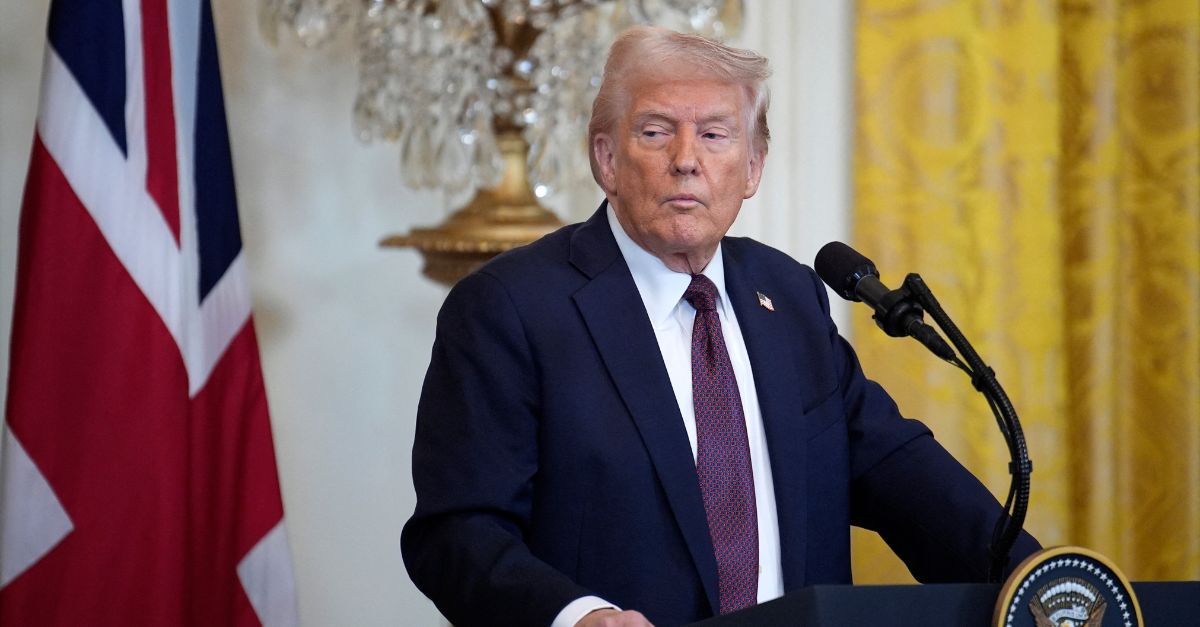
President Donald Trump at a press conference at the White House in Washington on February 27, 2025 (Yuri Gripas/Abaca/Sipa USA; via AP Images).
A federal court of appeals performed some rare theatrics and reversed a Trump administration victory in a Wednesday ruling over the long-beleaguered Consumer Financial Protection Bureau (CFPB).
In a two-page per curiam order, the full U.S. Court of Appeals for the District of Columbia Circuit voted to rehear en banc a case brought by the National Treasury Employees Union (NTEU) over massive layoffs.
"This case will be reheard by the court sitting en banc," the order reads. "It is further ordered that the court's judgment filed August 15, 2025, be vacated. The partial stay pending appeal entered on April 11, 2025, and later modified on April 28, 2025, is in effect."
The full court's review dislodges a summer ruling by a three-judge panel that gave the federal government the go-ahead to proceed with wholesale reductions in force (RIFs) based on a lack of jurisdiction and what amounts to a failure to state a cognizable claim.
Love true crime? Sign up for our newsletter, The Law&Crime Docket, to get the latest real-life crime stories delivered right to your inbox.
The seemingly settled matter went through several rounds of back and forth seesawing at both the district and appellate court levels.
In the underlying case, the NTEU alleged Office of Management and Budget (OMB) Director Russ Vought unlawfully fired CFPB employees without cause and scrubbed data, including important CFPB contracts "necessary for cybersecurity." The lawsuit alleged various constitutional insufficiencies and violations of the Administrative Procedure Act (APA), the statute governing agency behavior.
After the lawsuit was filed in February, U.S. District Judge Amy Berman Jackson, a Barack Obama appointee, issued a multi-pronged preliminary injunction in March. The lower court judge opined that she was acting with haste to "make sure [the CFPB] hasn't been choked out of its very existence" before a final judgment on the merits could be issued.
In early April, however, the appellate court stepped in to stay several prongs of the injunction, allowing some firings to continue.
Specifically, the appeals court modified the third prong of the eight-pronged injunction to allow the government to perform a RIF of employees determined "after a particularized assessment to be unnecessary to the performance" of the CFPB's statutorily mandated duties.
In turn, the Trump administration took the court's permission slip and ran, aiming to dye it pink at scale. One week later, OMB used the panel's order to try to fire between 1,400 and 1,500 employees, which would have eliminated some 90% of the agency's workforce.
The next day, Jackson issued a second injunction to stop the firings.
In late April, the panel reversed itself – clarifying some of the language but broadly making the proposed wave of layoffs impermissible.
"In response, plaintiffs highlight that the proposed RIF currently at issue, involving nearly 90 percent of agency employees, exceeds the scope of the RIF that prompted the district court's original preliminary injunction," the panel explained, in a volte-face.
Still, all that spring jostling was essentially an appetizer.
In August, in a 2-1 decision, Trump-appointed U.S. Circuit Judges Gregory Katsas and Neomi Rao voted to vacate the injunction in full.
"We hold that the district court lacked jurisdiction to consider the claims predicated on loss of employment, which must proceed through the specialized-review scheme established in the Civil Service Reform Act," Katsas wrote. "And the other plaintiffs' claims target neither final agency action reviewable under the Administrative Procedure Act nor unconstitutional action reviewable in equity."
In other words, the majority said the plaintiffs filed a defective lawsuit alleging far too much – and in the wrong court system – and that Jackson's relief for the plaintiffs could simply not be squared with those basic legal errors by the employees on the chopping block.
The August ruling goes on, at length:
The plaintiffs seek to set aside an abstract decision, inferred from a constellation of discrete actions, to prophylactically ensure that the Bureau can fulfill its statutory mandate. This theory contravenes all the APA limits…agency action, finality, ripeness, and discreteness alike. If the plaintiffs' theory were viable, it would become the task of the judiciary, rather than the Executive Branch, to determine what resources an agency needs to perform its broad statutory functions. Such pervasive judicial control of agency administration falls well beyond limited APA review."
Now, a different majority has had a say and the judges are offering the NTEU, and several other plaintiffs, a second bite at the appellate apple.
Briefing for the full appellate court's rehearing is set to begin on Jan. 9, 2026, and end by Feb. 17, 2026. The court further explained that the schedule was almost certainly set in stone.
"Because the briefing schedule is keyed to the date of argument, the court will grant requests for extension of time limits only for extraordinarily compelling reasons," the per curiam order reads.





Comments