
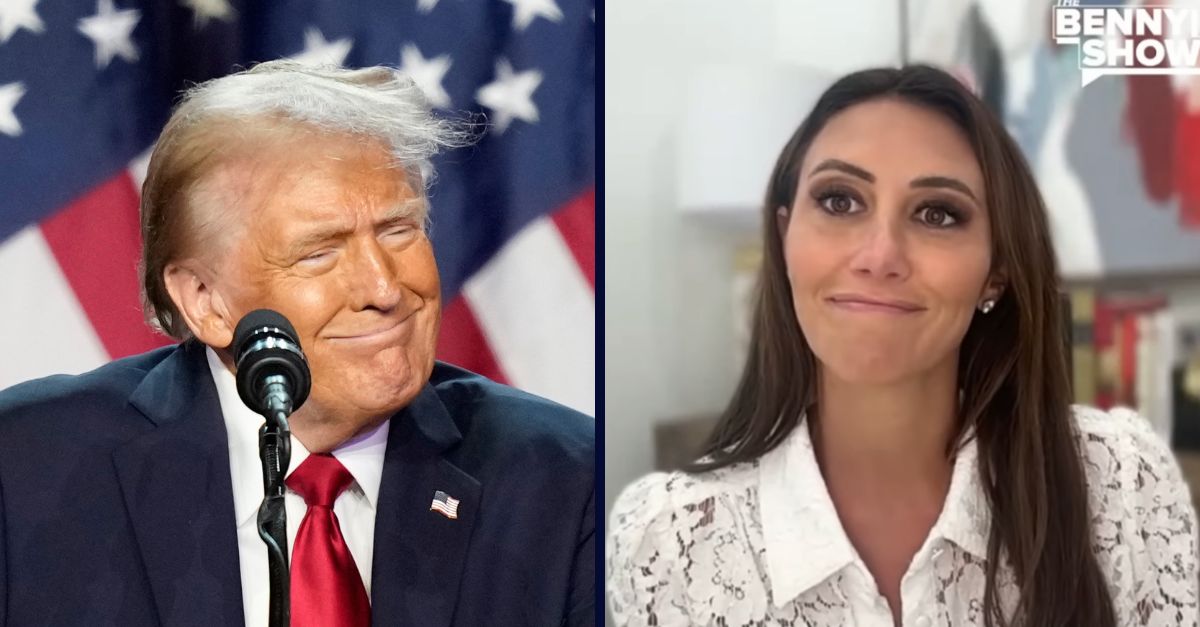
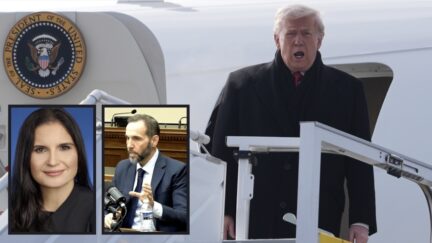
Left: Donald Trump speaks at an election night watch party, Wednesday, Nov. 6, 2024, in West Palm Beach, Fla. (AP Photo/Alex Brandon). Right: Alina Habba speaking in an interview about federal judges voting against extending her term as New Jersey's top prosecutor (The Benny Show/YouTube).
U.S. Department of Justice attorneys faced an irate New Jersey judge this week during a hearing in an otherwise standard criminal case made all the more salient over staffing and leadership issues.
The main issue facing those federal prosecutors is the looming presence of Alina Habba, President Donald Trump's former personal attorney who was once selected to run the U.S. Attorney's Office in the Garden State. Since her interim appointment ran out, she has been repeatedly rejected for the role by various federal judges.
But the stopgap measures employed by the Trump administration since the Habba dustup have not been particularly welcome either.
The latest vote of no confidence comes via U.S. District Judge Zahid Quraishi, a Joe Biden appointee who is overseeing the final stages of the government's case against Francisco Villafane, who pleaded guilty to possession and receipt of child pornography in April 2025.
"You have lost the confidence and the trust of this court," the judge told the DOJ on Monday. "You have lost the confidence and the trust of the New Jersey legal community, and you are losing the trust and confidence of the public."
On March 10, the court cited a recent decision in which two criminal cases were called into question by Habba's lack of authority.
One such reference reads, in relevant part:
Defendant Daniel Torres…was indicted pursuant to authority unlawfully exercised by the prior officeholder, Alina Habba, and additional briefing is necessary to determine whether that indictment may stand. Furthermore, the Government is warned that any further attempts to unlawfully fill the office will result in dismissals of pending cases.
That case was decided earlier this month by the Middle District of Pennsylvania's Chief U.S. District Judge Matthew Brann, a Barack Obama appointee, after he was assigned to oversee such challenges.
Brann was the same judge who found Habba's appointment invalid in August 2025 when two other criminal defendants challenged their indictments under the Appointments Clause.
In his recent and massive 130-page memorandum opinion, Brann cast doubt on the current operating structure of the New Jersey U.S. Attorney's Office. In that order, the judge disparagingly referred to three prosecutors — Philip Lamparello, Jordan Fox, and Ari Fontecchio — as a "triumvirate" on 59 different occasions.
Brann's order disqualified the tripartite structure but stayed his own order pending appeal — while musing that the DOJ was on thin ice.
"If the Government chooses to leave the triumvirate in place, it does so at its own risk," the court concluded.
The next day, Quraishi issued a minute order directing the prosecutors in charge of the Villafane case to address Brann's opinion.
The order reads, in relevant part:
In light of the recent holding…the assigned Assistant U.S. Attorney (AUSA) shall be prepared when appearing for the hearing to address questions from the Court as to: the current structure of the USAO-DNJ; the legal authority for the AUSA's appearance; the AUSA's personal knowledge of the content of the 130-page opinion by Judge Brann; the legal sufficiency of a waiver if Defendant agrees to proceed despite these circumstances; and any additional inquiry the Court deems appropriate. Depending on the Government's responses, the Court will then make a determination as to whether the hearing can proceed or if additional information/testimony and briefing will be required at a later date.
Since then, however, Quraishi has been none too pleased with the response he received from the DOJ in the Villafane case.
On Monday, the court held a hearing on the matter.
"So who is currently running the U.S. Attorneys Office today as you stand before me?" Quraishi asked prosecutor Daniel Rosenblum.
To which the prosecutor replied before getting cut off: "The leadership structure remains the same for now. In that regard, Chief Judge Brann stayed his disqualification –."
The judge interrupted to demand: "No. Let me hear the three names. Is is the three people who used to run the office?"
Rosenblum was then forced to list the prosecutors' names.
Next, the judge and the lawyer went back and forth about the role each person plays in the office and the limits of the lawyer's knowledge about the structure of the office. The judge finally short-circuited the discussion by suggesting Rosenblum has no personal knowledge of the matter and is simply relying on what other people are telling him.
"What role does Alina Habba have currently in operating your office?" Quraishi asked at one point.
Rosenblum answered: "None that I'm aware of."
Quraishi did not appreciate this response.
The transcript offers the next quick volley between the two:
THE COURT: None that you're aware of.
MR. ROSENBLUM: None.
THE COURT: All right. So she could be operating the office.
At this point, prosecutor Mark Coyne interjected to say: "She is not."
The judge considered Coyne's commentary wholly unwanted.
"Sit down, Mr. Coyne," Quraishi said. "If you speak again, I'm going to have you removed. I already told you not to speak."
The judge went on to note that Coyne had not formally filed an appearance to be part of the Villafane case. The DOJ lawyer, however, repeatedly tried to speak up and address the Habba issue.
"You don't get to blindside the Court and do whatever it is you guys want to do," the judge said. "If you continue to speak, you can leave."
But Coyne was undeterred and kept talking.
The judge then ordered court security officers to remove Coyne if he did not leave on his own accord. Finally, the unwelcome lawyer left.
The court then returned to Rosenblum. Again, the pair went back and forth as to what the three members of the so-called triumvirate might know about Habba's involvement. Rosenblum repeatedly demurred.
"You have no personal knowledge whatsoever as to whether Ms. Habba is still influencing the operations of your office even after two courts said she was operating unlawfully?" Quraishi asked.
Eventually, Rosenblum seemed inclined to agree that Lamparello, Fox, and Fontecchio might have knowledge about Habba's potential role. That was enough for the judge to issue an order.
"I'm going to want them here," Quraishi said. "You don't have personal knowledge to answer the questions that you so dismissively said you could respond to in your letter to the Court. I'm going to want Mr. Fontecchio, Mr. Lamparello, and Ms. Fox to provide that information to the Court under oath. They're going to testify, and this Court's going to figure out who is currently operating this office before I proceed."
As the hearing went on, the court offered a broader dressing-down of Rosenblum — saying he did not believe what the lawyer had said and would not believe him until the attorney testifies under oath.
"That is what has happened to the credibility of your office," Quraishi lectured. "Generations of Assistant U.S. Attorneys had built the goodwill of that office for your generation to destroy it within a year. So I don't believe who is running the office."
On Tuesday, the court formalized the demand in a minute order.
"[The triumvirate] shall appear and testify as to: the current structure and leadership of the USAO-DNJ; the legal authority for the assigned AUSA's appearance; any plans to change the leadership structure of the office; the legal sufficiency of a waiver if Defendant agrees to proceed despite these circumstances; and any other additional inquiry the Court deems appropriate," the order reads.
Comments